10 Business Professional Outfits That Don't Feel Like a Costume
Business professional for women, defined by published sources. Ten outfits that meet the code without making you feel like you borrowed someone else's uniform.
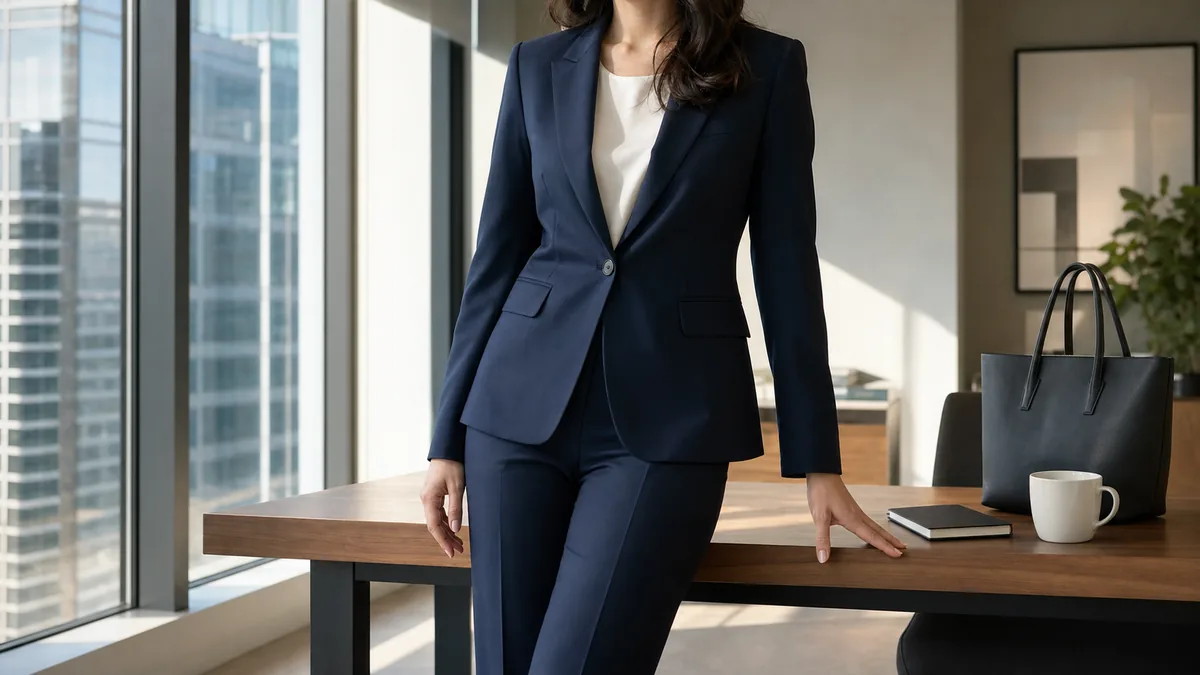
Working out an outfit for tomorrow? Save this page. It is easier to skim the night before than to remember.
At a glance
Works
- A matching pantsuit or skirt suit in navy, charcoal or black
- Closed-toe pumps with a low or mid heel
- A structured leather tote or briefcase-style bag
- Small stud earrings and a plain watch
Depends
- A knit top under a structured blazer, and only if the knit has its own shoulder line and the blazer stays on
- A jewel-tone suit instead of a neutral, and only in a deep shade, since Iowa's career centre advises against bright-coloured suits
- Flats instead of heels, which Illinois and Texas A&M both accept for professional dress, though a pointed flat reads more formal than a ballet flat
Skip
- Open-toe shoes, which fall outside every business professional guide cited here
- Unstructured canvas bags, which read as weekend rather than workday
- Visible athletic wear of any kind, including athleisure knits marketed as work clothes
Business professional is the dress code that sounds obvious and rarely is. It sits one tier above business casual, but many offices use the two terms interchangeably.
Career centres at Iowa and Illinois describe it in near-identical terms: a suit in a dark or neutral colour, closed-toe shoes and minimal accessories. The outfits below follow that definition, and the sources are at the bottom.
If your office has a written dress code, read it first. It outranks everything here.
1. The Navy Pantsuit With a Silk Shell
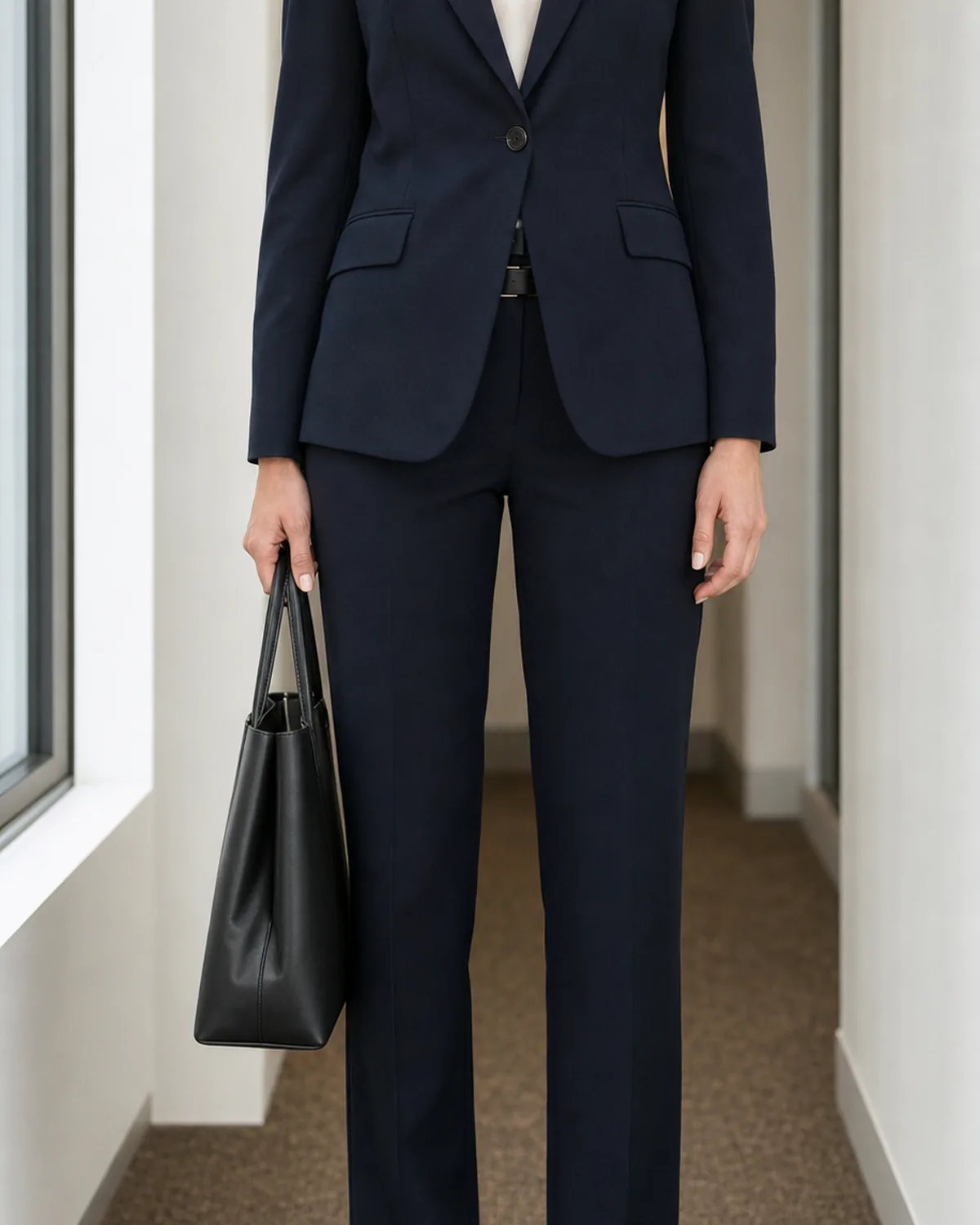
A navy pantsuit is the closest thing business professional has to a default. The blazer and trousers are the same fabric, the shell underneath is quiet, and the whole thing reads as deliberate without trying. Iowa, Texas A&M and Berkeley Law all open their professional-dress guidance with the suit.
- Choose a single-breasted blazer with notch lapels buttoned once at the waist
- Keep the shell in a neutral that does not compete with the suit (ivory, pale grey, white)
- Match the trouser weight to the jacket so the crease holds through a full day
- Stick to stud earrings and a plain watch; the suit does the talking
- A structured leather bag in black or dark brown finishes the line without adding noise
2. A Charcoal Skirt Suit at Knee Length
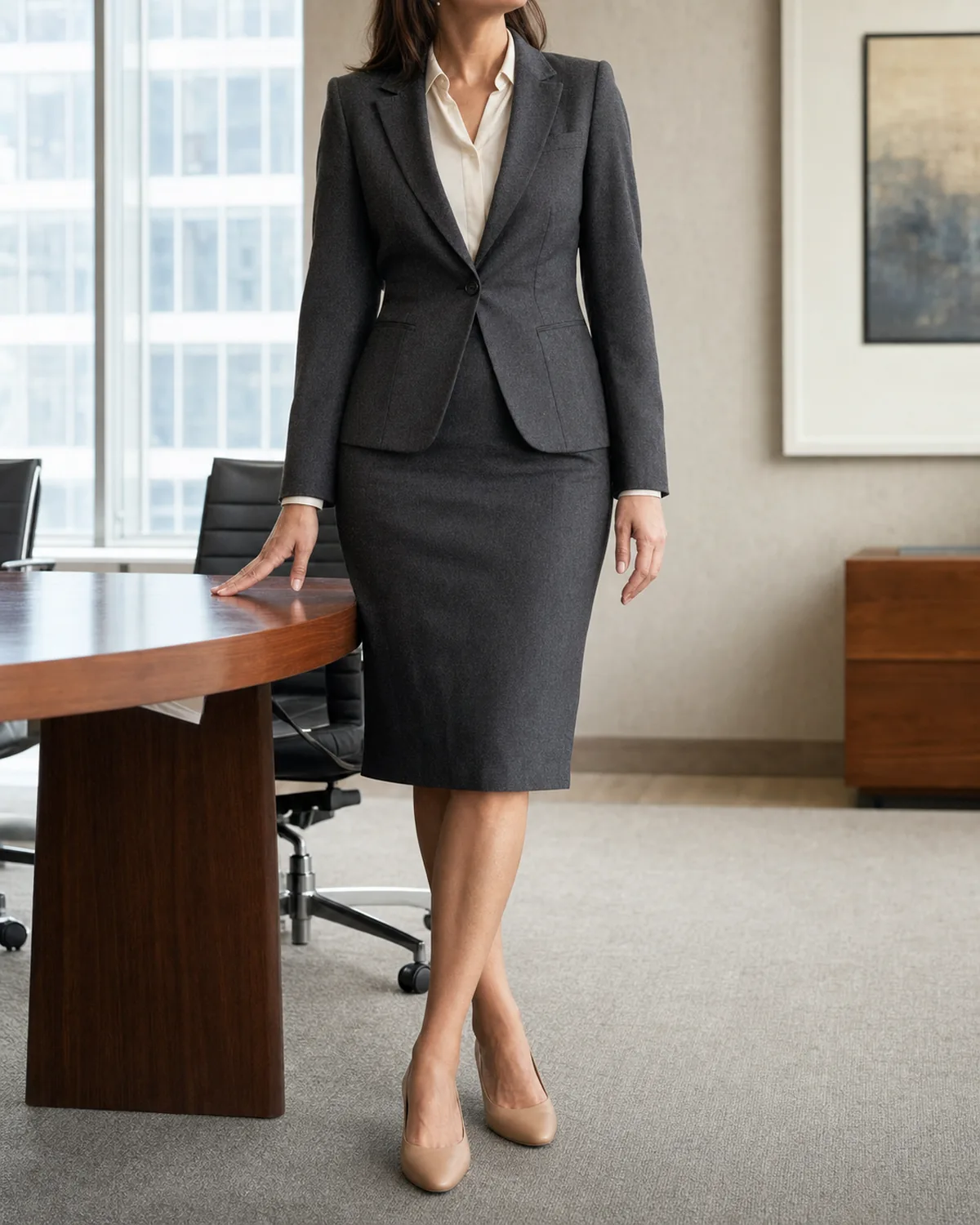
The skirt suit remains a core option under business professional, and charcoal is the workhorse alternative to navy. Knee length is the safest hem for this dress code because it stays appropriate seated and standing. Berkeley Law's interview guide sets the floor plainly: a skirt or sheath dress should be "knee-length - nothing shorter."
- Check the hem seated, not just standing; a skirt that rides up once you sit is the wrong length
- Match the blazer fabric to the skirt so they read as one piece, not a jacket over a separate skirt
- A cream or white blouse with a small collar keeps the neckline structured without adding layers
- Nude or flesh-tone pumps extend the leg line; black pumps are equally safe
- Pearl studs sit well with charcoal because they do not compete with the fabric tone
3. A Tailored Sheath Dress Under a Matching Blazer
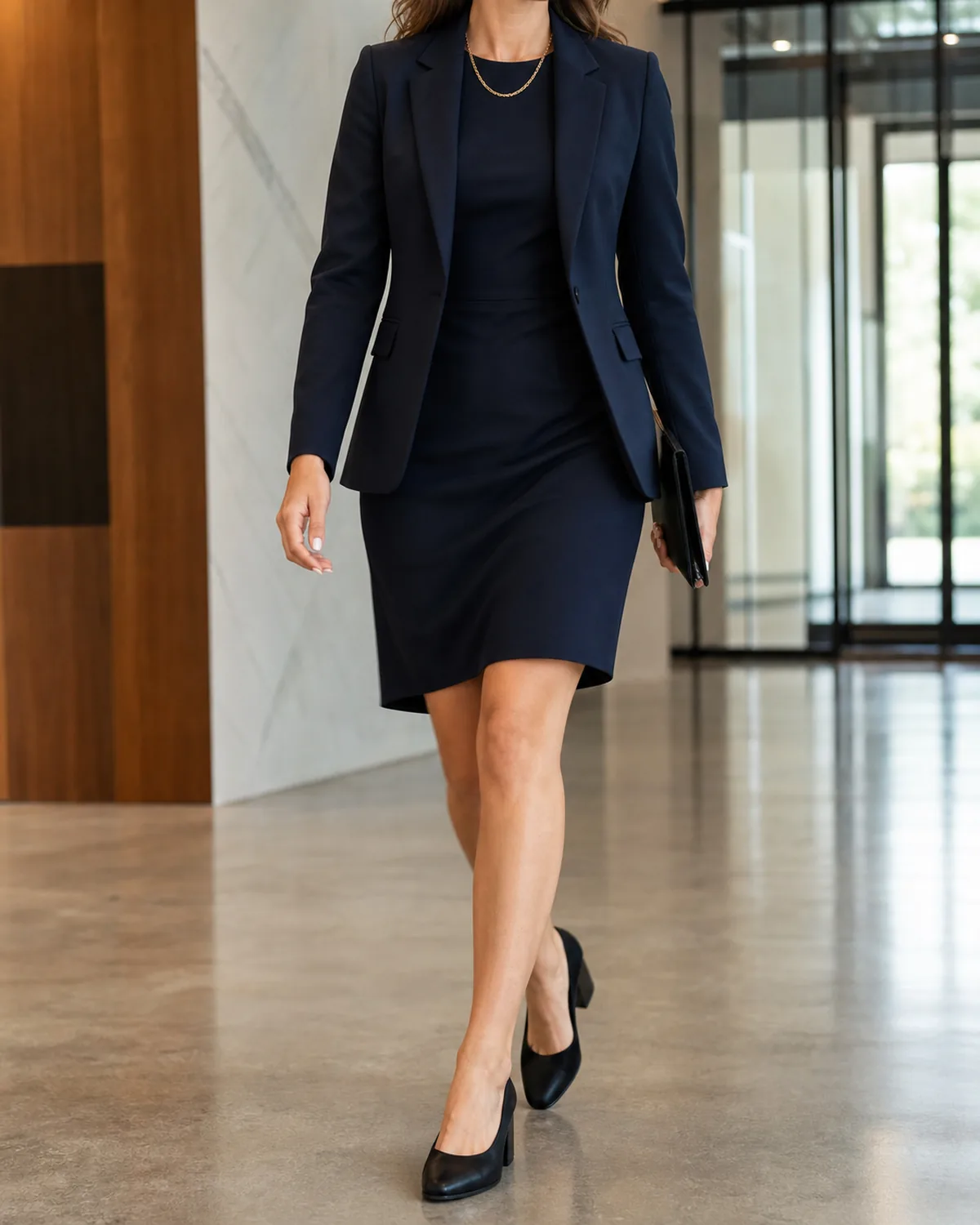
A sheath dress with its matching blazer gives you the simplicity of a one-piece outfit with the formality of a suit. The blazer is doing the work here; without it, a sheath dress alone may land closer to business casual depending on your office. With it, the pair reads as a coordinated set.
- The blazer and the dress need to be the same fabric and colour so they read as a matched set
- Keep the dress hemline at the knee; Duke's attire guide says hemlines should not sit above the top of the kneecap
- A thin gold chain at the collarbone is enough; the dress neckline should do most of the framing
- Black block-heel pumps hold up better than stilettos over a full day on hard floors
- Carry a slim portfolio or structured clutch instead of a full tote if you are moving between rooms
Where to start
Find your situation, skip ahead
You are starting at a firm that specifies business professional
Open with the navy pantsuit. A matched suit in a dark neutral is the starting point in every guide cited here.
01 The Navy Pantsuit With a Silk Shell02 A Charcoal Skirt Suit at Knee Length03 A Tailored Sheath Dress Under a Matching Blazer
You already own suits but they feel like a costume
The costume feeling usually comes from stiffness, not formality. Try a softer blouse underneath or a wider trouser leg.
04 The Pinstripe Suit, Softened05 A Wide-Leg Trouser Suit in Dove Grey07 A Double-Breasted Blazer With High-Waist Trousers
You are not sure whether your office means business professional or business casual
Idea 10 walks through the differences. When in doubt, the suit is always safer than the separates.
06 Neutral Separates That Read as a Suit10 Choosing Between Business Professional and Business Casual
4. The Pinstripe Suit, Softened
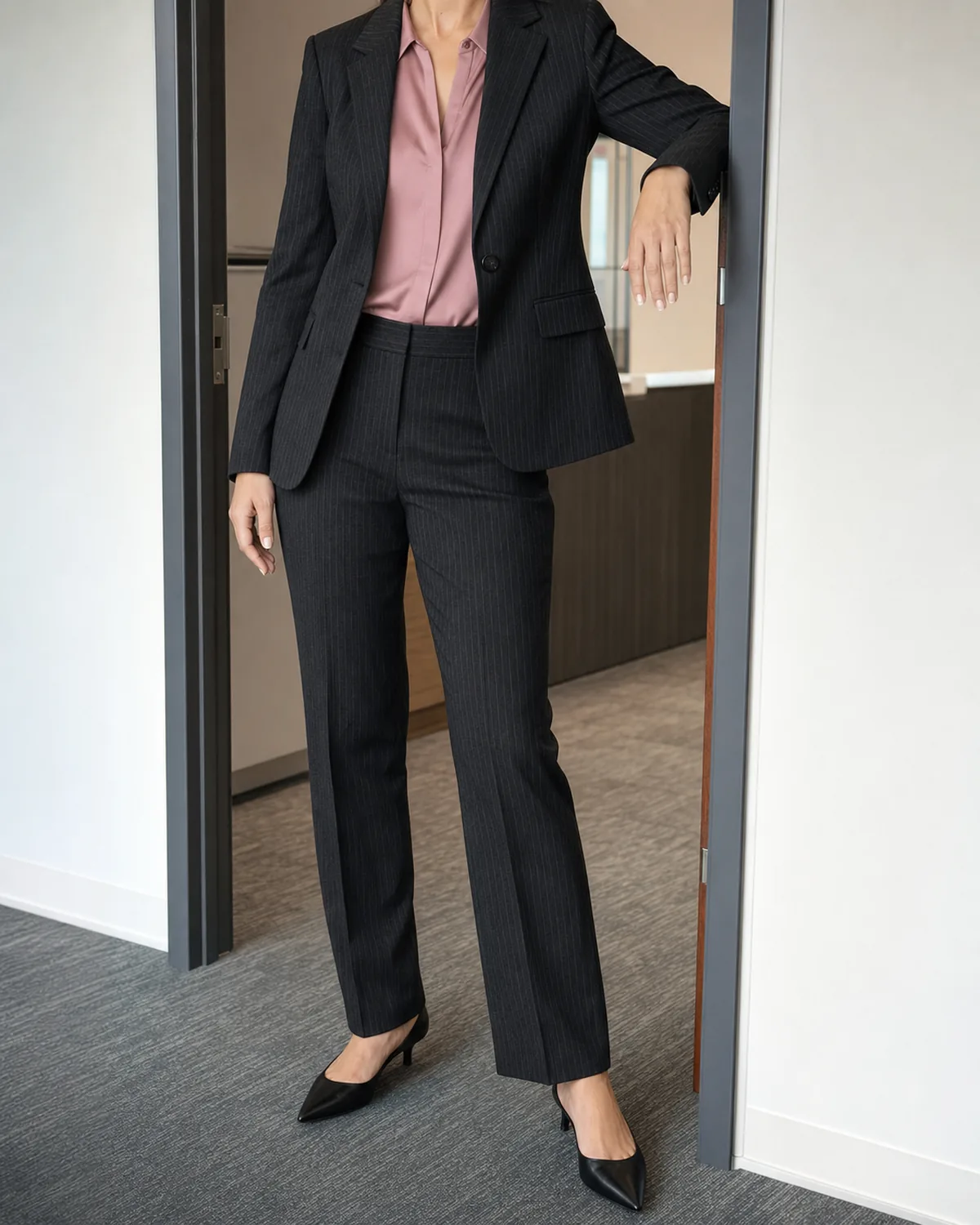
Pattern is where the guides split. Duke's attire guide lists "dark and subtly patterned suits" at its traditional business level, while also warning that prints or patterns "may be distracting." Berkeley Law wants an interview suit "without a noticeable pattern." A fine pinstripe is the quietest pattern there is, so wear it once you have the job.
Many women skip it anyway because it feels like borrowing from a Wall Street costume department. The fix is not to ditch the stripe but to soften one element inside it. Here that element is the blouse: a dusty-rose silk instead of white shifts the whole outfit from boardroom cliche to something you actually chose.
- A fine chalk stripe on dark charcoal is the least aggressive version; avoid wide banker stripes
- The blouse colour does the softening; keep the rest of the outfit neutral so it lands
- A pointed-toe low heel keeps the silhouette sharp without adding stiffness
- Leave the blazer unbuttoned when you are not in a meeting; buttoned reads more formal
- Pinstripe suits show lint quickly, so check the shoulders and lapels before you leave
5. A Wide-Leg Trouser Suit in Dove Grey
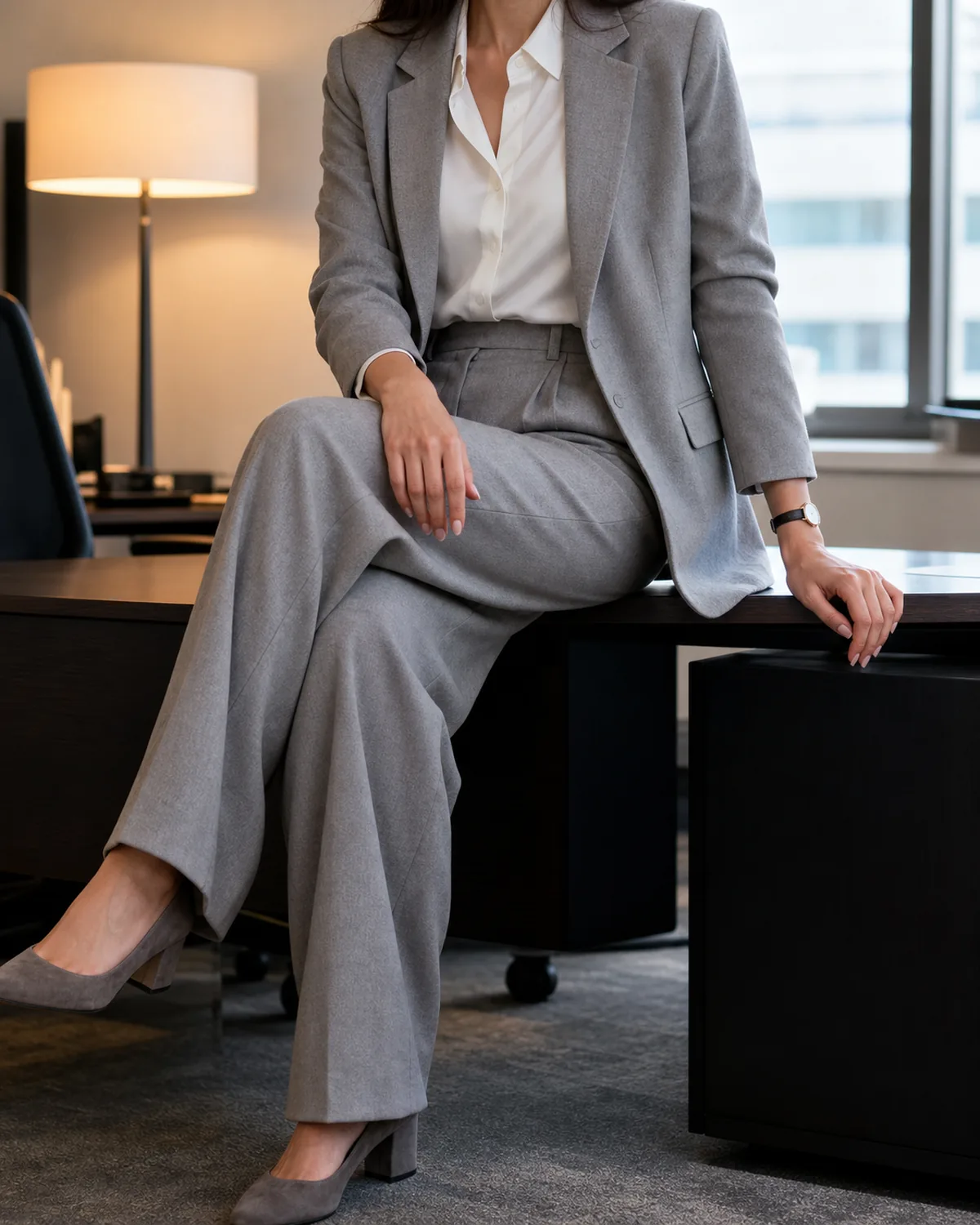
Wide-leg trousers are more comfortable than straight-leg trousers and just as formal, provided the fabric has structure. A high-waisted, clean-front pair in wool suiting drapes without collapsing, and the wider silhouette lets you cross your legs without the trouser pulling at the knee.
- The trouser needs a high waist and a clean front with no visible fly, so it reads as tailored rather than casual
- Match the blazer: a relaxed-fit jacket balances the wider trouser without looking boxy
- A white silk button-front tucked in anchors the waistline and keeps the proportions clean
- Grey suede block-heel pumps stay in the same tonal range without disappearing into the trouser
- A thin watch is enough on the wrist; a bracelet stack would tip the accessory count
6. Neutral Separates That Read as a Suit
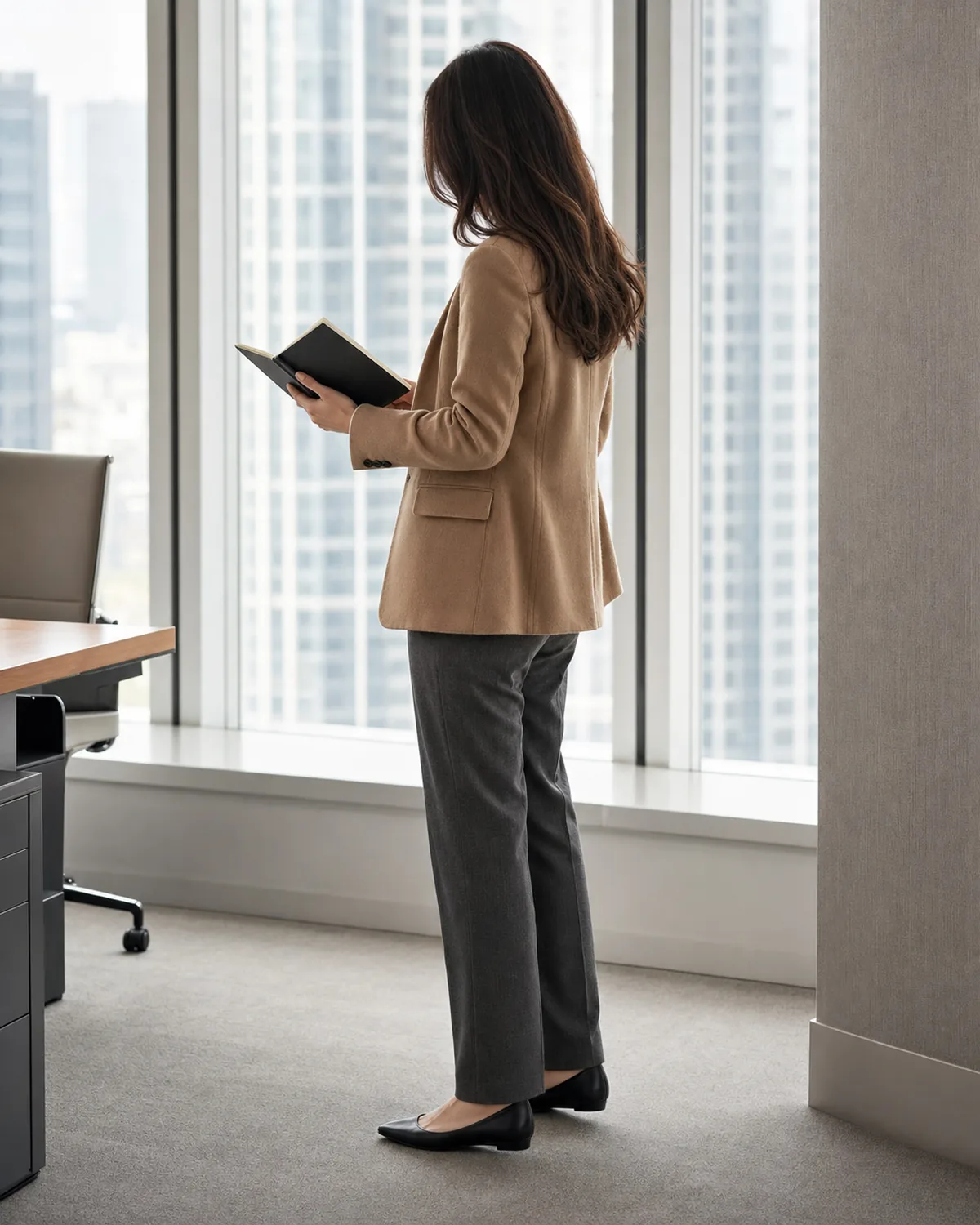
Interviews call for a true matched suit (Berkeley Law asks for "a two-piece suit where both pieces match in fabric and color"), but on an ordinary workday coordinated separates can do the same job.
A camel blazer over charcoal trousers reads as coordinated if the fabrics are both structured and the neutrals sit close enough in tone. The trick is to avoid contrast that splits the outfit into a top and a bottom; from a distance, it should look intentional.
- The blazer and trousers need to share the same level of structure (both wool-weight, both with a pressed crease)
- Keep the blouse or shell inside the neutral family so it does not break the tonal range
- Pointed-toe flats work here because the blazer carries the formality; heels are optional
- This combination lets you mix pieces across multiple suits, which stretches a small wardrobe
- If someone could mistake your separates for a suit at five paces, you are in the right range
7. A Double-Breasted Blazer With High-Waist Trousers
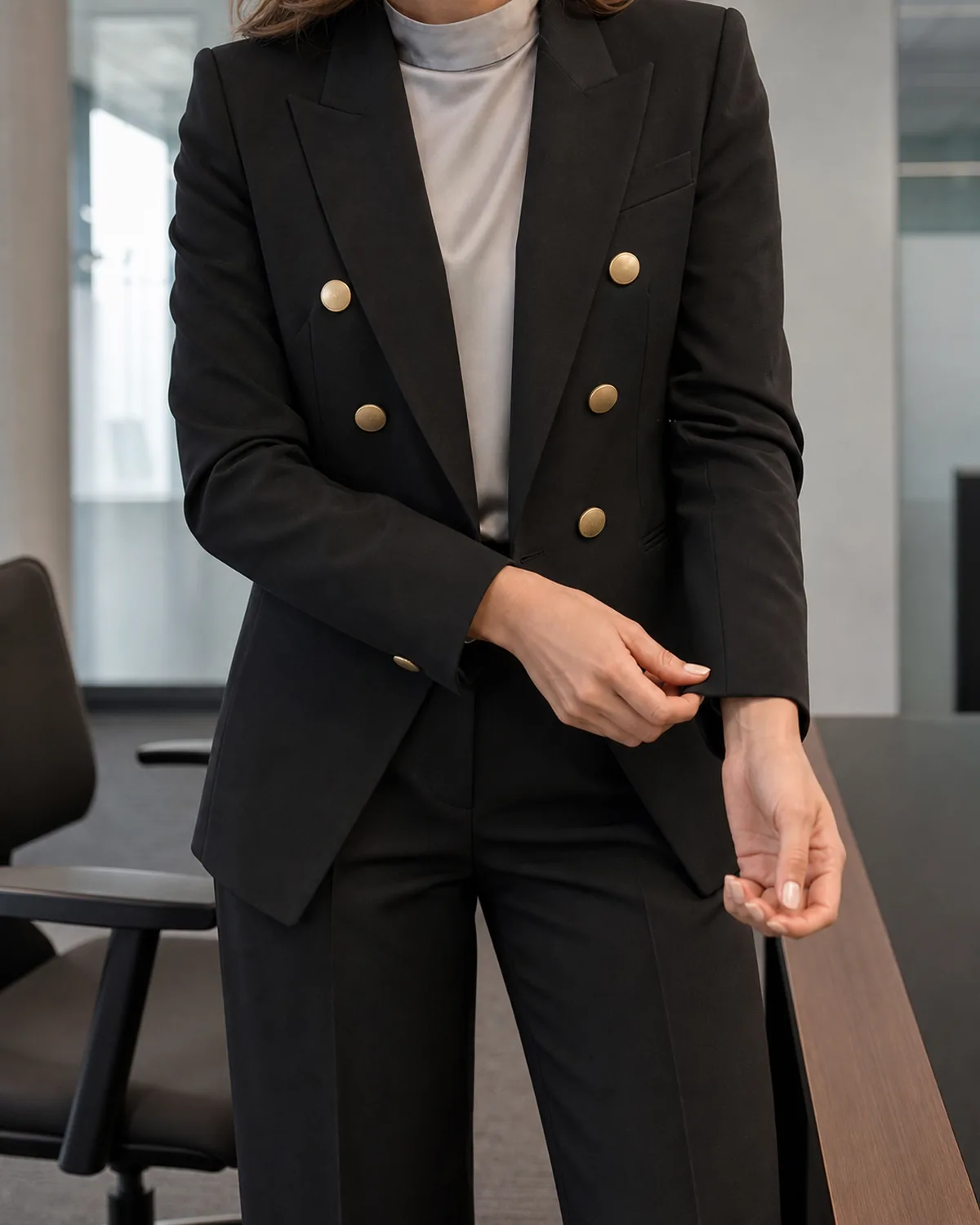
A double-breasted blazer adds visual weight that single-breasted jackets do not have. That weight is an asset under business professional because it makes the suit look more deliberate with less effort. The six-button front fills the chest area, so the top underneath can be quieter: a mock-neck shell instead of a collared blouse.
Keep it for workdays, though, because Berkeley Law's interview guide specifies a single-breasted jacket.
- Keep the buttons plain gold-tone or matte; branded or novelty buttons pull focus from the structure
- The mock-neck or crew-neck shell works because the blazer's own lapels handle the neckline framing
- High-waisted trousers balance the longer blazer line and keep the tuck clean
- A double-breasted blazer should stay buttoned; unbuttoned, it flaps open and loses the silhouette
- This is a good option when you want to look dressed up without adding accessories
8. A Midi Wrap Dress in Solid Crepe
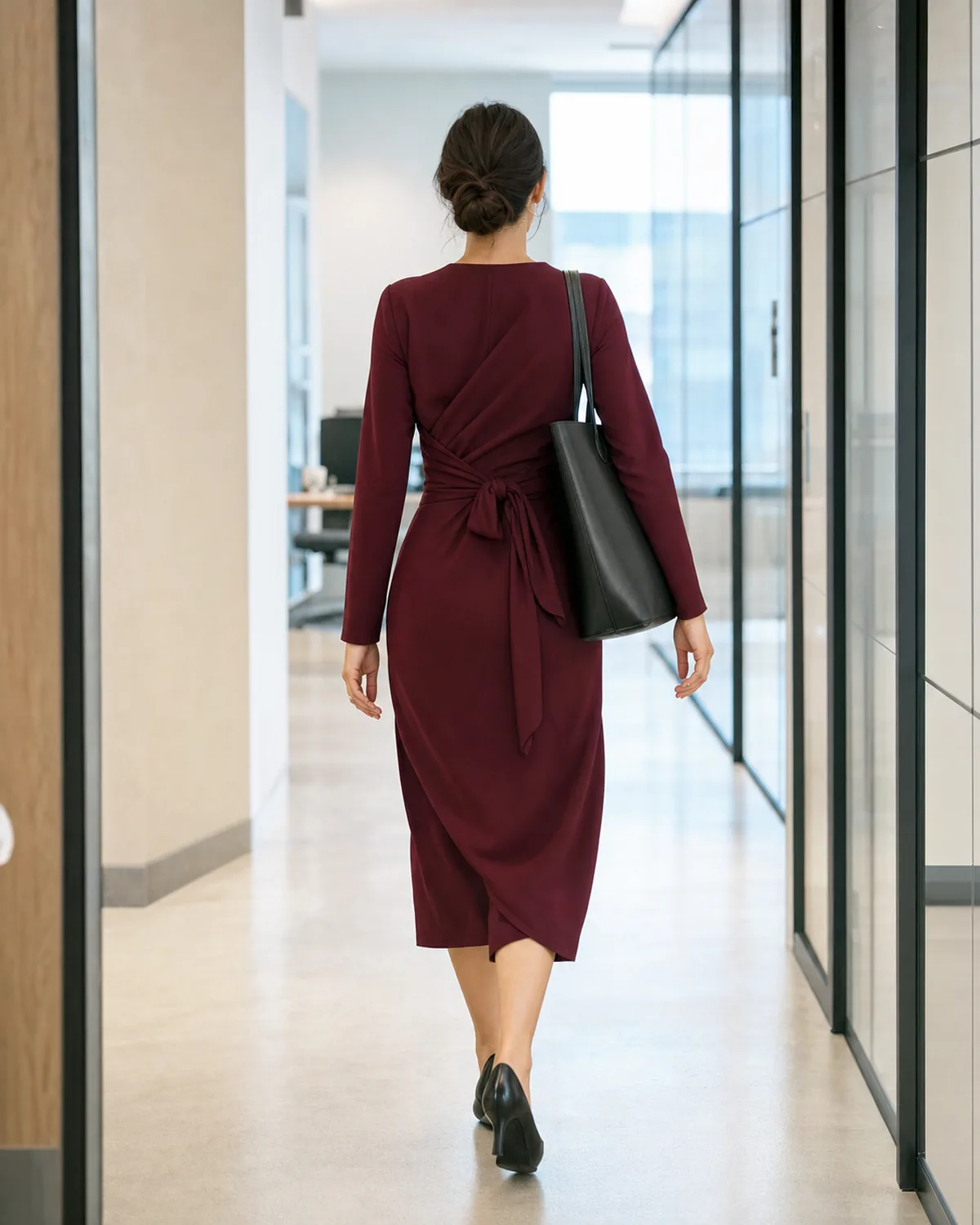
A wrap dress in a structured crepe is the dress I trust most in a business professional office, because the fabric holds its shape and the wrap silhouette follows the body without clinging. Solid colours read more formally than prints here. The deep burgundy is one example; navy, black, and forest green all work the same way.
- The fabric needs to be a matte crepe or similar suiting-weight material, not a jersey or knit that clings
- A midi hemline (mid-calf) clears the knee-length floor that Berkeley Law, Texas A&M and Duke all set
- The wrap tie should sit at the side or side-back so it reads as a clean seam from the front
- Closed-toe shoes are required, not optional, at this formality level
- A structured tote completes the outfit; a crossbody bag would pull the formality down
9. The Shoe That Makes or Breaks Business Professional
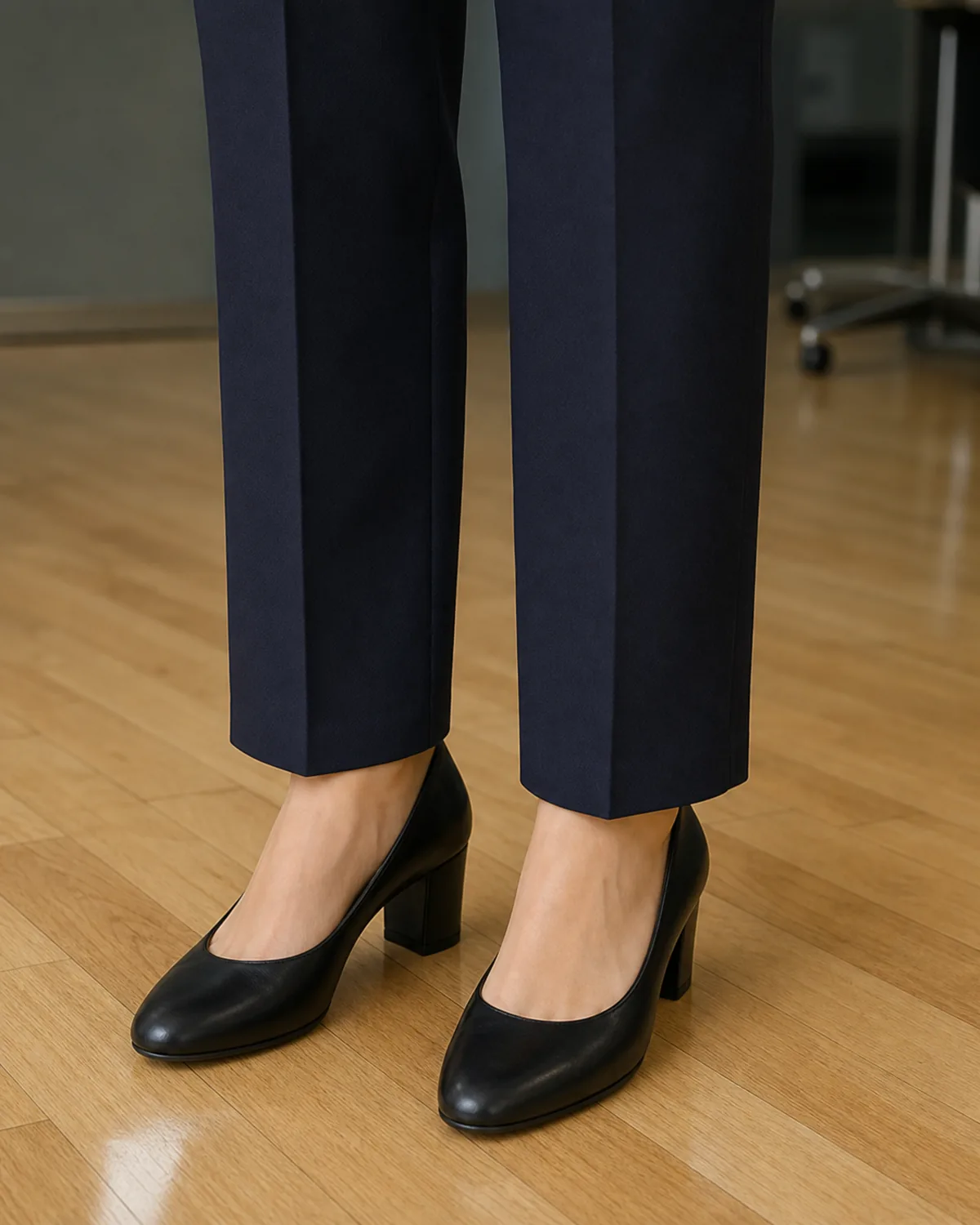
Every guide cited for this article asks for closed-toe shoes at this level. Iowa asks for "solid colored, closed-toed shoes"; Berkeley Law says shoes "should have a closed toe and low heel." Open-toe sandals, no matter how expensive or clean, sit outside this code.
- A block heel of one to two inches, the range Texas A&M gives for interviews, is stable enough for a full day and formal enough for a meeting
- The toe shape matters less than the coverage; almond, round, and pointed all work if the toe is fully closed
- Black leather is the safest colour because it pairs with every suit in this article
- Nude or flesh-tone pumps are the second option; they extend the leg line under skirt suits
- Clean the shoe the night before; scuffed or dusty leather reads as careless regardless of the silhouette
10. Choosing Between Business Professional and Business Casual
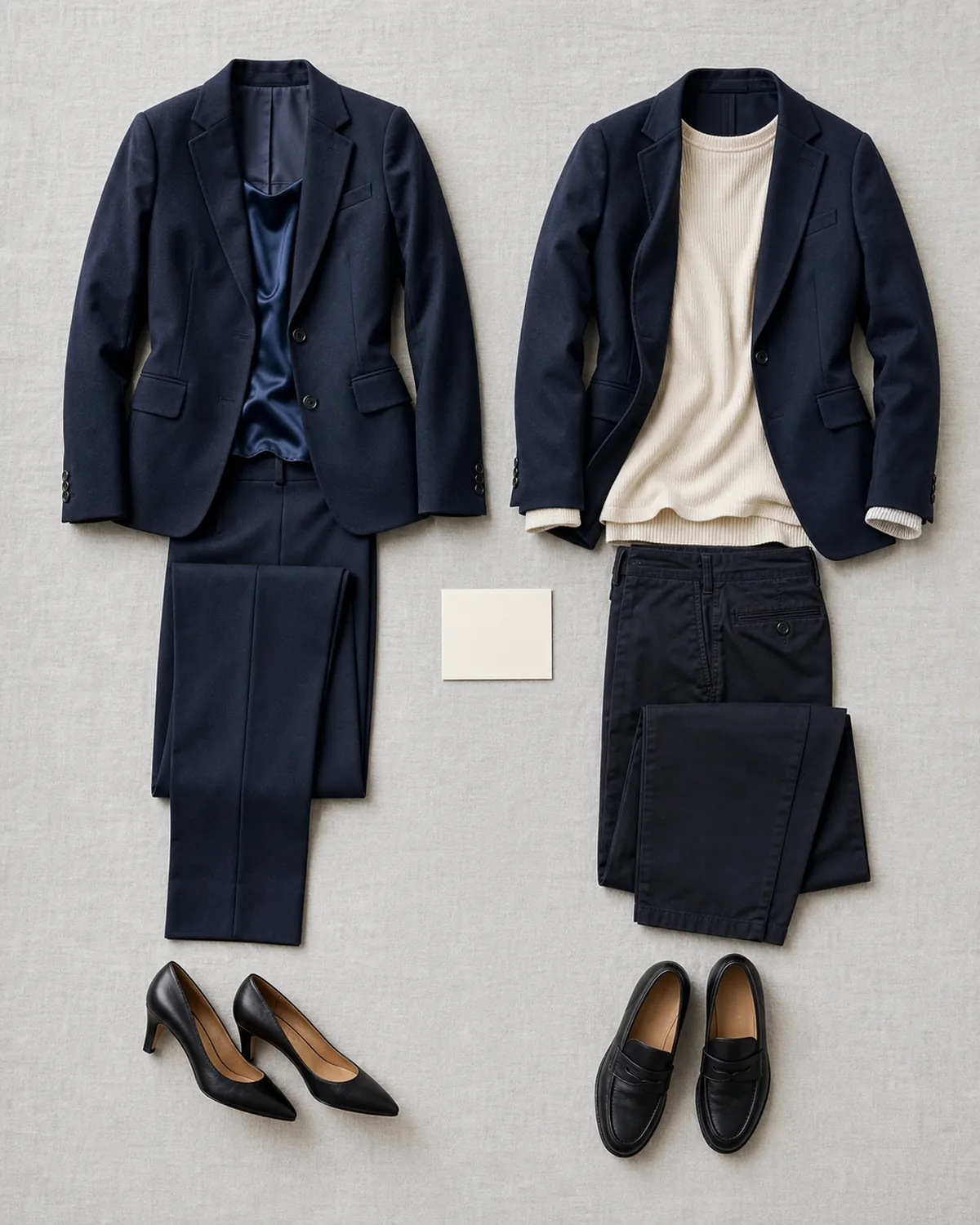
The flat-lay above puts the two codes side by side. On the left, business professional: a matched suit, a silk shell, and mid-heel pumps. On the right, business casual: the same blazer worn open, a relaxed knit, dark chinos, and loafers. The blazer is the same; the difference is what surrounds it.
- If your offer letter or employee handbook says "business professional," wear the left side until you see otherwise
- If it says "business casual," start with the right side and adjust based on what colleagues wear
- If it says nothing, wear the suit for your first week and watch the room
- The fastest tell is the shoe: if the office wears loafers and sneakers, you are likely in business casual territory
- When in doubt, the matched suit is always the safer bet; you can always remove the jacket later
Where the dress-code definitions come from
- Dress for Success — Pomerantz Career Center, The University of Iowa
- Dress for Success — The Career Center, University of Illinois Urbana-Champaign
- Interviews: Dress and Presentation Guidelines (PDF, 2023) — Career Development Office, Berkeley Law
- Dress for Success — Career Center, Texas A&M University
- Attire Guide — Career Hub, Duke University
Keep this one
Save it where you plan outfits
Pin the image above to the board you actually check on a Sunday night. This guide is written to be re-read, not read once.
Tonight, before you close this tab
- Lay your suit jacket and trousers side by side under two different lights and check the fabric match
- Try your closed-toe shoe with the trouser hem and look at where the break falls
- Remove one accessory from whatever you planned to wear tomorrow
- Iron or steam the blouse collar flat tonight so it sits clean under the blazer lapel