17 Summer Teacher Outfits That Handle the Heat Without Looking Like You Gave Up
Summer teacher outfits that handle the commute heat and the classroom AC. Seventeen combinations with dress-code tiers, fabric picks and layering logic.
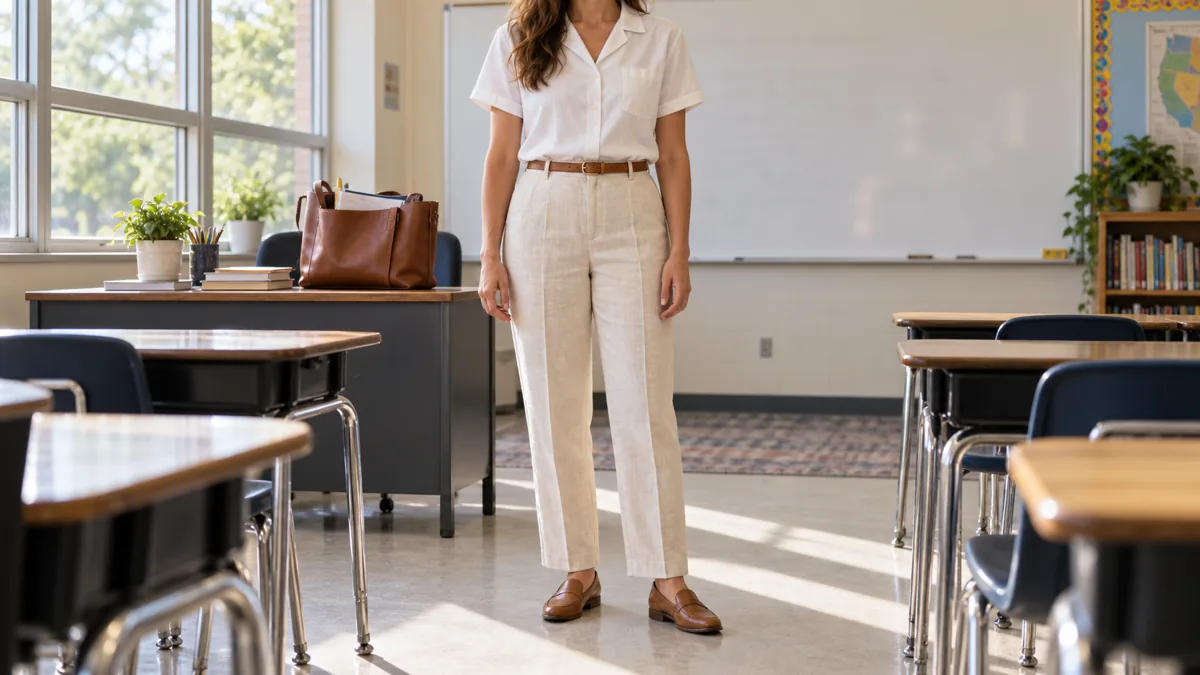
Working out an outfit for tomorrow? Save this page. It is easier to skim the night before than to remember.
At a glance
Works
- Cotton or linen-blend straight-leg trousers with a structured blouse, the safest summer baseline across districts
- A midi dress in a dark solid, one piece with full coverage and zero morning decisions
- A desk cardigan or blazer for the AC gap between the parking lot and the classroom
Depends
- Knee-length or bermuda shorts, only where your school dress code explicitly permits staff shorts
- Sleeveless tops, check your district policy because some list only tops with sleeves as appropriate
- White sneakers, common in relaxed schools, but some district guidelines rule out athletic shoes
Skip
- Spaghetti straps or visible bra straps without a covering layer, on any teaching day
- Athletic shorts, gym clothes or flip-flops on regular teaching days
- Sheer or see-through fabrics without a lining layer visible underneath
Summer teaching is a two-climate problem. The commute happens in heat that makes you reconsider every fabric choice you have ever made. The classroom happens in air conditioning calibrated by someone who is apparently never warm.
Most summer teacher outfit advice treats this as one question about staying cool. It is not. It is a question about layering, fabric weight and which items your school dress code will accept when the temperature climbs.
These seventeen combinations name the dress-code tier each one clears, the fabrics that breathe and the layering logic that gets you from the parking lot to the last bell.
1. Linen-Blend Straight-Leg Trousers With a Cotton Poplin Camp-Collar Blouse
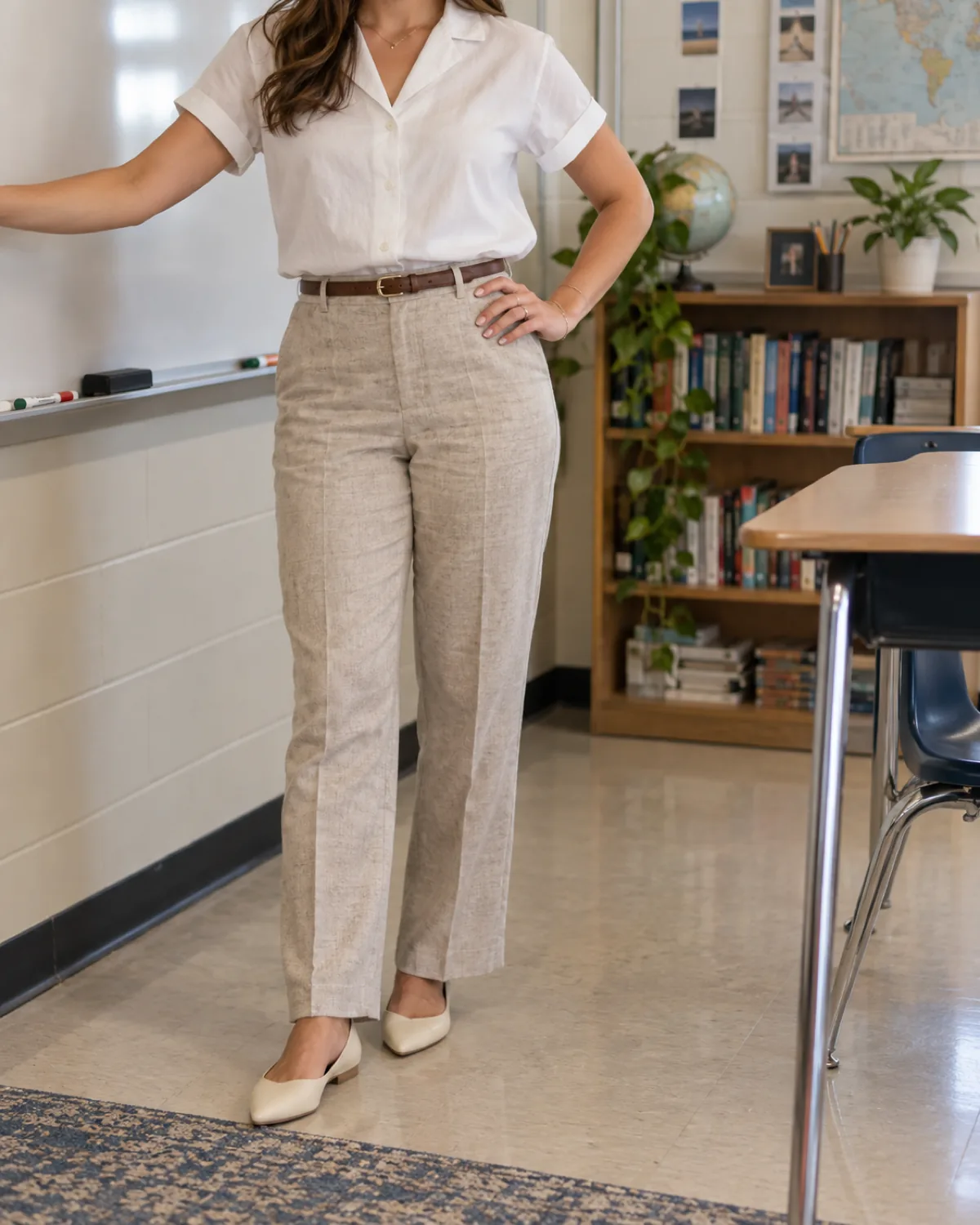
Linen-blend holds its shape through a full school day while still letting air move. Pure linen wrinkles within an hour of sitting, but a cotton-linen or linen-poly blend keeps the front crease intact longer. The camp collar sits flat and open without trapping heat at the neck, and it reads structured enough for any business-casual school environment.
- Press the front crease before wearing because linen without a crease reads instantly casual
- Tuck the blouse and show the belt so the waistband signals trouser rather than lounge pant
- Keep a lint roller in your desk because linen weave picks up whiteboard marker dust
- Swap the flats for loafers if your school leans more formal
2. A Cotton Shirt Dress With a Leather Belt and Flat Mules
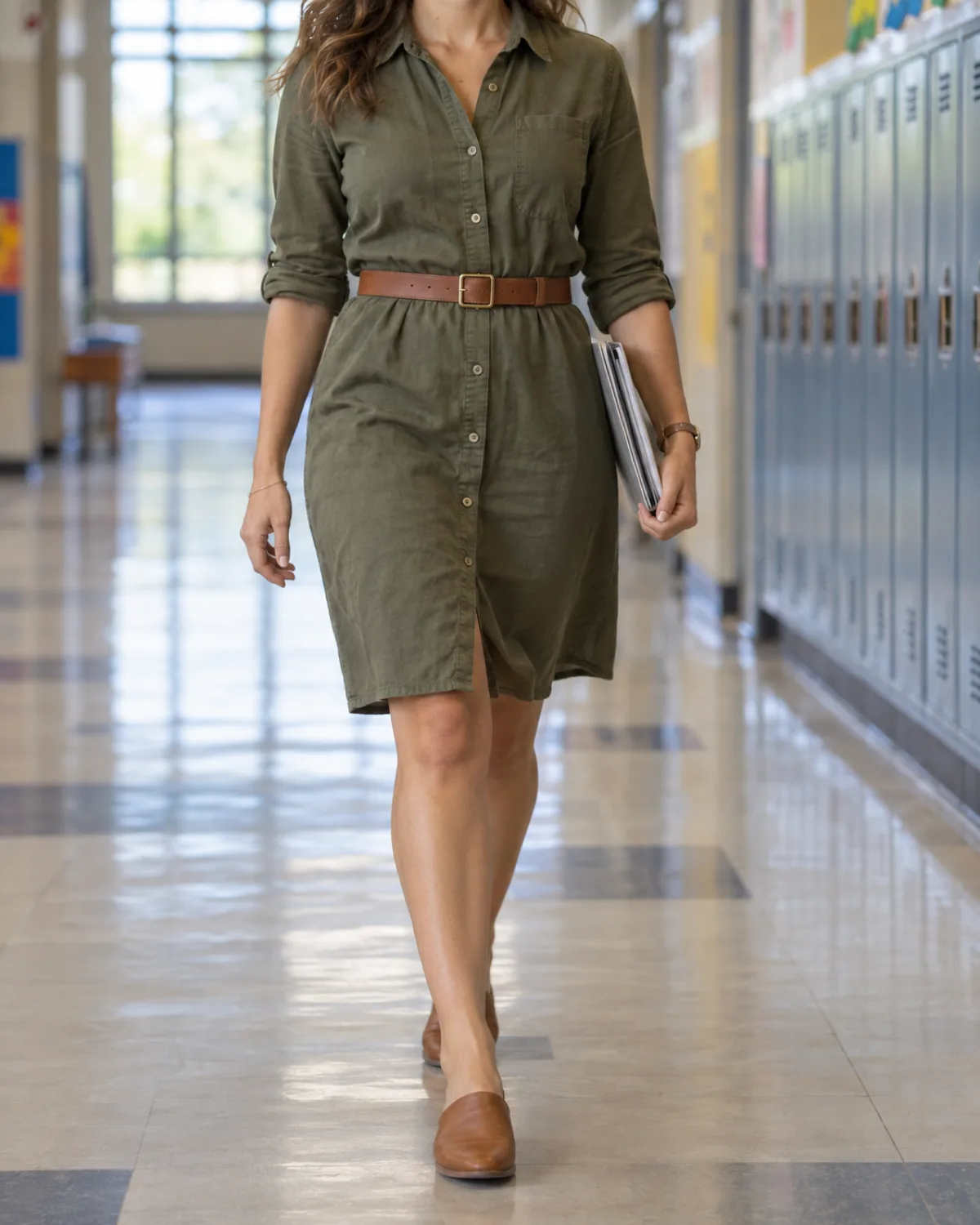
One piece, zero morning decisions. The belt creates a waist so the dress reads structured rather than shapeless. Cotton breathes better than the polyester blends that most work dresses default to. Flat mules handle hallway walking without the sweat buildup of fully closed shoes.
- Choose below-the-knee length to clear the strictest skirt rule you are likely to meet
- Pick a dark or mid-tone solid because light cotton shows sweat marks more visibly
- The belt is doing most of the formality work here so do not skip it
- Mules slip on and off easily for playground duty if your schedule includes it
- Georgia school-system policies, as summarised in a Georgia Southern University teaching guide, list closed-toed shoes with backs as appropriate, so if your district draws the same line, swap the mules for loafers
3. Wide-Leg Cropped Trousers With a Sleeveless Mock-Neck Top and a Desk Cardigan
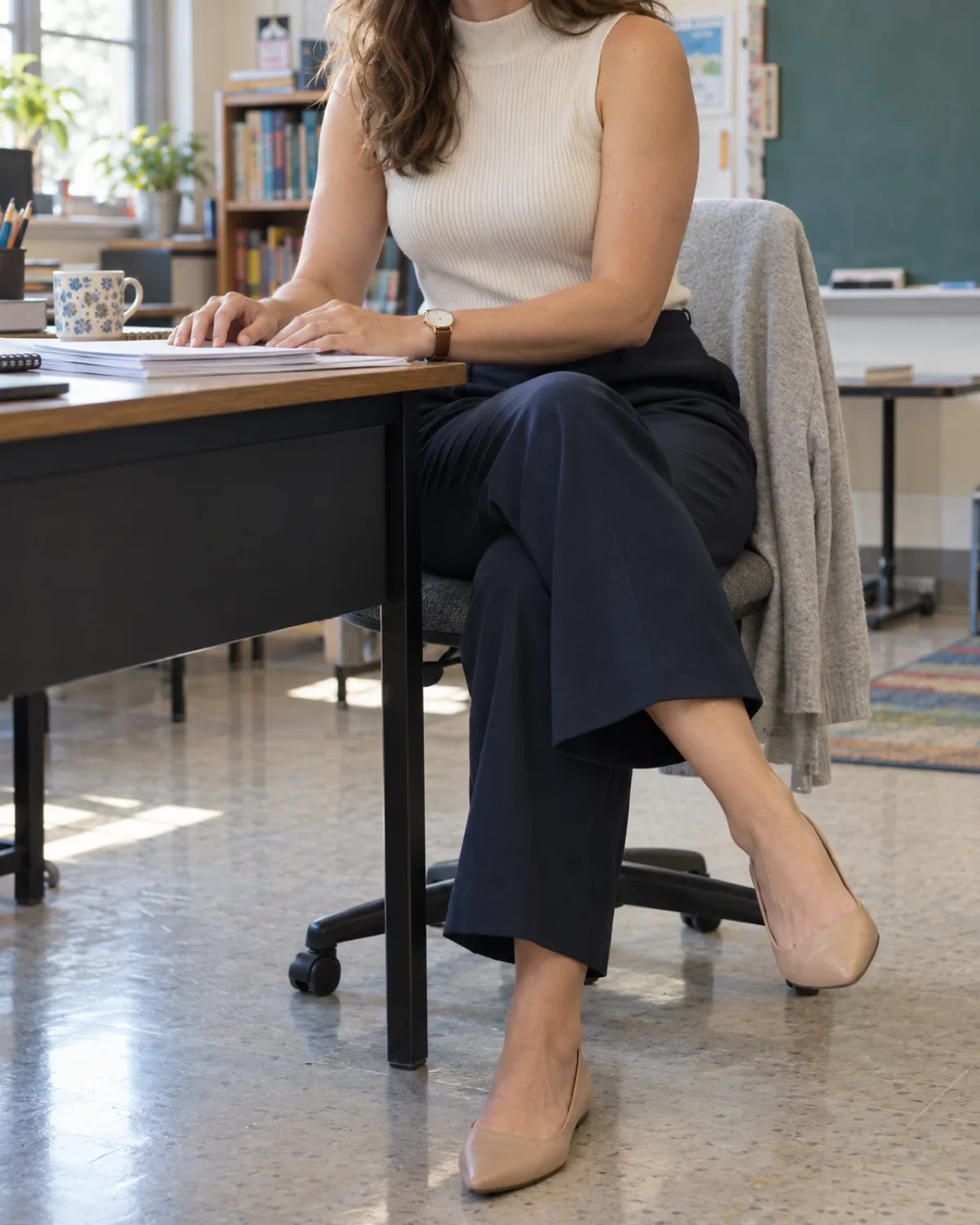
The mock-neck without sleeves is the coolest high-neckline option. Wide-leg cropped trousers let air circulate around your ankles. The desk cardigan handles the temperature gap between the parking lot and the classroom. Leave the cardigan at school so you never have to commute in an extra layer.
- Ankle-length cropped is different from capri length and reads more professional
- Check your school sleeve policy before going sleeveless because some district guidelines list only tops with sleeves as appropriate
- The desk cardigan should be structured enough to pass as a layer, not a blanket
- Navy and cream reads polished without effort in nearly every school setting
4. Ponte Pencil Skirt With a Short-Sleeve Cotton Blouse
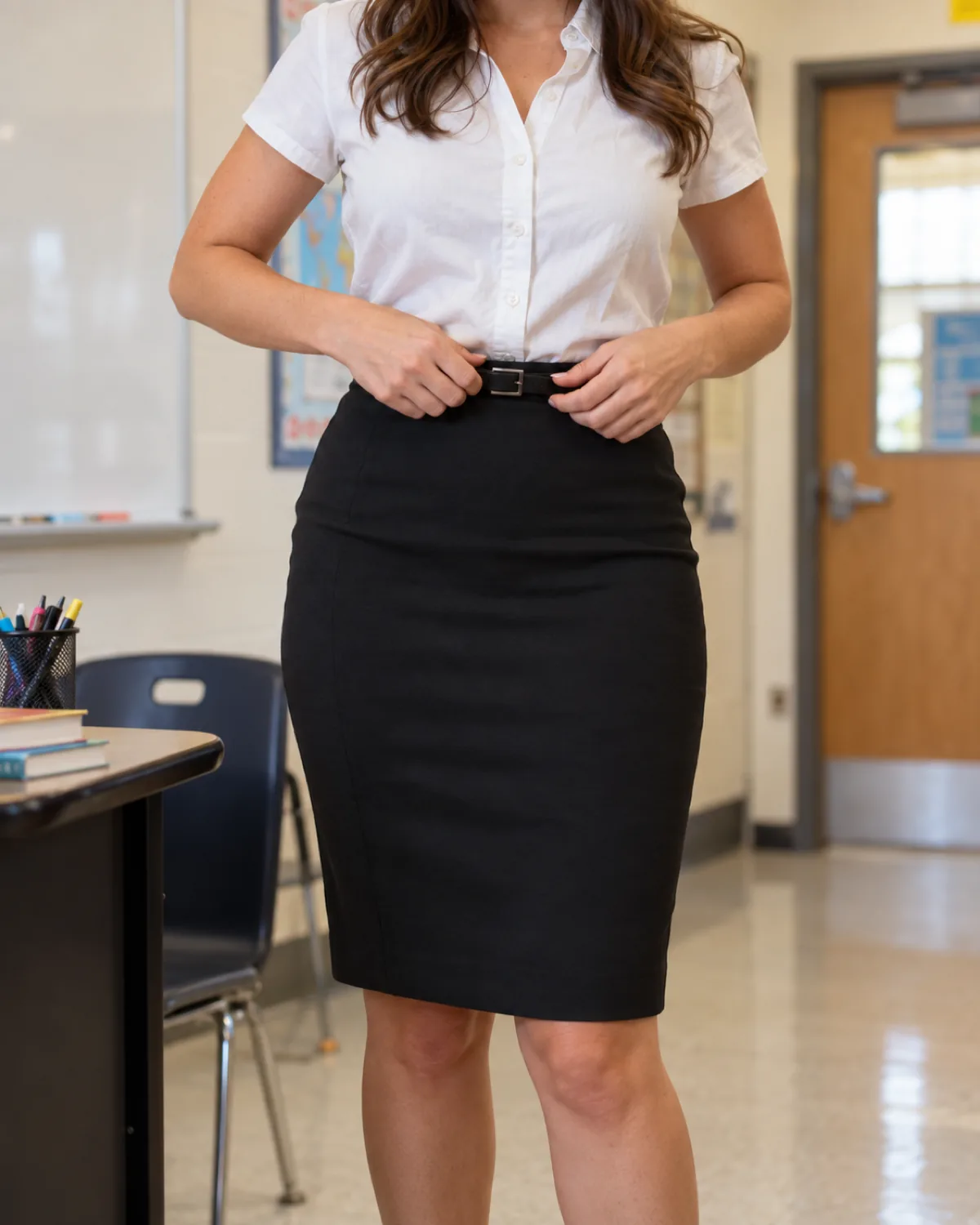
Ponte fabric stretches for every movement a teaching day demands: sitting, standing, bending to student desks, crouching to plug in a projector. Short-sleeve cotton on top breathes without raising the bare-shoulder question.
The knee length sits inside most skirt rules: the Georgia policies allow dresses and skirts up to two inches above the knee, though Indeed's summary of teacher codes lists skirts that "fall below the knee." If yours says below, choose a midi.
- Ponte resists wrinkles better than woven fabrics so it still looks pressed at three in the afternoon
- A thin belt at the waist defines the transition between blouse and skirt
- This combination clears business casual and can push into business professional with a blazer
- Black ponte reads as a standard pencil skirt to most people which is exactly the point
Where to start
Find your situation, skip ahead
Your school enforces a written business-casual dress code and this is your first summer teaching
Start with ideas 1, 4 and 8. Structured trousers or a ponte skirt with a blouse sit squarely inside the business-casual lists teacher guides publish.
01 Linen-Blend Straight-Leg Trousers With a Cotton Poplin Camp-Collar Blouse04 Ponte Pencil Skirt With a Short-Sleeve Cotton Blouse08 High-Waisted Cotton Trousers With a Sleeveless Shell and a Linen Blazer
Your school is relaxed and you see other teachers in shorts and sneakers
Ideas 5, 14 and 13 give you comfortable range without crossing into too casual for a classroom.
05 Chino Shorts With a Tucked-In Button-Down and Loafers14 A Chambray Shirt Dress With White Sneakers13 Cotton Chinos With a Printed Camp-Collar Shirt
You commute in ninety-degree heat but your classroom AC is set to sixty-four
Ideas 3, 8 and 17. Cool base with a desk blazer, cardigan or vest you put on at the door.
03 Wide-Leg Cropped Trousers With a Sleeveless Mock-Neck Top and a Desk Cardigan08 High-Waisted Cotton Trousers With a Sleeveless Shell and a Linen Blazer17 Tencel Trousers With a Tissue-Weight Knit Tee and a Cotton Vest
5. Chino Shorts With a Tucked-In Button-Down and Loafers
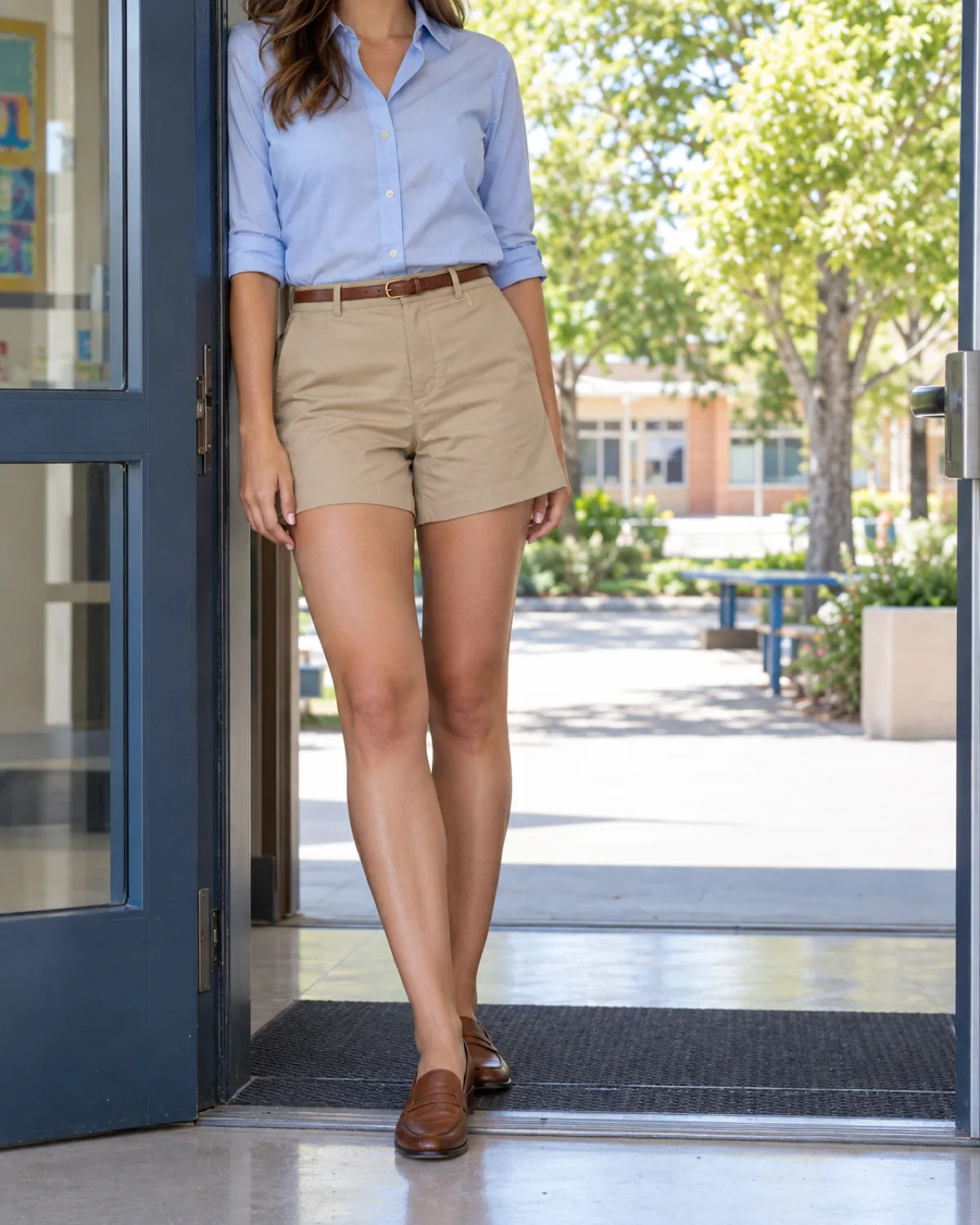
Only for schools where shorts are explicitly allowed for staff. Check the written dress code rather than guessing from what you see in the hallway. The 7-inch inseam matters because shorter reads as weekend. A tucked button-down makes the outfit intentional rather than accidental. Loafers anchor the bottom half in a way that flip-flops never could.
- Read the actual staff handbook before wearing shorts for the first time
- The button-down is doing the heavy lifting so keep it pressed and properly tucked
- Penny loafers without socks are fine in summer but avoid sandals with shorts in a school
- If you are not sure about shorts, wear the same top with chinos instead until you see what others wear
6. A Midi Wrap Dress in a Dark Solid Colour
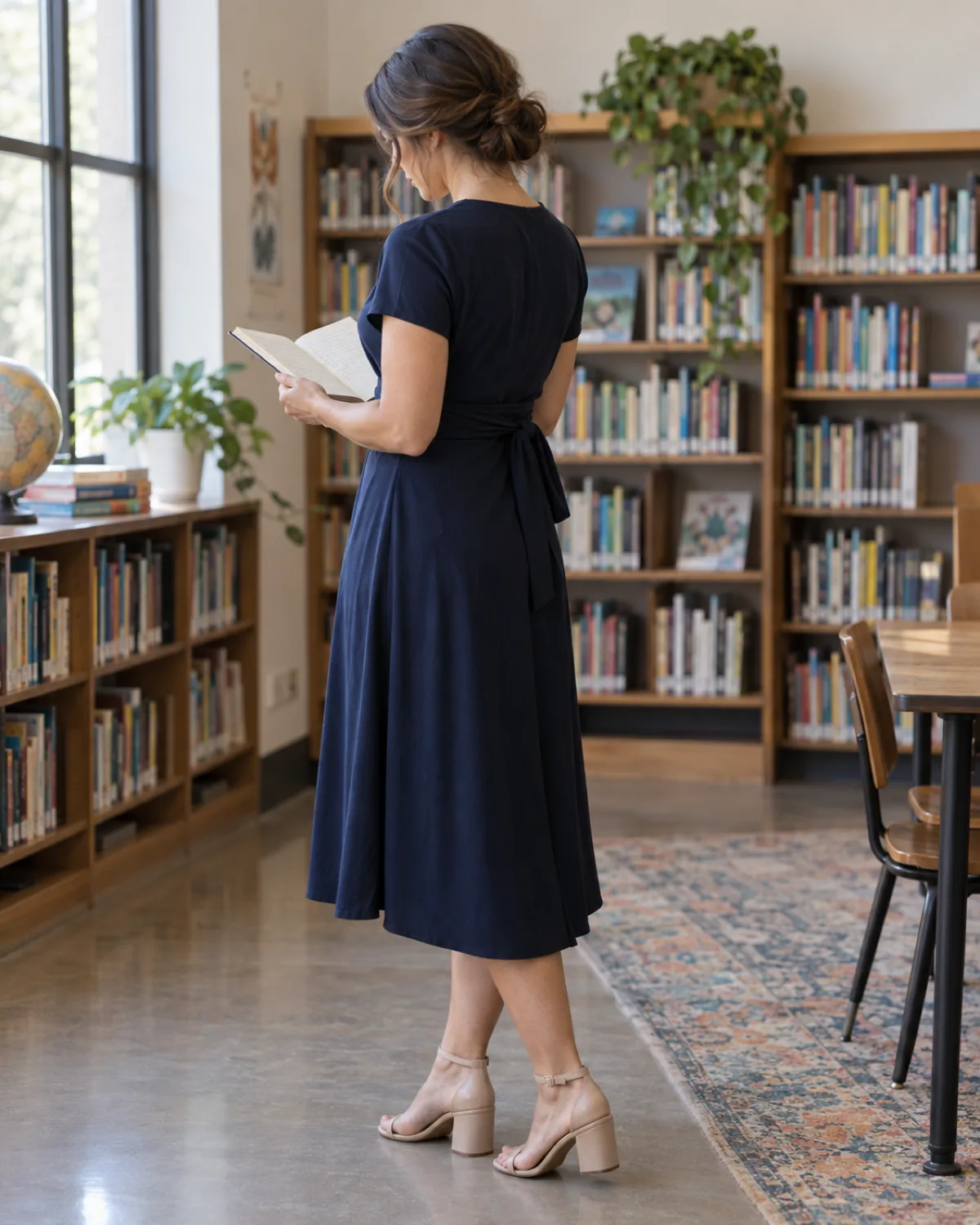
The wrap silhouette creates shape without needing a belt. Midi length clears every knee-or-below code. Dark solids read more professional than prints in most school contexts. A wrap dress is also one of the fastest outfits to put on in the morning while still looking like a deliberate choice.
- Dark navy, deep green or black all work as solids that read professional
- The wrap should be secure enough that you do not have to adjust it while teaching
- Midi length means below the knee and above the ankle
- Add a desk cardigan if your classroom runs cold and the wrap alone is not enough
7. Lightweight Palazzo Pants With a French-Tucked Linen Shirt
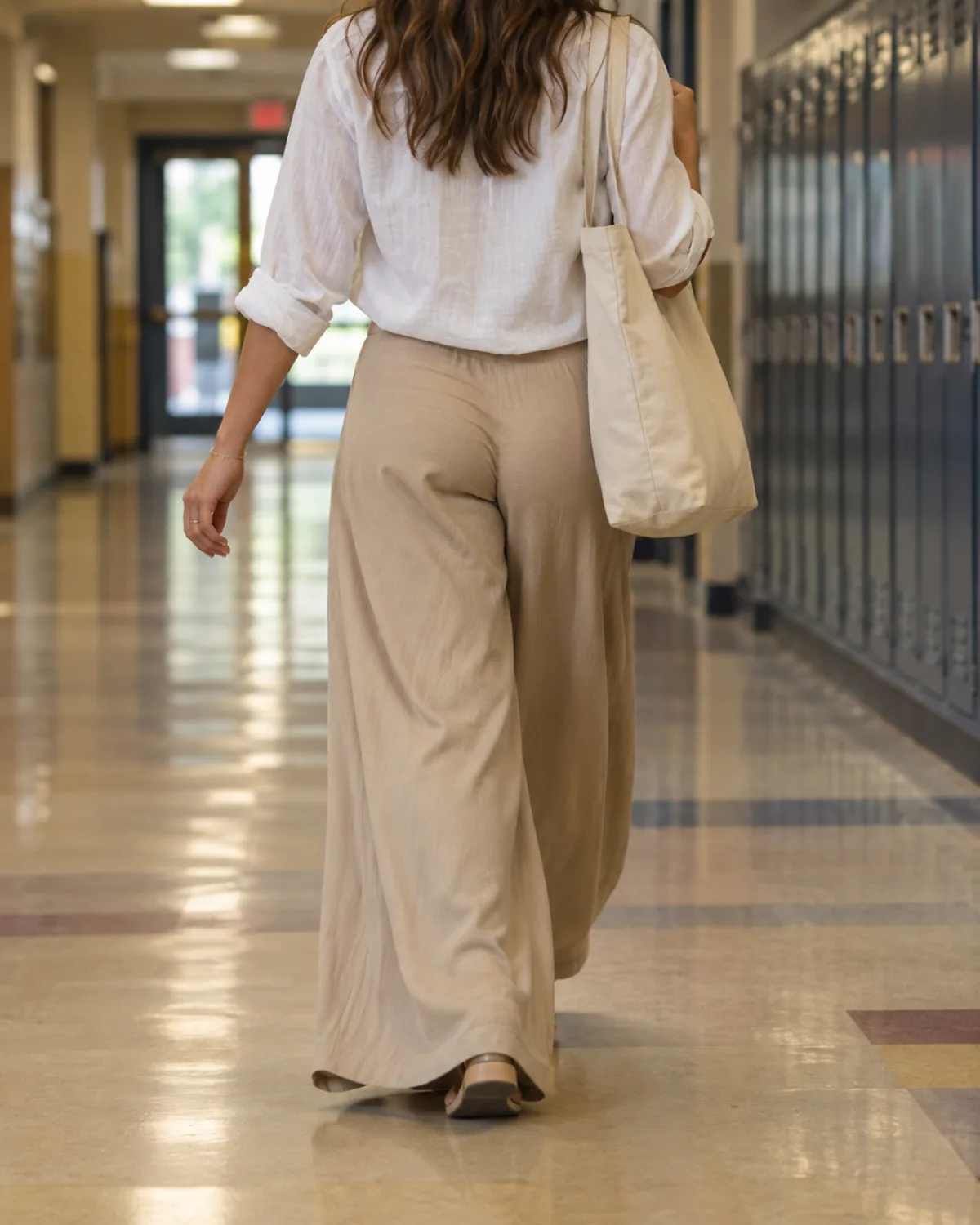
Palazzo pants in a lightweight woven fabric like rayon or a cotton-linen blend move air without clinging. The French tuck breaks the column of fabric and shows the waistband, which signals that these are trousers rather than pyjama bottoms. This reads as professional in casual-code schools but skip it for strict business-casual environments where tailored trousers are expected.
- The French tuck is the front-only tuck that shows the waistband while the back hangs free
- Palazzo width works best with a flat or low-heeled shoe rather than a sneaker
- Lightweight rayon or cotton-linen moves air better than heavy linen alone
- If your school is stricter, swap palazzos for wide-leg trousers with a more defined waistband
8. High-Waisted Cotton Trousers With a Sleeveless Shell and a Linen Blazer

The linen blazer adds professional weight without adding heat. The sleeveless shell means you can take the blazer off the moment the meeting ends and still look appropriate. This is the summer version of the classic trouser-and-blazer combination that clears business casual everywhere.
- The blazer lives on your desk chair, not on your body for the entire day
- A sleeveless shell under a blazer gives you two formality levels in one outfit
- High-waisted cotton trousers anchor the formality at the bottom
- This combination works for parent conferences, evaluations and regular teaching days equally
9. A Cotton-Linen Jumpsuit With a Thin Belt
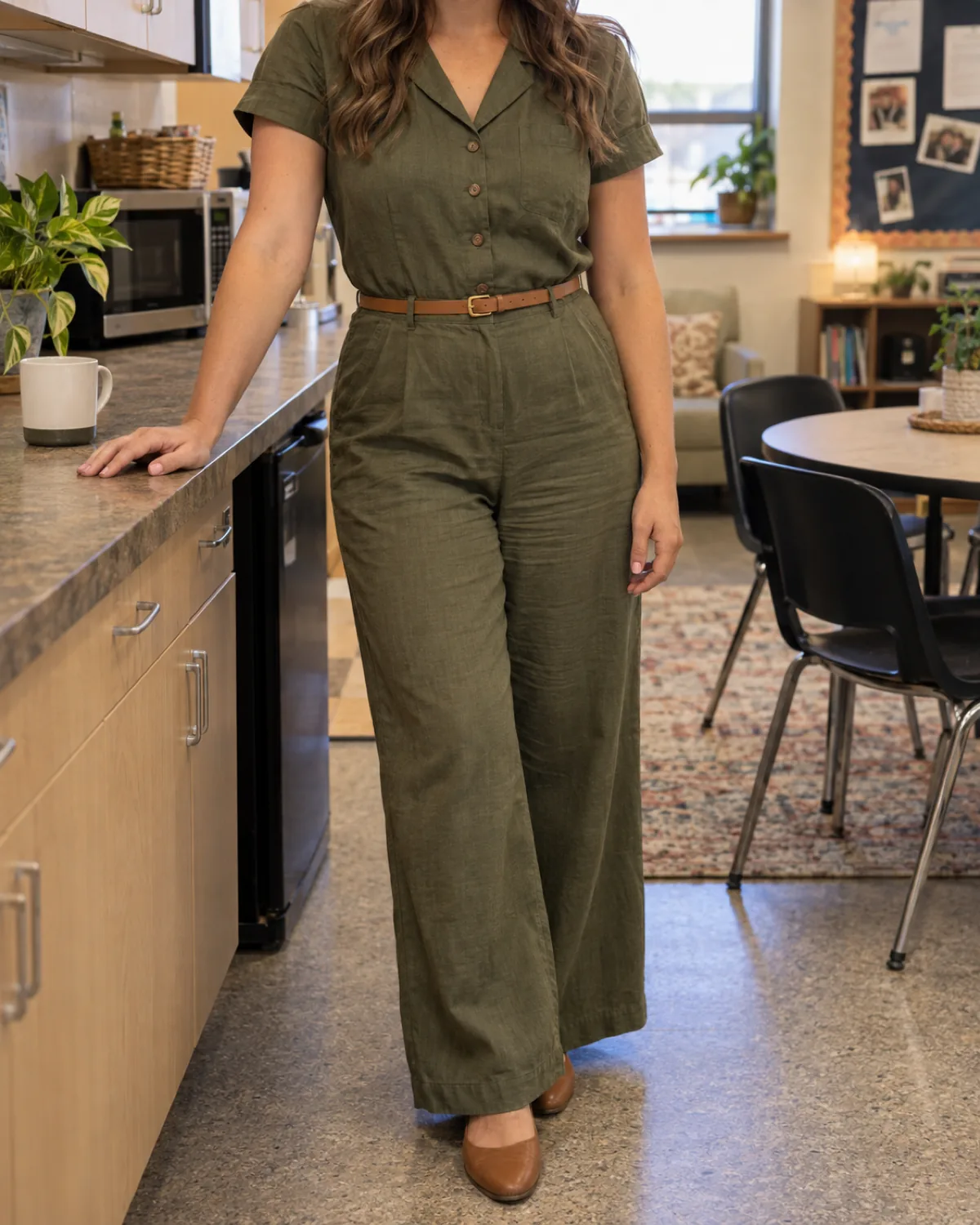
Jumpsuits are still unusual enough in some schools that you may get comments. In my experience, most casual-code and business-casual-code districts accept them. The thin belt at the waist prevents the mechanic silhouette that makes jumpsuits read as utility wear. One piece, full coverage, no tucking failures for the entire day.
- A belt at the waist is the difference between a professional jumpsuit and a boilersuit
- Button-front bodice with a notch collar reads more structured than a pullover style
- Wide-leg jumpsuits read more formal than tapered or jogger-style legs
- If your school has not seen a jumpsuit before, test it on a low-stakes day first
10. Tapered Ankle Pants With a Boxy Short-Sleeve Blouse
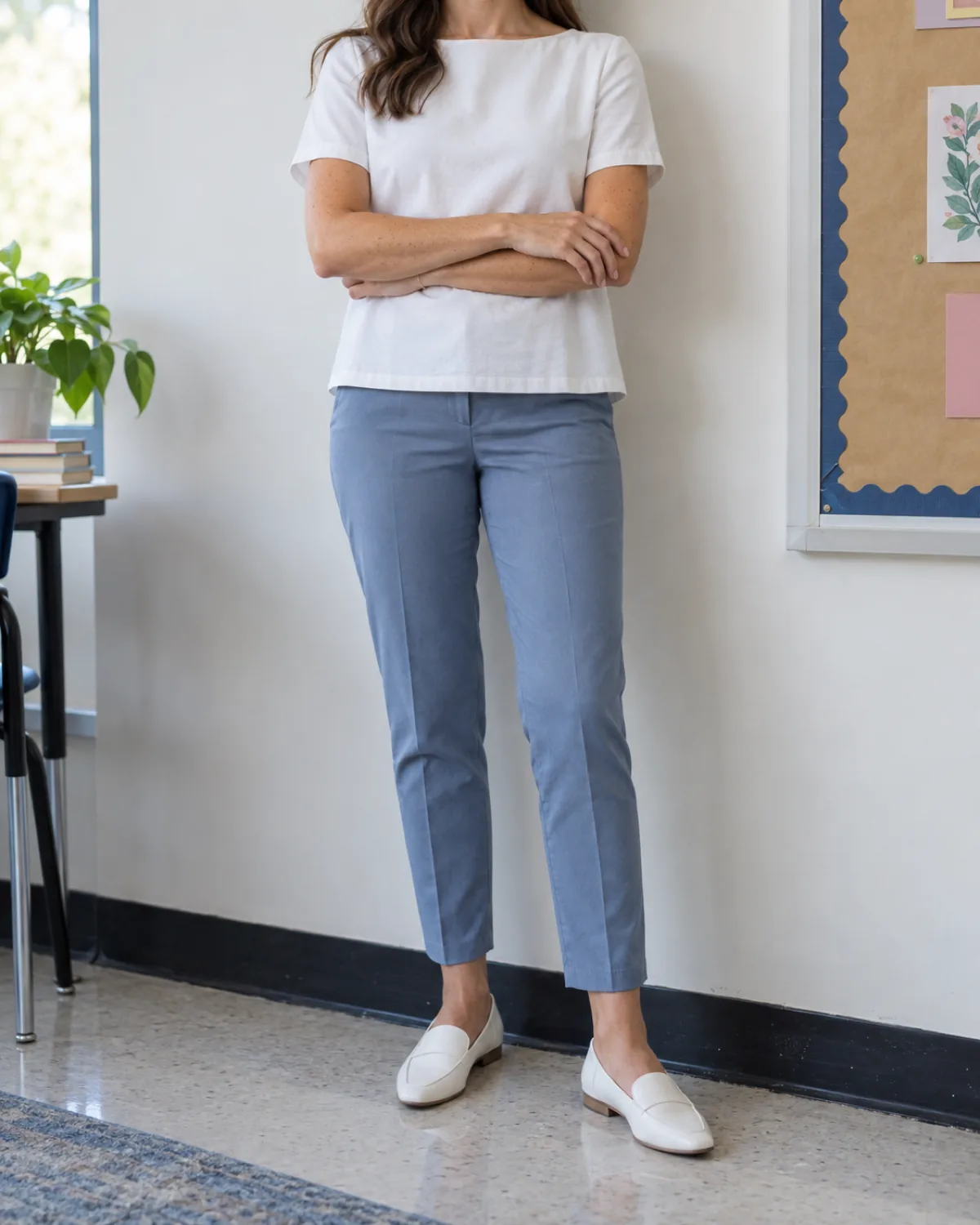
Tapered ankle pants in a cotton-stretch blend sit closer to the leg than wide-leg options, which reads tidier. A boxy blouse balances the slim pant without clinging to the torso. This combination works in air-conditioned classrooms where you need to look professional but the commute is the hot part of the day.
- Cotton-stretch blend holds shape better than pure cotton through a full teaching schedule
- A boxy blouse should end at the hip, not the mid-thigh
- White loafers keep the bottom half light and summery
- This is a safe choice for any school that expects business casual
11. A Midi A-Line Skirt With a Tucked-In Sleeveless Knit Top
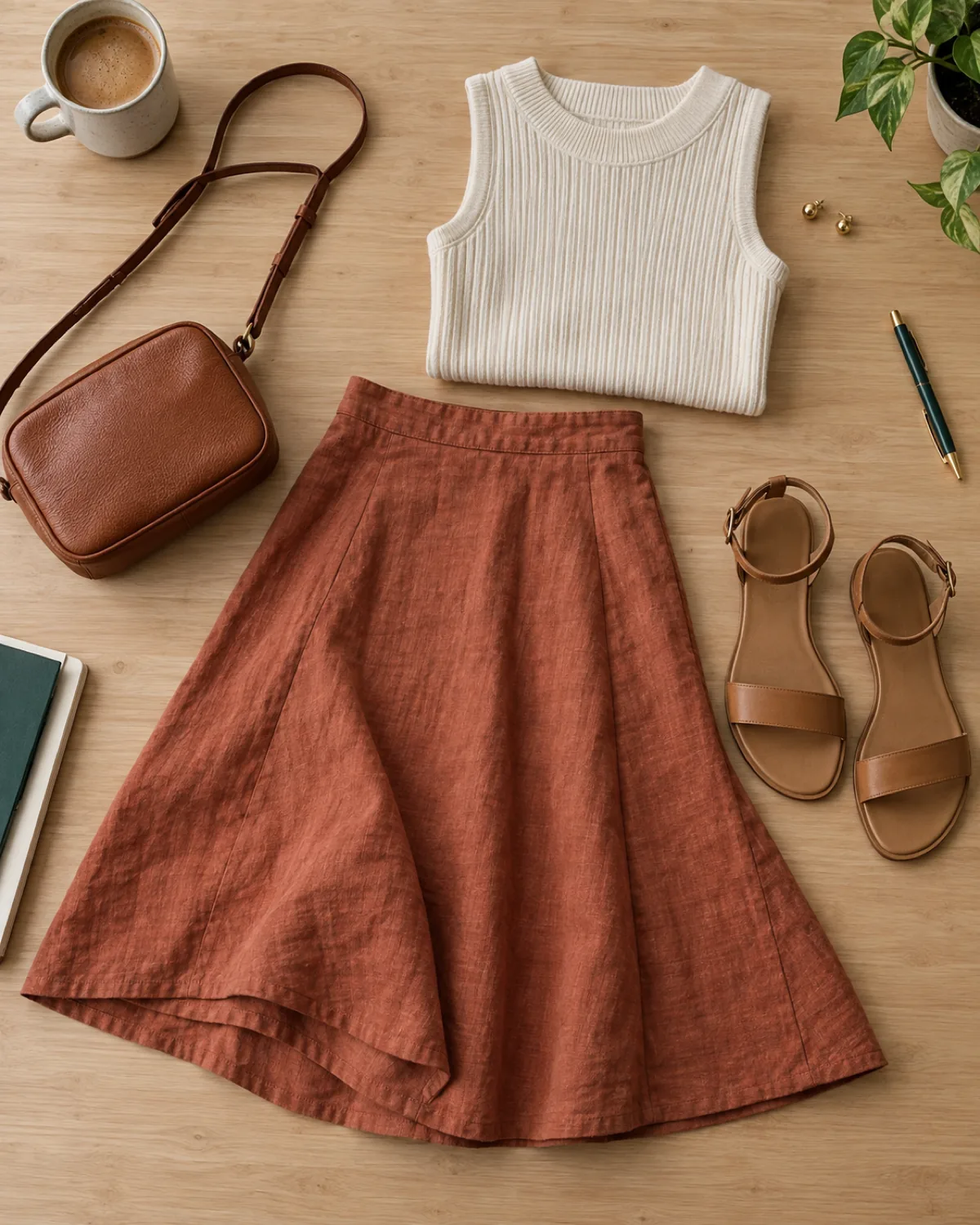
The A-line midi does not cling and does not ride up when you sit. A sleeveless ribbed knit top with a high round neckline pairs seamlessly. Check your school sleeve policy: some district guidelines list only tops with sleeves as appropriate, in which case layer a light cardigan or switch to a short-sleeve knit.
- A-line means the skirt widens from waist to hem which lets air circulate
- Tuck the knit top in so the waistband is visible and the silhouette reads intentional
- Terracotta, olive and dusty blue all work as warm-weather neutrals in a school
- Flat sandals with an ankle strap keep the outfit grounded without adding heat, but check first, since some district guidelines expect closed-toed shoes
12. Linen-Blend Bermuda Shorts With a Structured Cotton Blazer and a Tee
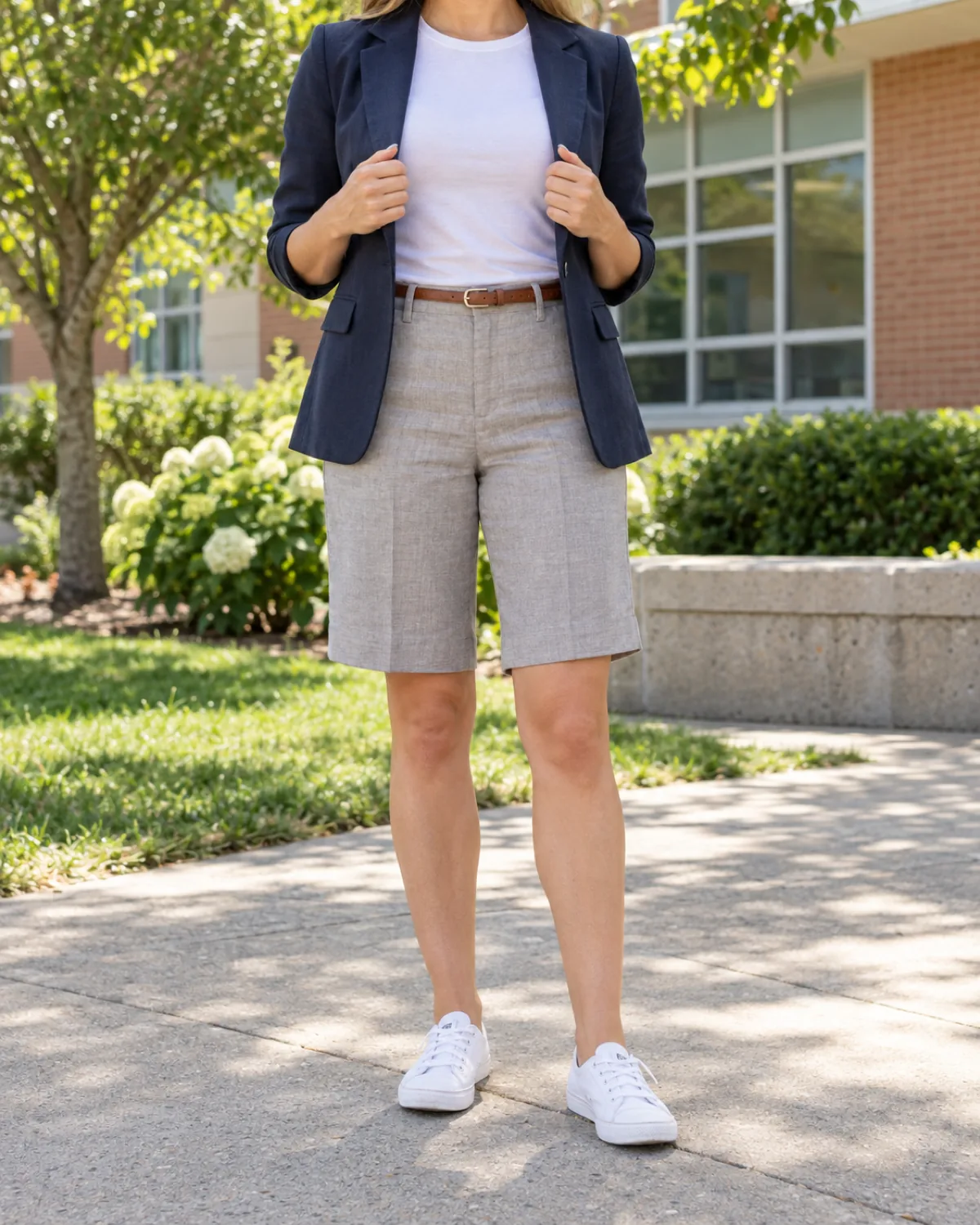
This is the dressed-up version of idea 5. The blazer converts bermuda shorts from weekend wear to workday wear. Only for schools that permit shorts for staff. The tee must be a clean, fitted crew or scoop neck. A graphic tee under a blazer still reads as a graphic tee.
- Bermuda length means at or just above the knee, not mid-thigh
- The blazer is the entire formality structure of this outfit so keep it on during teaching hours
- White sneakers work here because the blazer carries the professional signal
- Remove the blazer only when you are outside on duty or in the staff lounge
13. Cotton Chinos With a Printed Camp-Collar Shirt

The print adds personality and the camp collar adds structure. In my experience, cotton chinos are the most widely accepted summer teacher pant. A printed shirt in a muted palette reads intentional without reading loud. This combination works in almost every school environment without overthinking it.
- Muted botanical, geometric or tonal prints read professional while solid blocks can read plain
- Camp collar means the notched collar that lies flat and open without needing a tie
- French tuck the front to show the waistband and break the fabric column
- This is a good outfit for the last week of school when you want to be comfortable but not sloppy
14. A Chambray Shirt Dress With White Sneakers
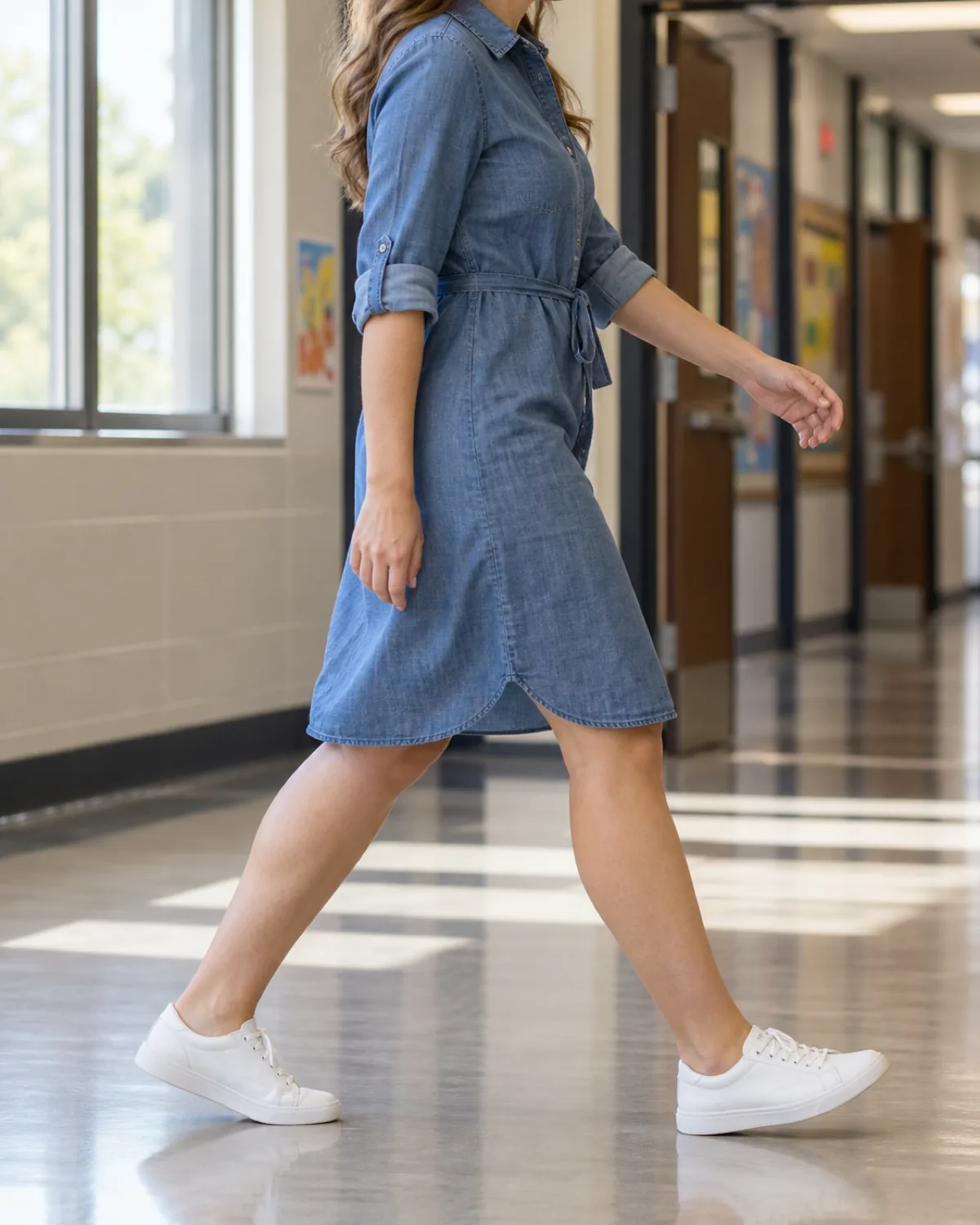
Chambray is cotton woven to look like denim but without the weight or the "jeans at school" connotation. White sneakers are common in relaxed schools, but the Georgia policies list athletic shoes as inappropriate unless you teach an athletic activity, so check your code first. The shirt-dress structure, with its collar and buttons, reads professional enough for the classroom.
- Chambray is lighter than denim and wrinkles less which makes it better for all-day wear
- Roll the sleeves to below the elbow for a clean summer look
- A waist tie or belt defines shape so the dress does not hang like a sack
- White sneakers should be clean because scuffed sneakers undermine the whole outfit
15. Cropped Wide-Leg Trousers With a Fitted Ribbed Knit Tank and a Light Scarf
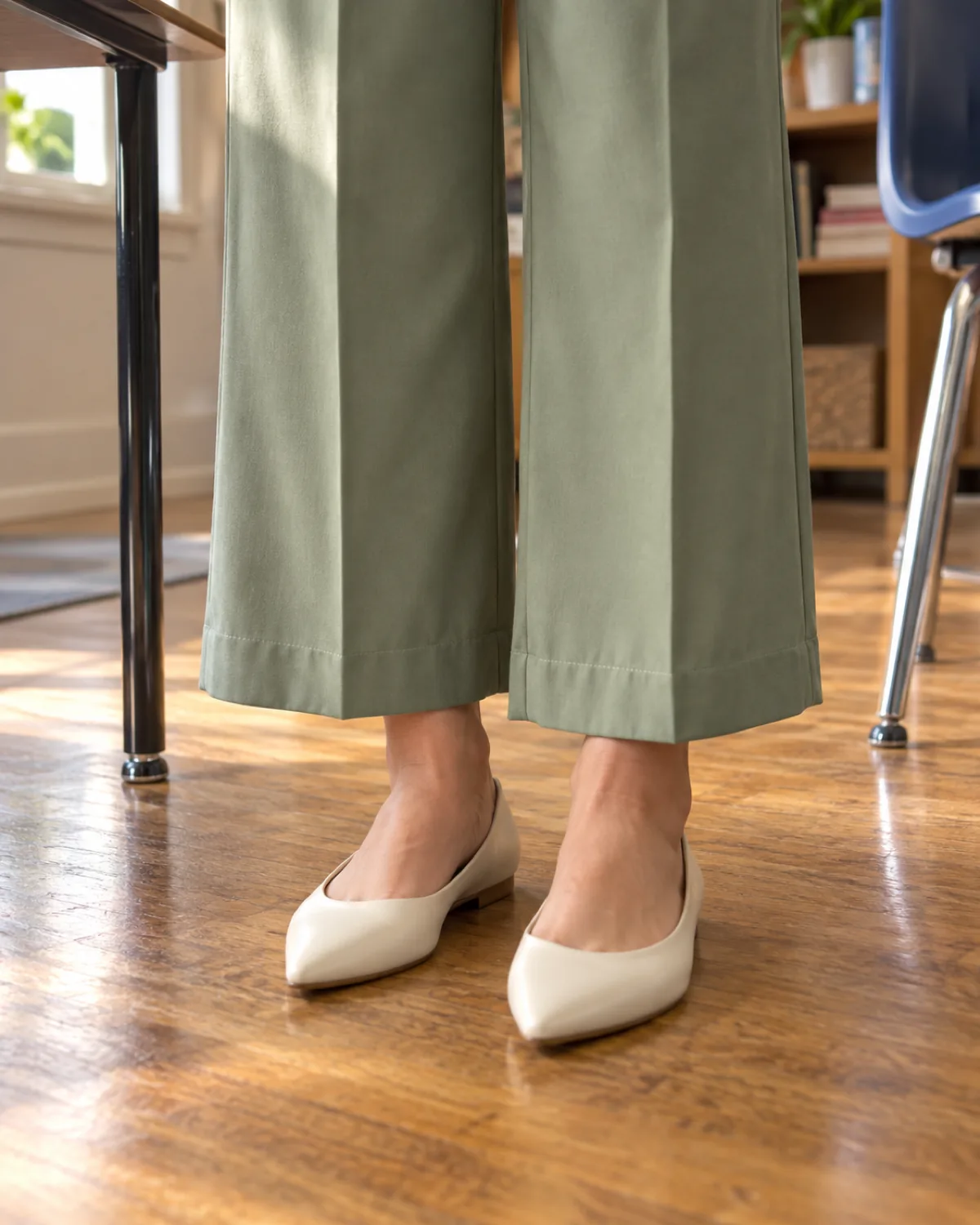
The scarf is a styling tool that adds a formality signal without adding heat. Cropped wide-leg trousers let air circulate at the ankle. The ribbed knit tank is fitted enough to anchor the top half. This combination works where sleeveless is acceptable and where you want one more visual element without reaching for a blazer.
- A light scarf draped or loosely knotted at the neck reads as an accessory choice not a warmth layer
- Cropped wide-leg means the hem sits above the ankle bone
- Pointed-toe flats bring enough structure to balance the soft trouser fabric
- If sleeveless is not accepted at your school, swap the tank for a short-sleeve version of the same knit
16. High-Waisted A-Line Midi Skirt With a Short-Sleeve Button-Down
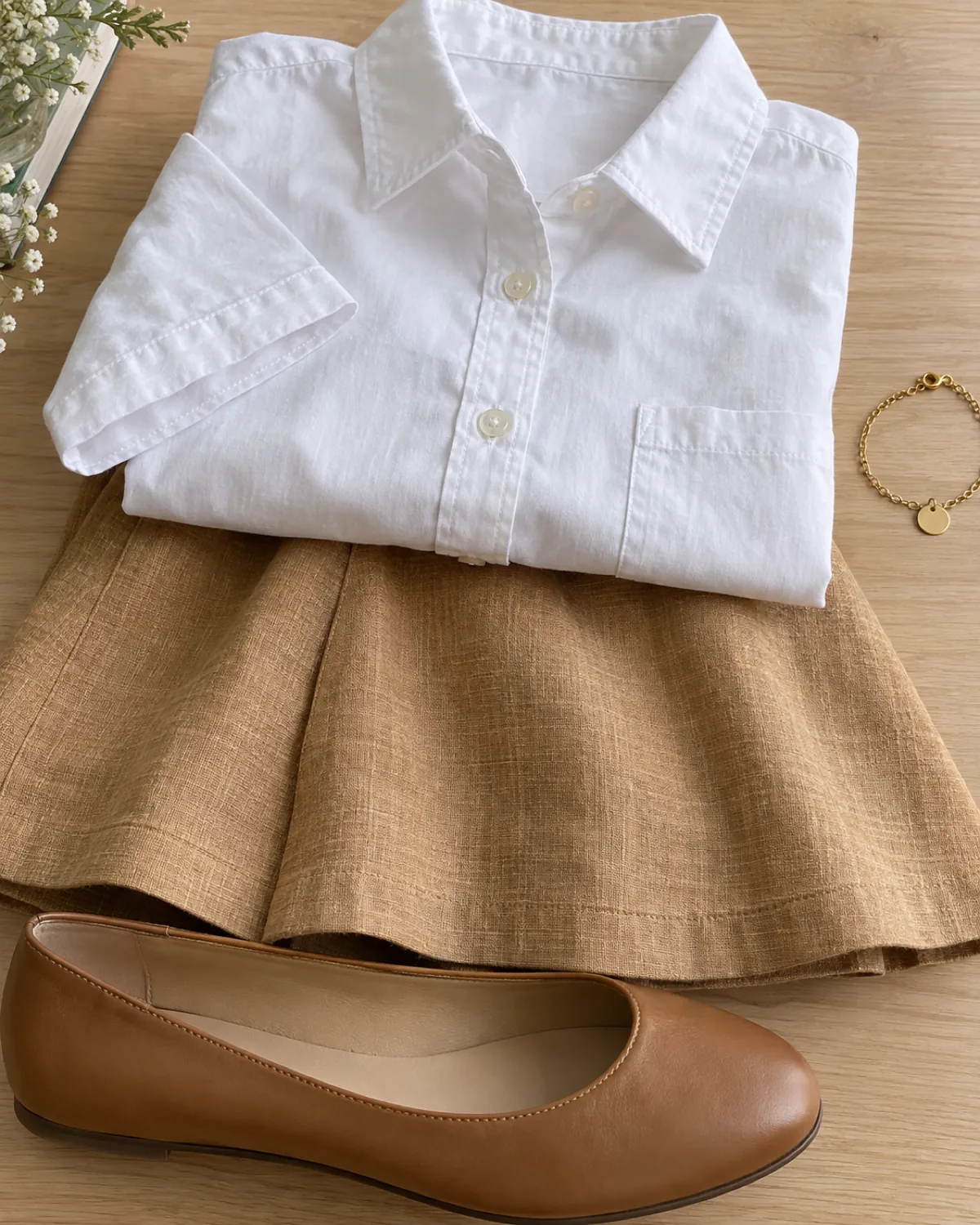
The A-line midi in a light fabric does not wrinkle against a desk chair. The short-sleeve button-down handles temperature swings between outdoor duties and air-conditioned classrooms. Tuck it in so the waistband is visible. An untucked button-down with a midi skirt reads oversized rather than polished.
- Cotton or cotton-linen blend A-line skirts wrinkle less than pure linen
- The button-down collar provides formality that a crew neck or V-neck does not
- Camel and white is a summer palette that reads warm without reading loud
- Ballet flats keep the bottom half light and comfortable for standing all day
17. Tencel Trousers With a Tissue-Weight Knit Tee and a Cotton Vest
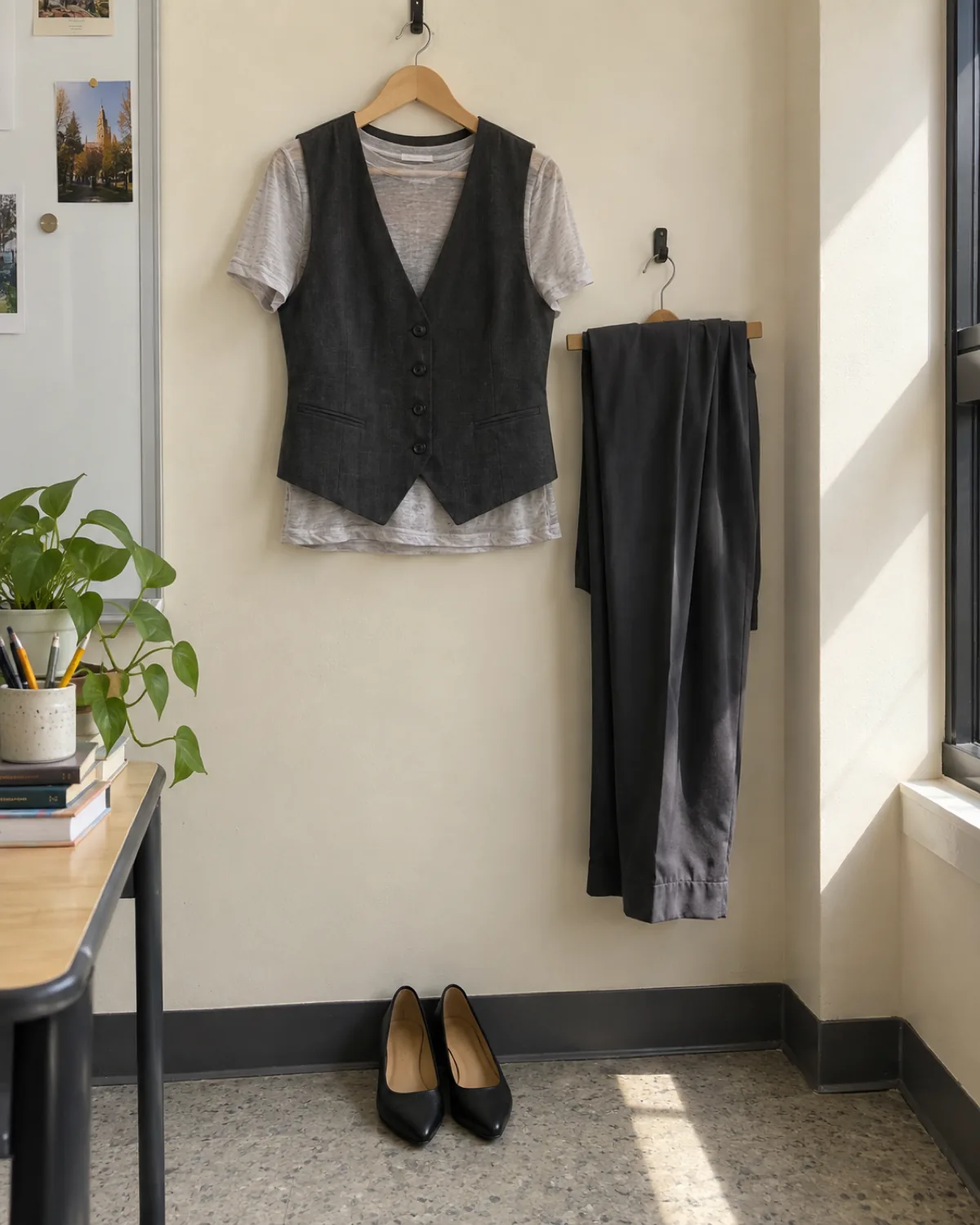
Tencel drapes like silk but breathes like cotton and wrinkles less than linen. A tissue-weight knit tee handles the heat. The cotton vest adds the third layer that signals outfit rather than underwear. This is for teachers who run hot and want the least fabric possible while still reading as professionally dressed.
- Tencel (lyocell) has a slight sheen that reads slightly more polished than matte cotton
- The vest is the structure of this outfit so do not skip it
- Charcoal and grey is a neutral palette that works in every school setting
- The vest comes off in the parking lot and goes back on at the classroom door, just like idea 8
Teacher dress codes vary widely. The Georgia policies list shorts, jeans and athletic shoes as inappropriate, while Education Week reports that the Minnetonka district in Minnesota has no teacher dress code at all. Your own handbook is the answer that counts.
If your school runs a year-round teacher dress code rather than a summer-specific one, several of these combinations still clear it. The fabric swaps and layering logic here also apply to summer business-casual outfits outside of teaching.
Where the dress-code definitions come from
- Professional Appearance for Educators (KEYS to Teaching Success guide) — Georgia Southern University Libraries (KEYS to Teaching Success guide)
- The Evolution of Teacher Dress Codes: Adapting to Online Learning — Indeed for Employers
- What Does It Mean for Teachers to Dress ‘Professionally’? — Education Week
Keep this one
Save it where you plan outfits
Pin the image above to the board you actually check on a Sunday night. This guide is written to be re-read, not read once.
Tonight, before you close this tab
- Check your school written dress code for the words sleeveless, shorts and open-toe because those three define your summer ceiling
- Try on last summer classroom outfit and sit in a desk chair for ten minutes to see if the skirt rides or the shirt pulls free
- Set out a desk layer like a blazer or cardigan that lives at school so you never commute in it
- Iron or steam one week of cotton and linen tops on Sunday because wrinkled linen in a school reads as slept-in