18 Interview Outfits for Plus Size Women That Read as Deliberate, Not Default
Eighteen plus size interview outfits sorted by dress code and industry. Each names the silhouette decision that changes above a size 16.
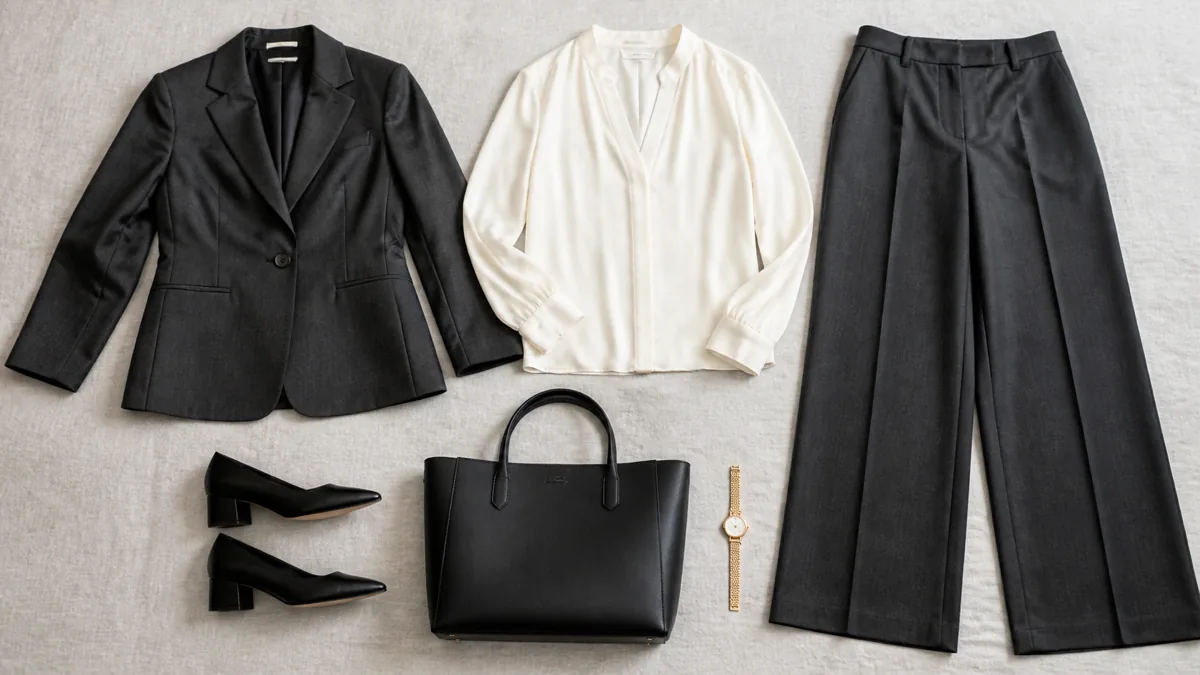
Working out an outfit for tomorrow? Save this page. It is easier to skim the night before than to remember.
At a glance
Works
- A single-button blazer with princess seams that follow your waist over wide-leg trousers, the sharpest plus-size baseline for any corporate interview
- A matched navy trouser suit with a straight-leg and full-length break, reads authoritative in government, law, and finance
- A collarless blazer over a fitted sheath dress, the lapel-free front lies smoother across a fuller bust than a notched-collar jacket
Depends
- Dark straight-leg jeans with a blazer, only if you have confirmed the company is genuinely smart casual and seniors wear jeans to meetings
- A linen-blend blazer with chinos, reads right for a warm-weather startup but too relaxed for a bank or law firm
- A paper-bag waist trouser, polished in marketing and media but may read too trend-forward for government or healthcare
Skip
- Visible leggings styled as trousers, which Texas A&M's business-casual guide rules out in so many words
- A mini or above-knee hemline for a first interview, published guides consistently recommend at or below the knee
- An outfit you have never sat down in, because what looks right standing may ride, gap, or bunch the moment you take a chair
Most interview advice for plus-size women recycles straight-size looks or defaults to dark shapeless layers. Neither accounts for what changes above size 16: where a blazer pulls, how a waistband sits when seated, which silhouette reads deliberate.
These eighteen outfits start from those realities. Each one names a dress-code tier, an industry context, and the specific fit decision that makes it work on a fuller bust, hip, or thigh.
If your company has a written dress code, it outranks anything here. Otherwise, follow Duke's career centre: find the everyday level of dress, then dress "up one level" for the interview.
1. Structured Blazer and Wide-Leg Trouser for a Corporate Interview
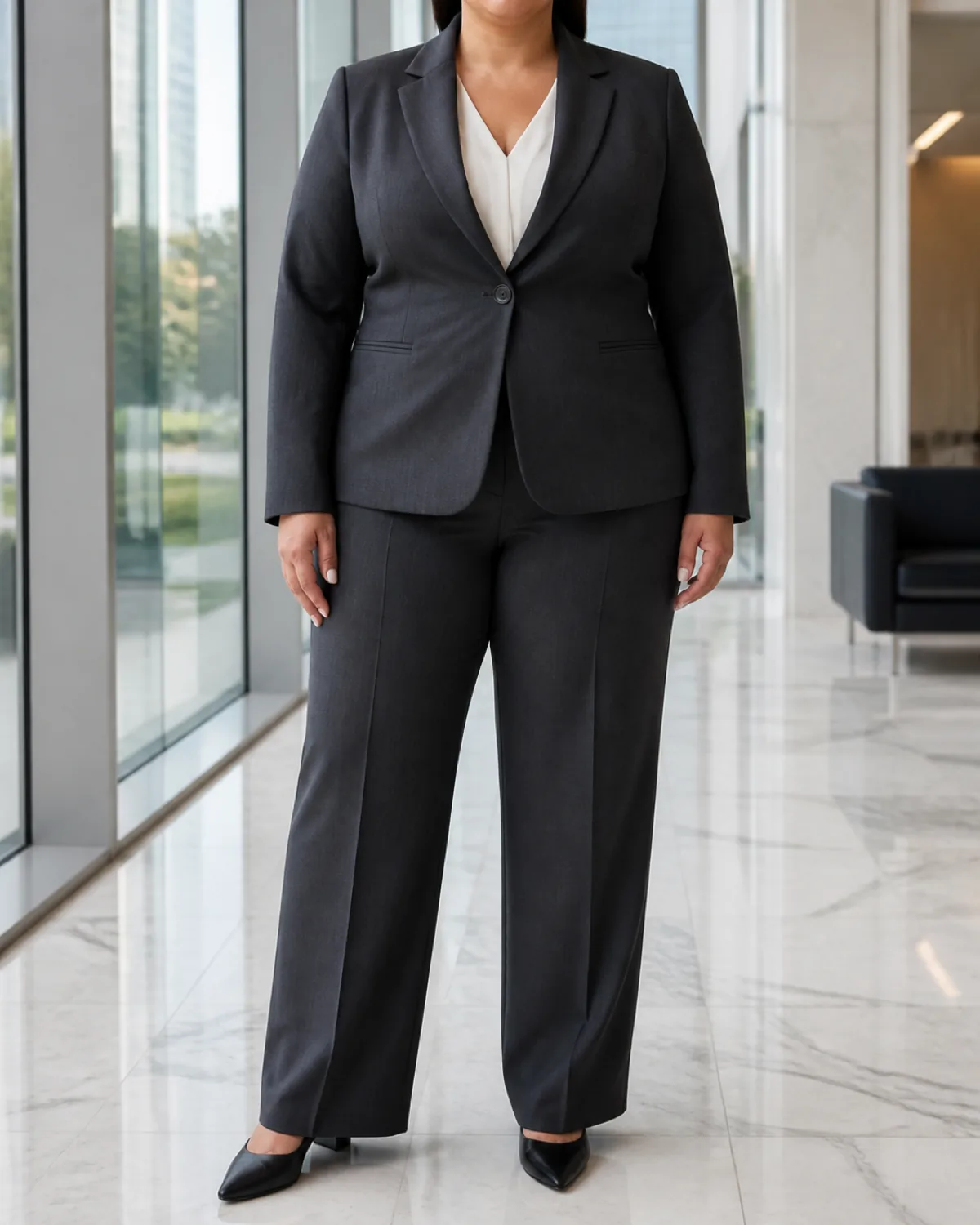
The single button matters more than any other detail on this blazer. A two- or three-button front pulls across the bust when one button closes at the wrong height. A single button at the natural waist closes where the body narrows, and princess seams follow the torso curve instead of hanging straight from the shoulder.
The wide-leg trouser balances the hip with a wider hem. Matching the fabric family reads as a near-suit without requiring a literal match. For law, finance or government, where Duke's guide lists suits as the norm, buy the trousers that match the jacket.
- Choose a single-button blazer with princess seams and try it buttoned while seated before buying
- Pair with wide-leg trousers in the same colour family so the combination reads as a coordinated set
- Keep the blouse simple and tucked so the blazer silhouette stays clean
- Stick to a closed-toe pump or a pointed-toe flat in black or a dark neutral
- Dress code tier: business professional
2. Wrap Dress with a Tailored Jacket for Finance or Consulting
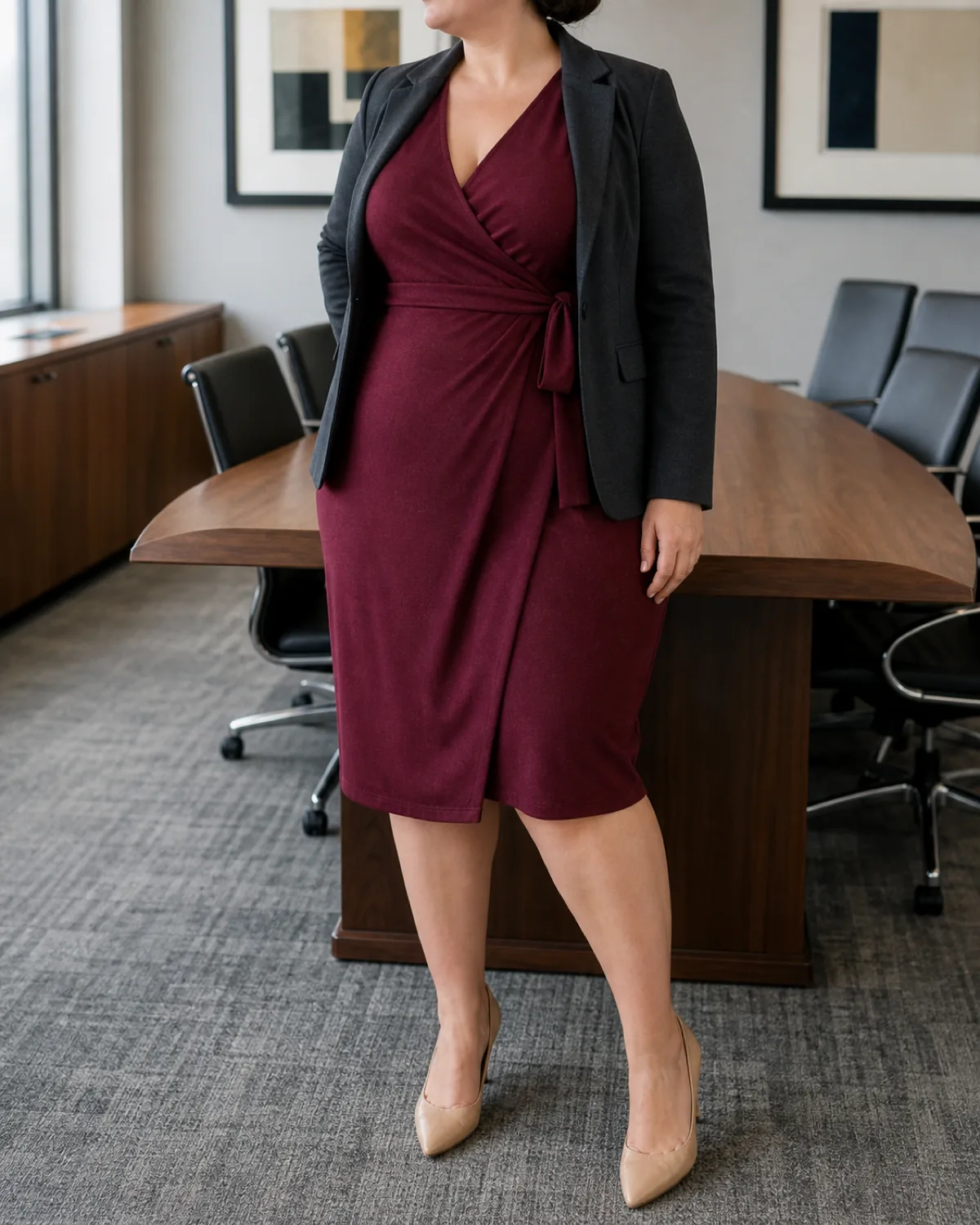
A true wrap creates a defined waist without relying on a belt, a tuck, or an elastic panel. The crossover front adjusts to the bust instead of gapping, and the tie sits at the side, keeping the jacket front clean.
The jacket is what pushes this toward business professional. Indeed's interview guide lists "A tailored dress with a matching jacket" for formal workplaces, so the closer the jacket matches, the safer it is. Without it, the same dress reads business casual at most offices.
- Look for a true wrap with a tie closure rather than a faux wrap that pulls over the head
- Layer a structured blazer on top to push the formality into business professional territory
- The dress should fall at or just below the knee when you are standing
- Nude or neutral pumps elongate the leg line under the dress hem
- Dress code tier: business professional
3. Midi Pencil Skirt and Tucked Blouse for a Law Firm
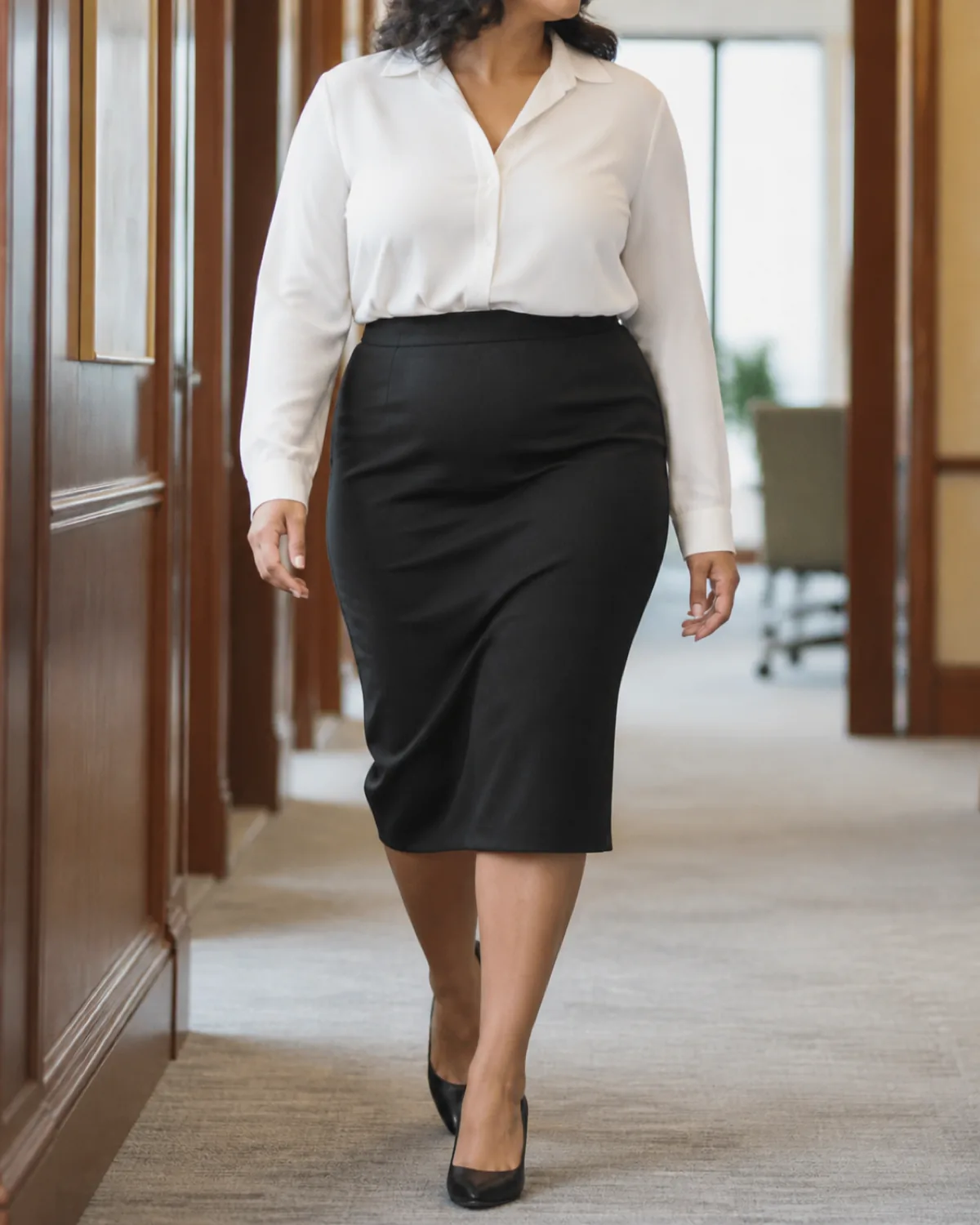
A pencil skirt for a law-firm interview works when two conditions are met: the hem falls below the knee, and the back has a vent rather than a slit. A vent lies flatter at larger hip circumferences than a slit, which can spread open when you walk.
The waistband should sit at the natural waist, not the hip, so the skirt stays put when you sit. A tucked silk blouse keeps the torso line simple.
Berkeley Law's interview guide says law employers expect business formal even at firms known for a casual culture, so for the interview itself, add the skirt's matching jacket.
- Choose a pencil skirt with a back vent rather than a back slit for a flatter lay at the hip
- The waistband should sit at the natural waist so the skirt stays in place when seated
- Tuck the blouse fully and check the tuck stays clean when you raise your arms
- Closed-toe pumps with a moderate heel complete the business professional look
- Dress code tier: business professional
4. Blazer Dress with Structured Shoulders for Administrative Roles
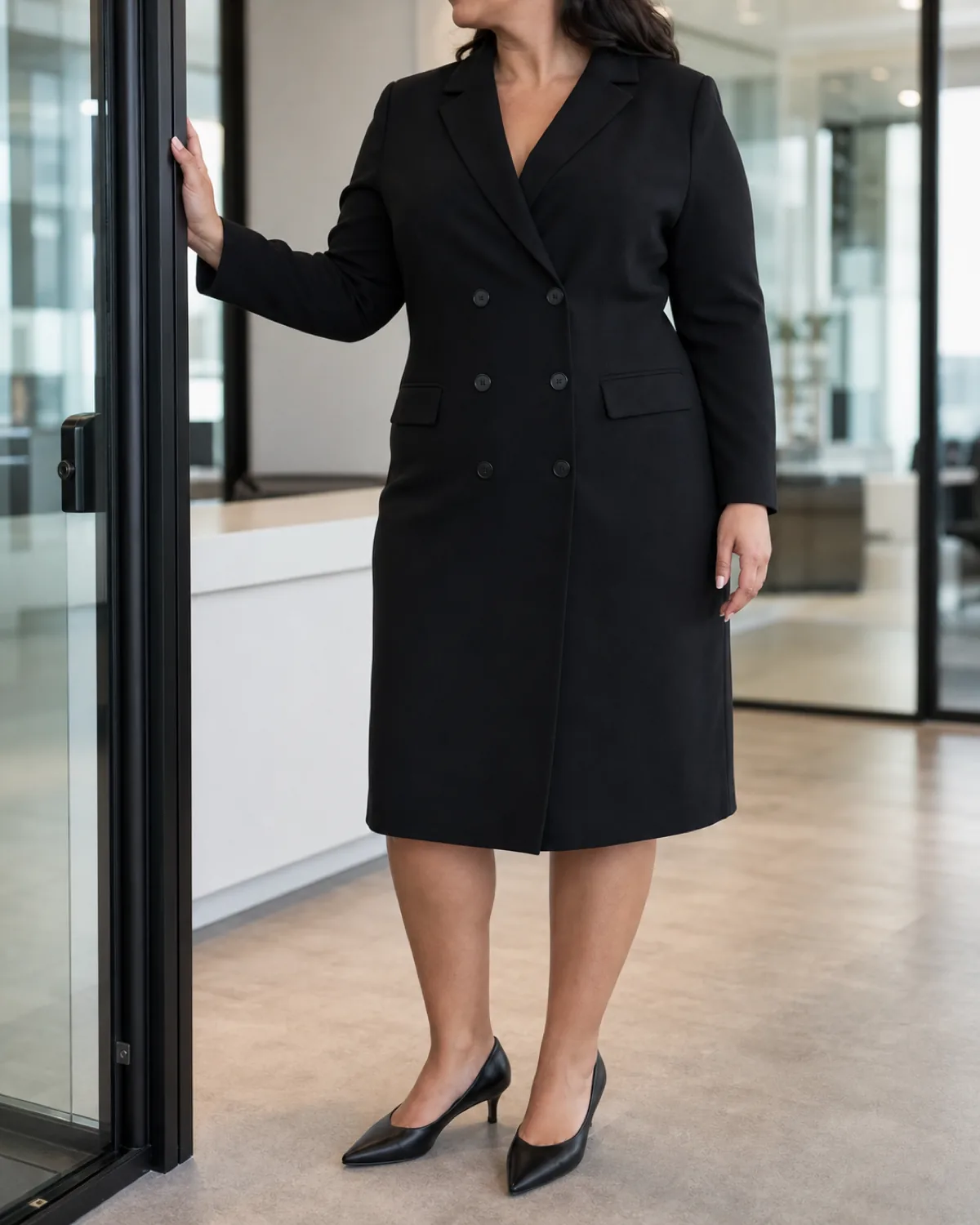
A blazer dress reads as a suit without the trouser, which makes it a strong single-piece option when you do not want to coordinate separates. The double-breasted front bypasses the single-button gap problem because the overlap covers the bust.
Structured shoulders hold the line of the garment even if the body beneath is soft, and the knee-length hem reads professional without being restrictive.
- A double-breasted front gives more coverage and avoids the single-button gapping risk
- Check that the structured shoulders do not extend past your actual shoulder line
- The dress should fall just below the knee and not ride up when you sit
- Pair with kitten heels or low block heels for a clean, grounded silhouette
- Dress code tier: business professional to business casual
5. Column Blazer and Slim Ankle Pant for a Tech Company
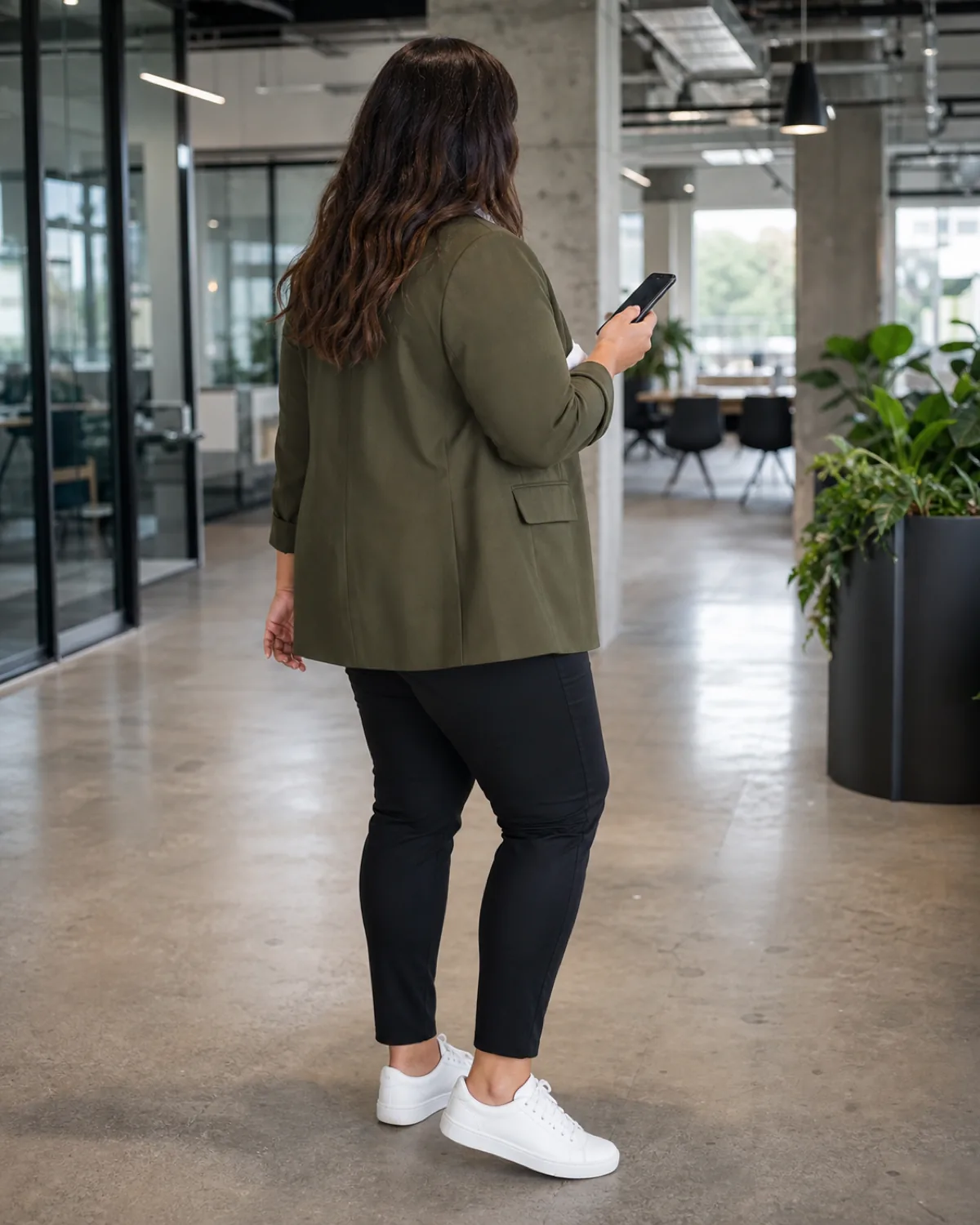
A longer-line blazer that hits mid-hip creates a vertical column instead of cutting at the widest point of the hip. Unstructured shoulders read relaxed enough for a tech office while the blazer still signals intention.
High-rise slim ankle pants stay anchored when you cross your legs or shift in a chair. White sneakers work only if the company genuinely allows them.
- Choose a blazer that hits at mid-hip or lower to create a column silhouette
- High-rise pants stay anchored when you sit and shift
- White leather sneakers read intentional at tech companies but swap to flats if you are unsure about the dress code
- Keep the top layer simple so the longer blazer line does the visual work
- Dress code tier: business casual
Where to start
Find your situation, skip ahead
Your interview is at a corporate office, law firm, or government building
Start with Idea 11, the matched suit these fields expect. Ideas 1 and 3 get there once jacket and bottom match, and all three handle bust and hip fit.
Your interview is at a creative company, startup, or tech firm
Ideas 6, 13, and 17 match smart casual without overdressing. The blazer or jumpsuit signals intention without a suit.
You are not sure about the dress code and want one safe outfit
Idea 4 or 18. A blazer dress or belted shirt dress crosses business casual and business professional without looking over- or under-dressed.
6. Dark Straight-Leg Jean and Blazer for a Creative Agency
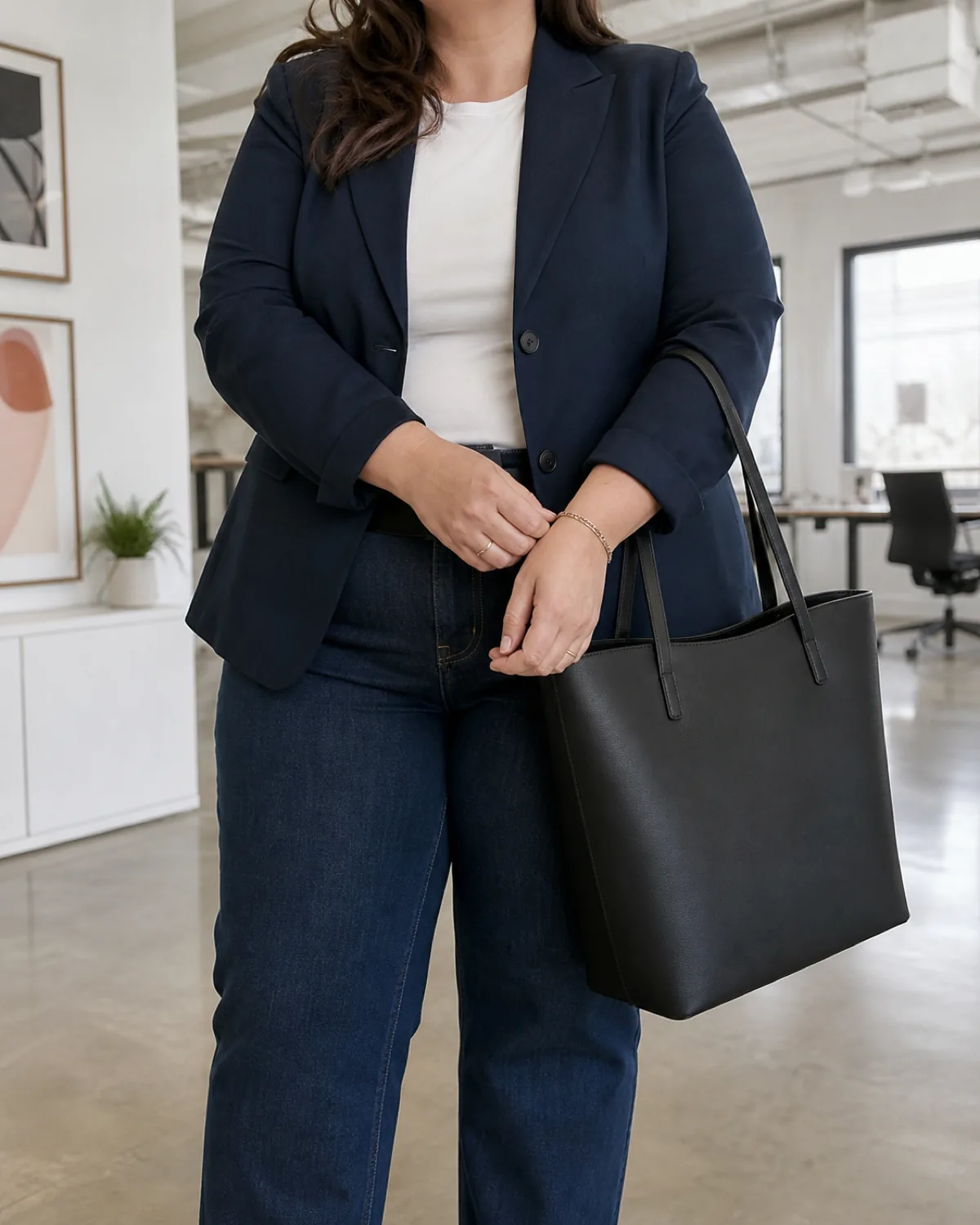
Jeans at an interview are a specific bet. You make it when you have confirmed the agency is genuinely smart casual and seniors wear jeans to client meetings.
Dark indigo with no distressing is the safest denim for an interview. The straight leg balances the hip. The blazer elevates this above weekend wear.
- Dark indigo straight-leg jeans with zero distressing are the safest denim here
- The guides split on jeans: Indeed's interview guide lists "Dark jeans or pants" for casual workplaces, while UMass Dartmouth's says "Jeans are almost always inappropriate"
- The blazer is non-negotiable because it is the piece that makes this an interview outfit
- A pointed-toe flat or a low block heel keeps the shoe line clean
- Only choose this outfit if you have confirmed the company genuinely wears jeans day-to-day
- Dress code tier: smart casual
7. Knit Sheath and Structured Tote for a Non-Profit
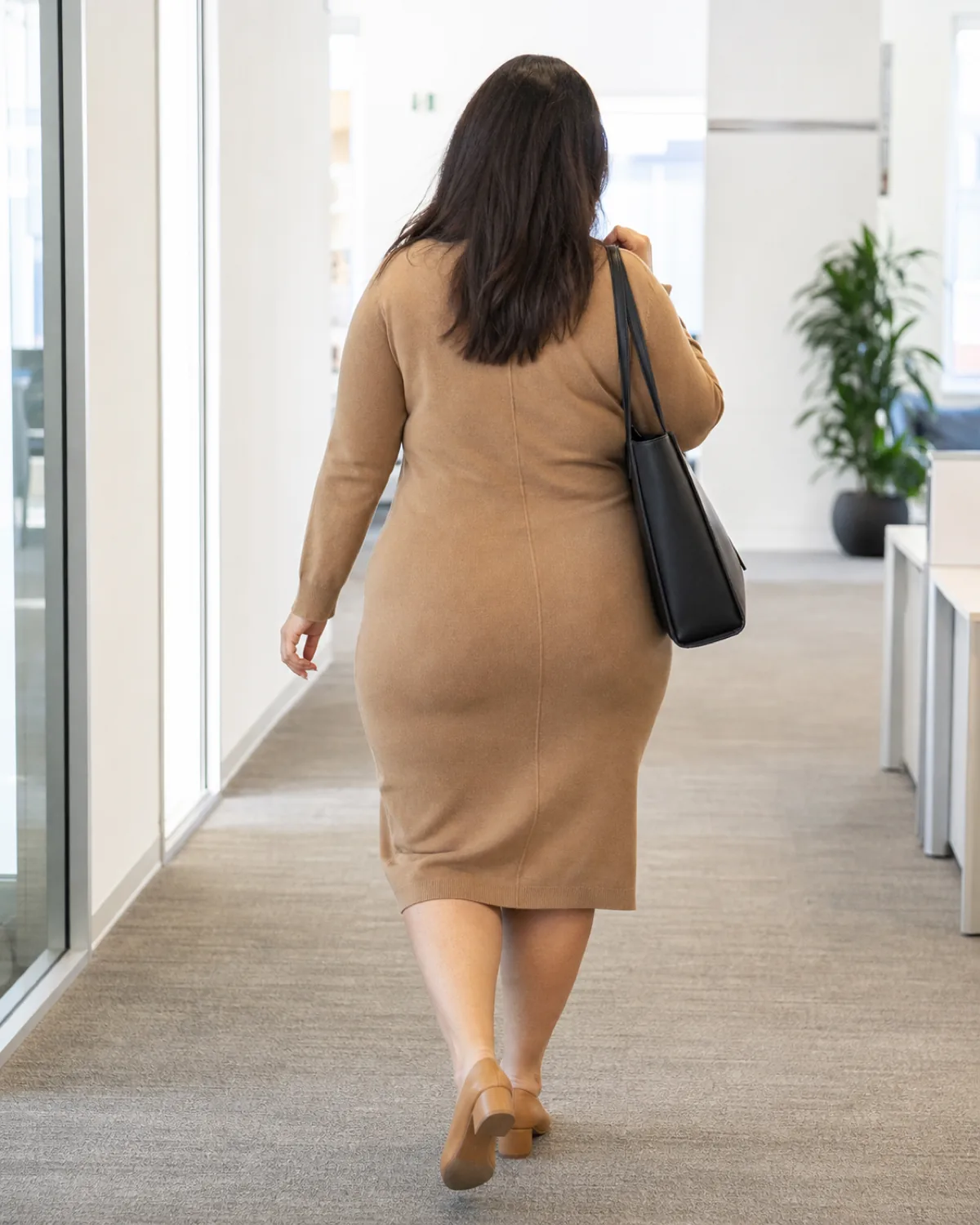
A mid-weight knit sheath that skims rather than clings is one of the most forgiving single-piece interview options. The knit moves with the body through a multi-hour panel interview without wrinkling.
The weight matters: too thin and it clings to every line; too thick and it adds visual bulk. A structured tote replaces the need for a separate bag and folder.
- The knit should be mid-weight, thick enough to hold its shape but not so thick it adds bulk
- Skimming means the fabric follows the body line without pulling tight at the hip or bust
- A structured tote in black or dark brown replaces a separate portfolio case
- The hem should fall just below the knee, inside the at-or-below-the-knee line career-centre guides set
- Dress code tier: business casual
8. High-Rise Wide-Leg Trouser and Fitted Turtleneck for Publishing
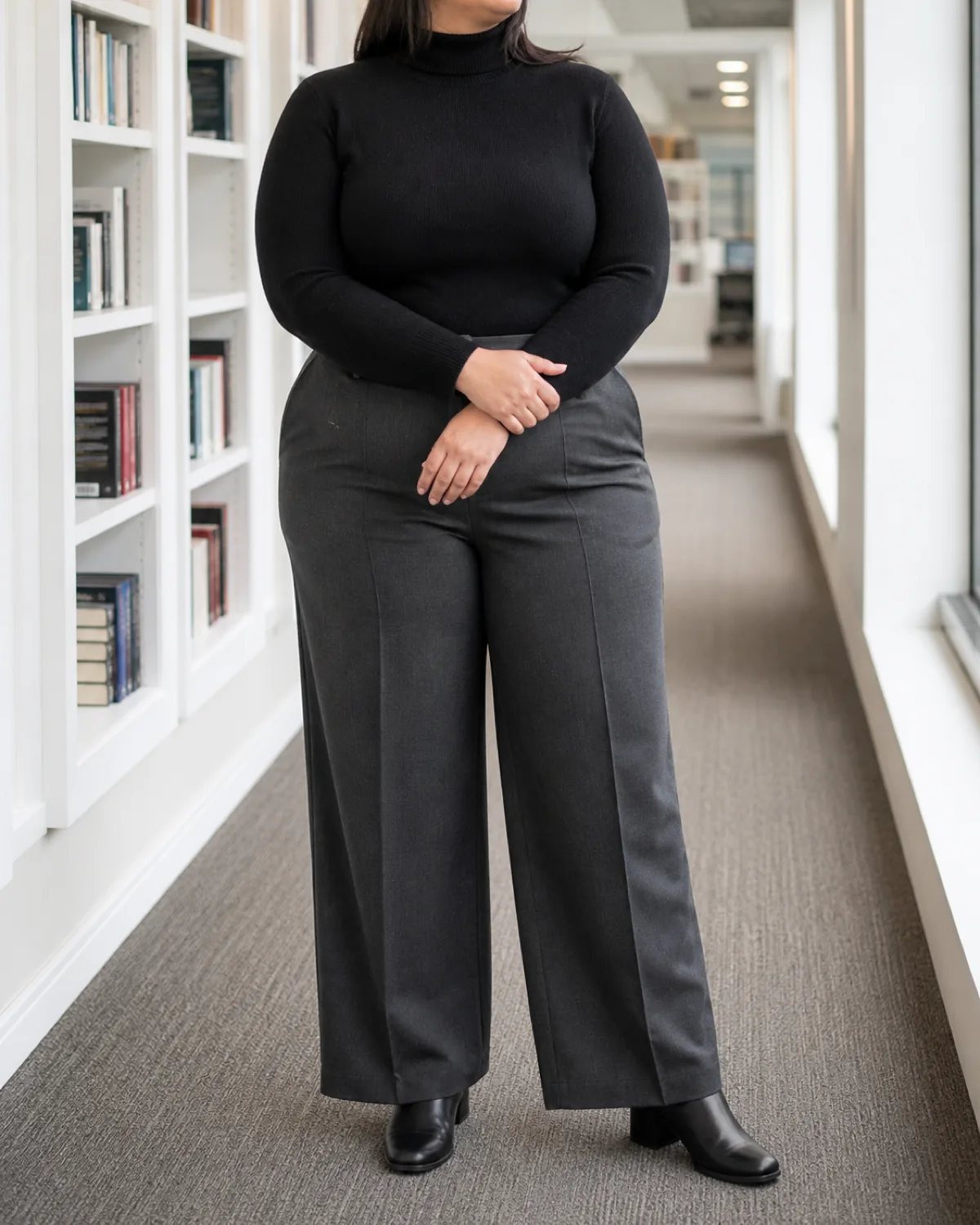
High-rise trousers with a front crease read deliberate rather than casual. The crease creates a vertical line down each leg, which counteracts the width of the wide-leg cut. A fitted fine-knit turtleneck tucked in shows the high waistband, which is the visual anchor of this outfit. Without the tuck, the trouser waist disappears and the outfit loses its structure.
- The front crease on the trouser is what makes the wide leg read polished rather than relaxed
- Tuck the turtleneck in fully to show the high waistband
- The turtleneck should be fine-knit, not chunky, so it tucks cleanly without bulk
- Ankle boots with a low block heel finish the trouser line without competing
- Dress code tier: smart casual to business casual
9. A-Line Midi Skirt and Structured Top for Education
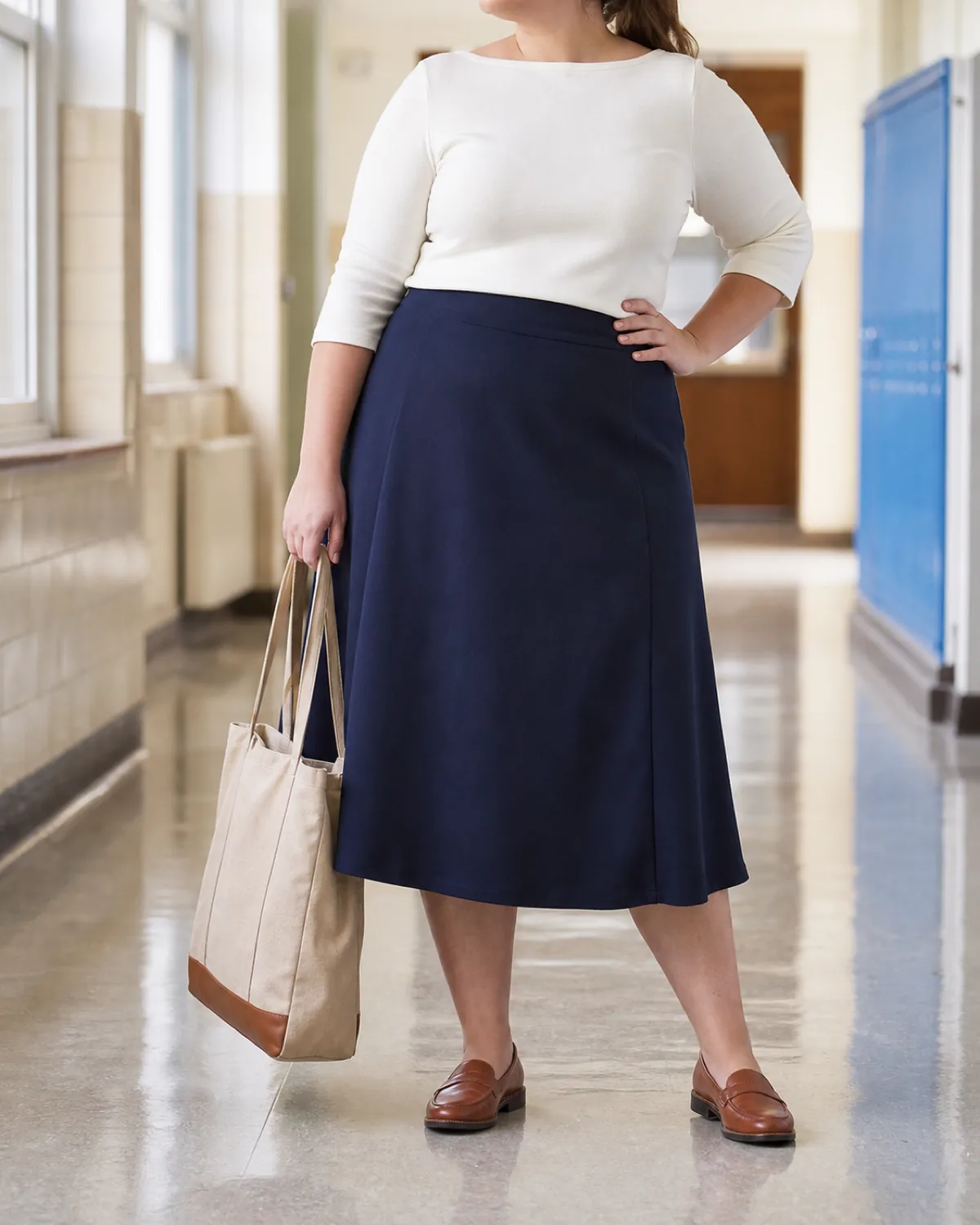
An A-line provides thigh clearance that a pencil skirt does not. For an education interview that may involve a campus tour, walking between buildings, and sitting in low student chairs, the A-line moves naturally without riding.
A structured knit top with a boat neckline keeps the shoulder line clean without a collar, and the combination reads business casual without looking corporate.
- An A-line midi gives thigh clearance for walking, sitting, and touring a campus
- A boat-neck knit top keeps the shoulder line clean without requiring a collar
- Brown leather loafers or low block heels work for walking-heavy interview formats
- No pattern on pattern, keep either the skirt or the top in a solid neutral
- Dress code tier: business casual
10. Collarless Blazer and Sheath Dress for Healthcare Administration
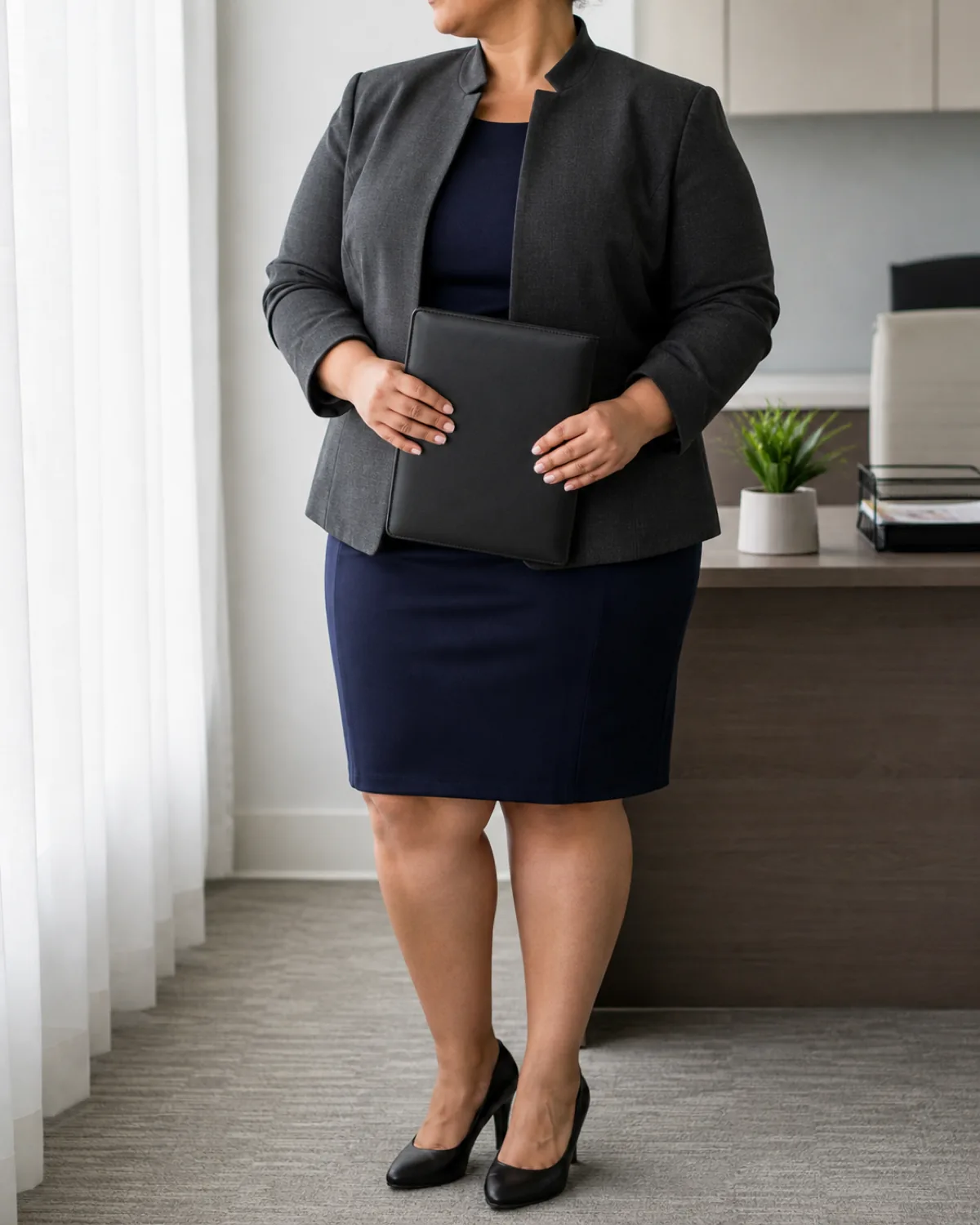
A collarless blazer opens the neckline without competing with a blouse collar. The lapel-free front lies smoother across a fuller bust than a notched-collar jacket because no fold of fabric adds width at the chest.
Over a fitted sheath dress, this blazer adds formality and structure without the bulk of a traditional suit jacket.
- A collarless front lies flatter across a fuller bust than a notched lapel
- The sheath dress underneath should fit through the waist and skim the hip
- The blazer should end at the hip, not above it, so it does not cut at the widest point
- A leather portfolio at waist height is the right accessory for a healthcare administration interview
- Dress code tier: business professional
11. Trouser Suit in Navy for Government or Public Sector
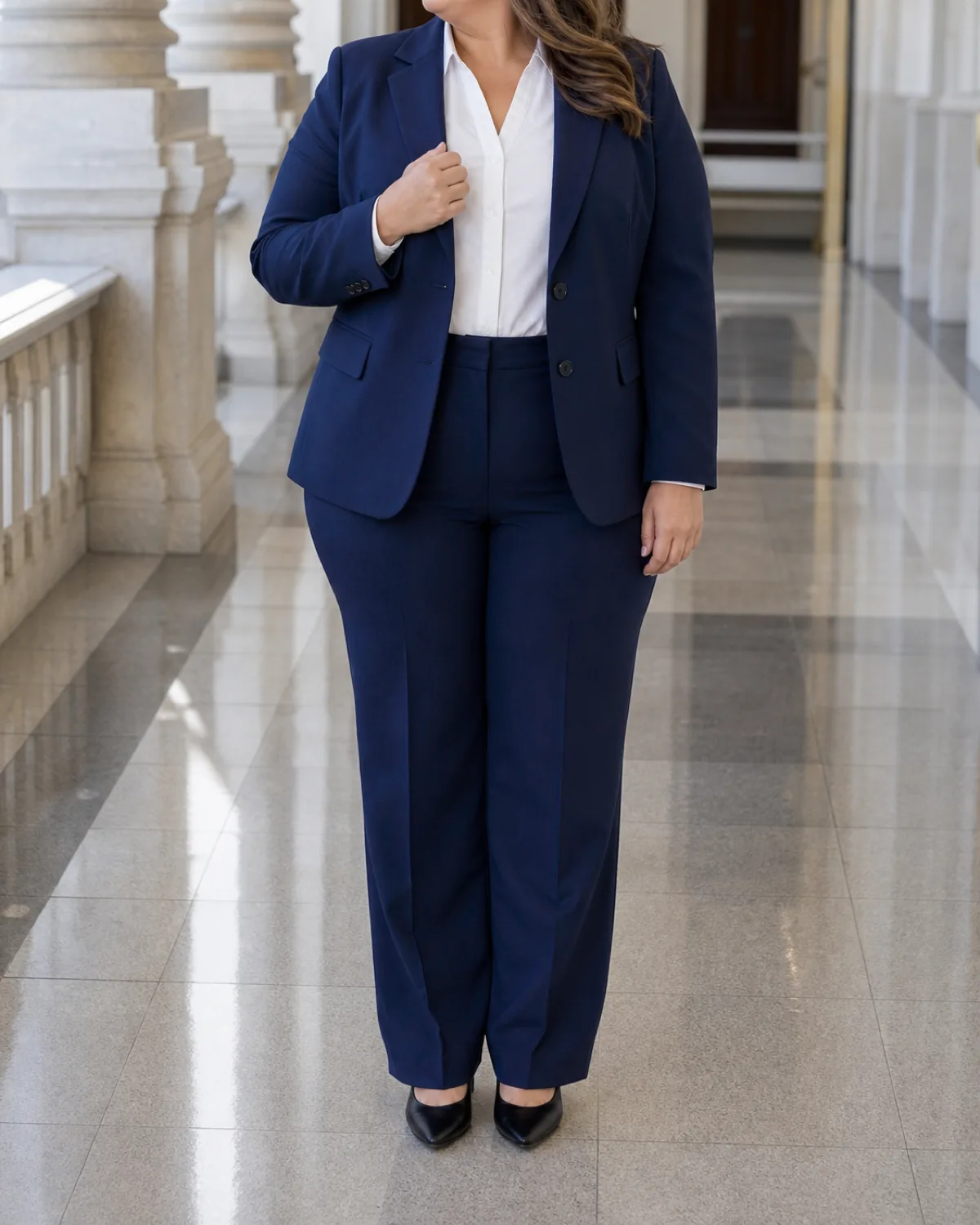
A matched suit is still the default for government and public-sector interviews. Navy reads authoritative without the severity of black, which can look stark under fluorescent lighting.
The straight-leg trouser with a full-length break over a closed-toe pump is the most conservative option. Check that both jacket buttons close without pulling. If they do not, wear only the lower one fastened.
- Navy reads authoritative without the starkness of black under fluorescent lighting
- A straight-leg trouser with a full-length break is the most conservative option
- Test both buttons closed while seated, and if the upper button pulls, fasten only the lower one
- A white button-down shirt is the safest under-layer for a government interview
- Dress code tier: business professional
12. Pleated Midi and Knit Top for Retail Management
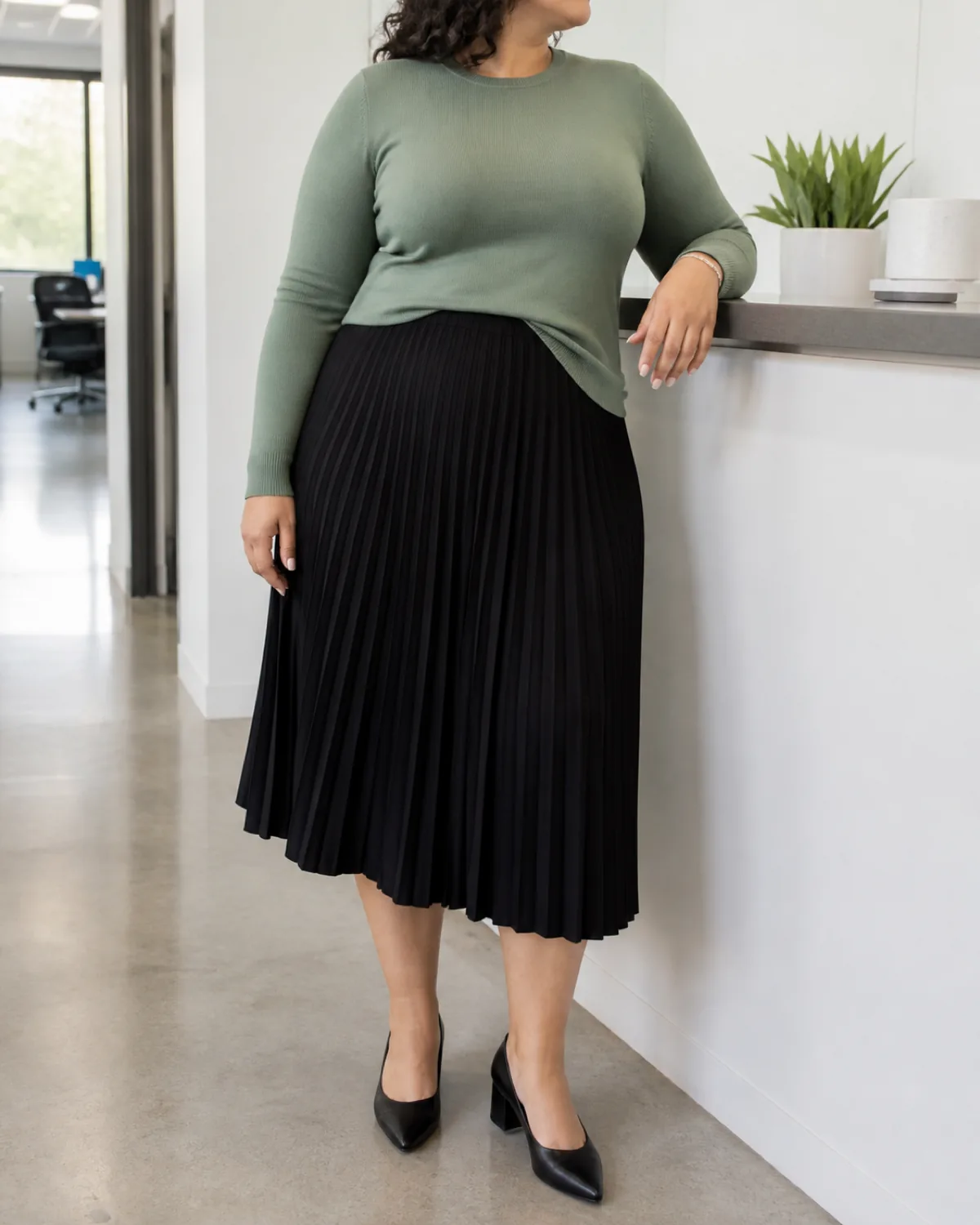
Pleats accommodate hip width by design. A pleated midi skirt distributes fabric evenly around the hip and creates vertical lines that move naturally when you walk. A fine-gauge knit top tucked at the front gives the waist definition without the formality of a button-down.
This combination reads business casual with a touch of polish, which in my experience is the level most retail management interviews expect.
- Pleats distribute fabric evenly around the hip and create natural vertical movement
- A fine-gauge knit top reads polished without the formality of a button-down
- Front-tuck the top to define the waist without a full tuck that might bunch
- The skirt should be dark enough to read professional under bright retail store lighting
- Dress code tier: business casual
13. Relaxed Linen Blazer and Chinos for a Startup
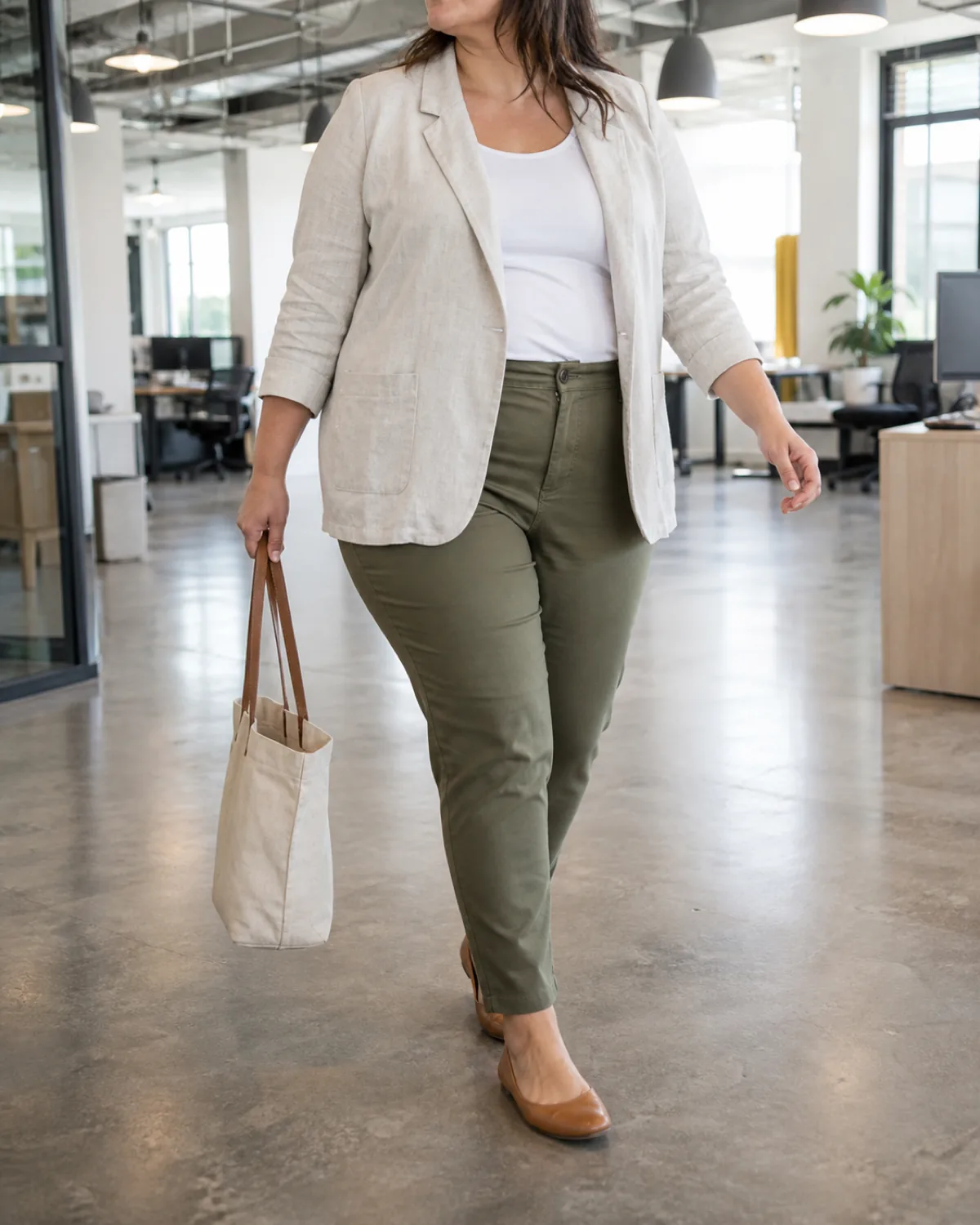
A linen-blend blazer signals that you read the room. In my experience, at a company where the CEO wears a T-shirt, showing up in a navy suit reads as if you do not understand the culture.
A relaxed-fit blazer with a patch pocket, tapered chinos, and clean leather flats is the controlled version of casual. Without the blazer, the chinos and tee read like a day off.
- A relaxed-fit linen-blend blazer with patch pockets reads intentional without being formal
- Tapered chinos with a mid-rise waistband stay in place during a casual interview format
- Clean leather flats keep the shoe line simple without heels
- This outfit only works if the company culture genuinely allows casual dress at senior levels
- Dress code tier: smart casual
14. Fit-and-Flare Dress and Cardigan for a Library or Museum
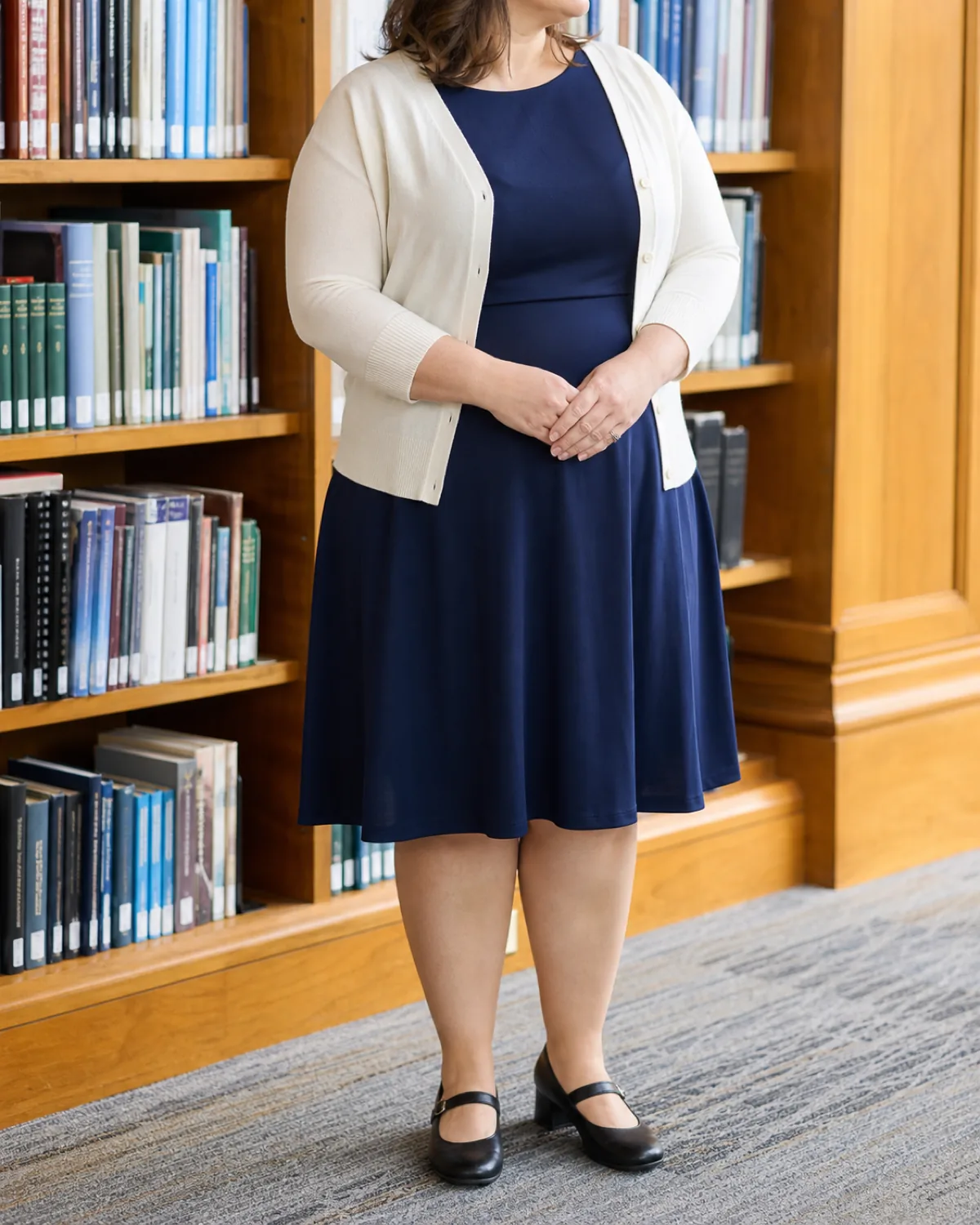
A fit-and-flare dress works for interviews that involve touring. Library and museum interviews can include walking through stacks, sitting in different rooms, and standing for introductions in quick succession.
The flared skirt moves through all positions without riding or restricting. A fine-knit cardigan adds a layer without the weight of a blazer.
- The flared skirt moves comfortably between sitting, standing, and walking
- A fine-knit cardigan adds warmth and a layer without the weight of a blazer
- The dress waist should sit at the natural waist for the most stable fit
- Mary Janes or low block heels are practical for a tour-format interview
- Dress code tier: business casual
15. Paper-Bag Waist Trouser and Silk Blouse for Marketing
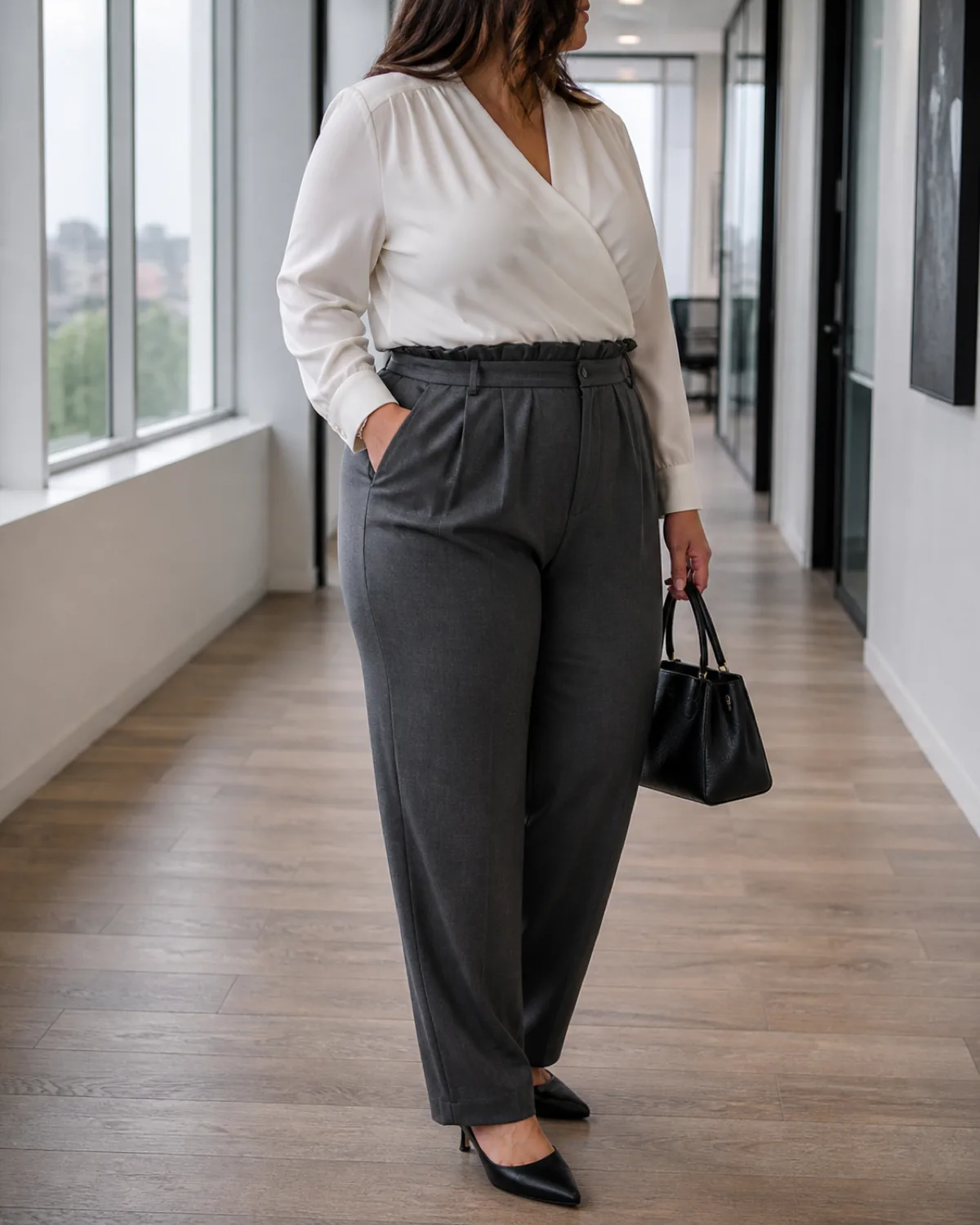
The gathered waist on a paper-bag trouser creates definition without a rigid waistband. For a fuller midsection, the gathered fabric sits more comfortably than a flat waistband that digs.
The blouse tucks in cleanly because the design is built for a tuck. A draped silk V-neck elongates the torso. This combination reads marketing-appropriate: polished, slightly trend-aware, not corporate.
- The gathered waist sits more comfortably on a fuller midsection than a rigid flat waistband
- A draped silk blouse with a V-neck elongates the torso
- Tuck the blouse in fully to show the paper-bag waist detail
- Kitten heels keep the shoe line sharp without competing with the trouser hem
- Dress code tier: business casual
16. Dark Trouser and Printed Blouse for Account Management
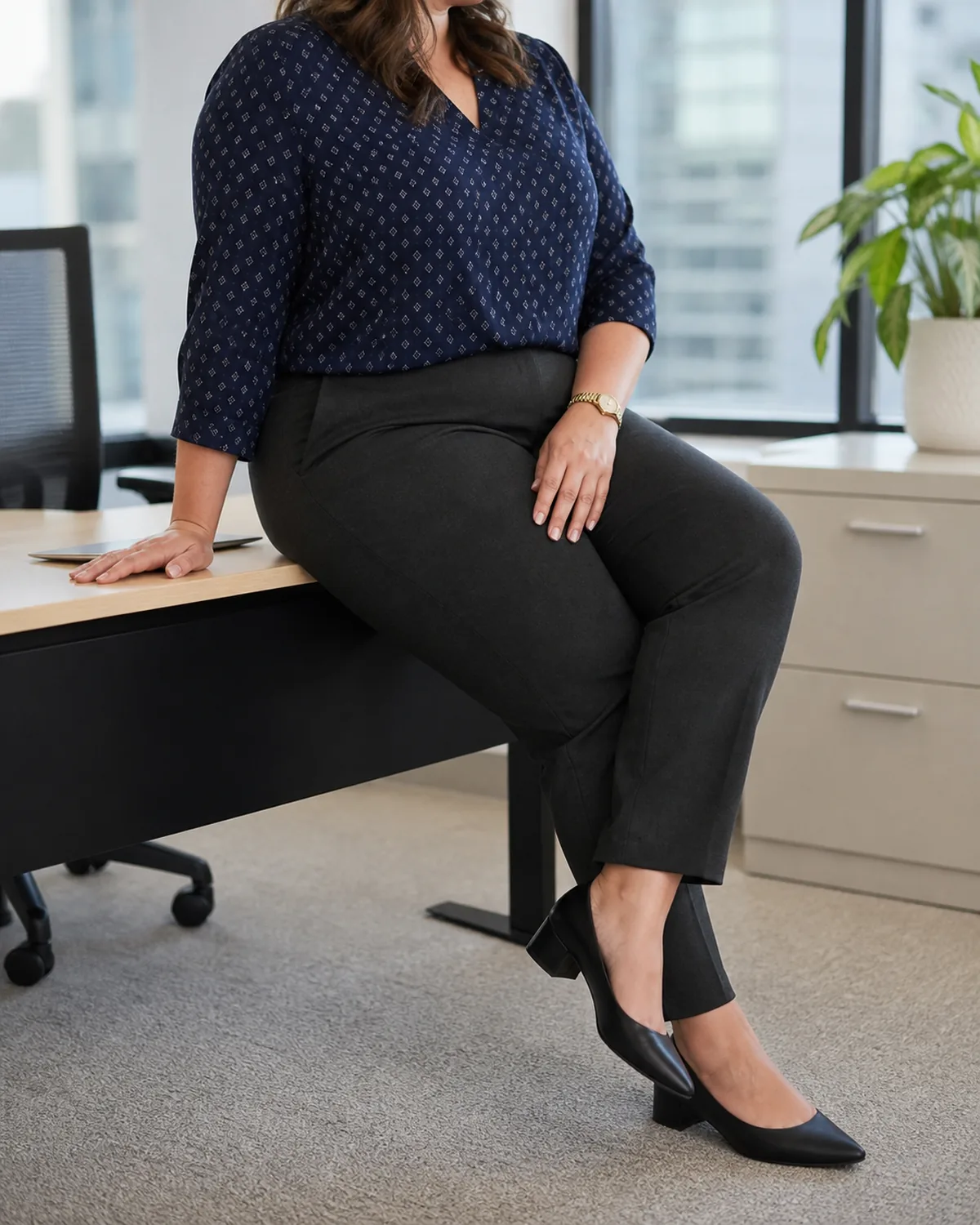
A print blouse does the work of a statement piece without accessories. For an account management interview, a single pattern on the blouse replaces the need for a necklace or scarf. The V-neck elongates the torso.
Dark slim trousers anchor the outfit without drawing attention downward. One piece of simple jewelry, a watch or a single bangle, is enough.
- A print blouse acts as the statement piece so you need no additional accessories
- The V-neckline elongates the torso and opens the chest line
- Dark slim trousers in charcoal or black anchor the outfit with a clean lower half
- One simple piece of jewelry is enough when the blouse carries the visual interest
- Dress code tier: business casual
17. Jumpsuit for Architecture or Design Studio
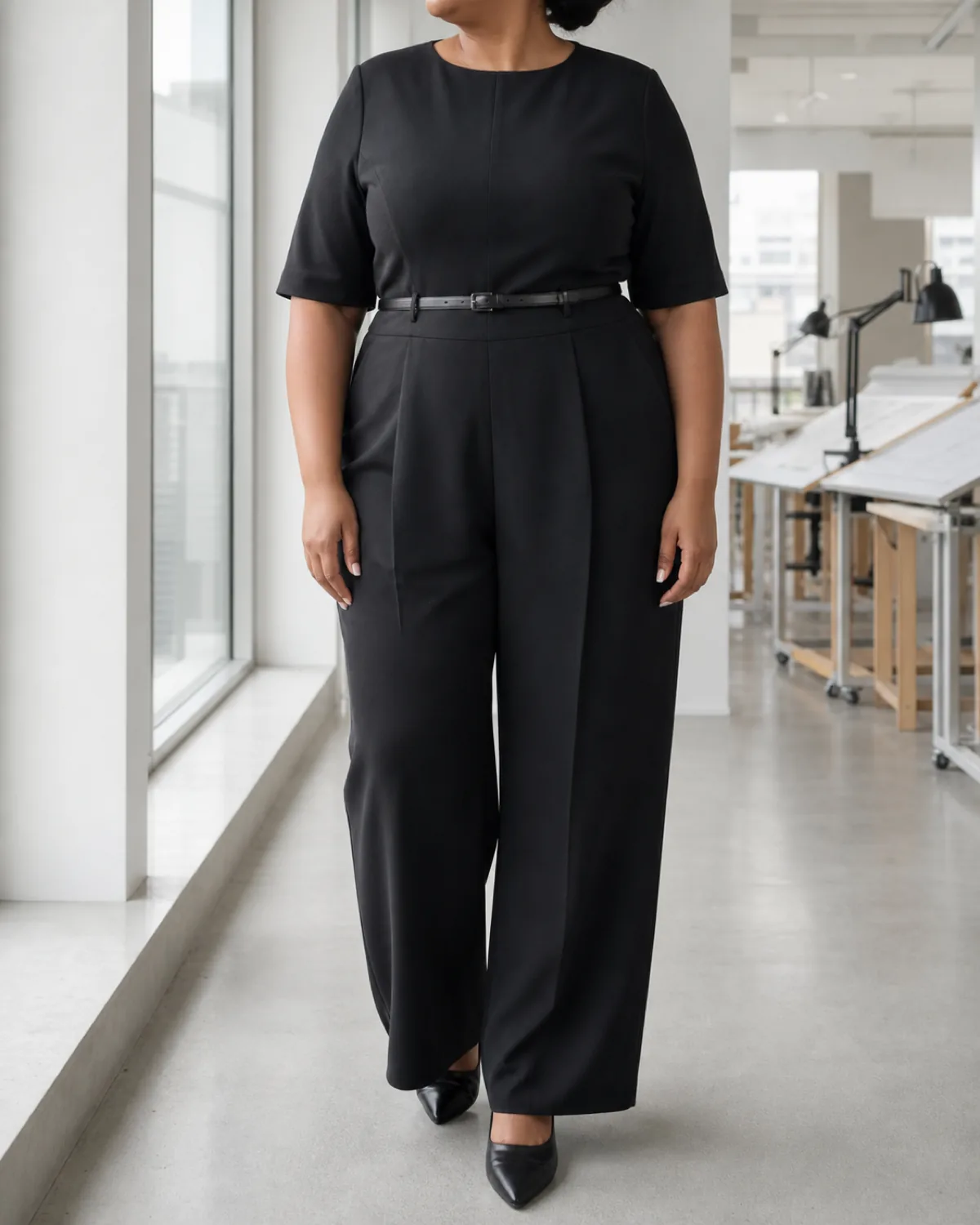
A tailored jumpsuit in black or navy reads as a decision, not a shortcut. The waist seam creates a two-piece illusion and breaks up the single-fabric expanse.
Choose a style with a defined seam rather than a dropped or elastic waist. Wide legs give a trouser silhouette without the coordination work. A thin belt adds definition if the seam alone does not.
- The waist seam is what makes the jumpsuit read as intentional rather than casual
- Wide legs give a trouser silhouette without requiring coordinated separates
- A thin belt at the waist adds definition without competing with the seam
- This works at design studios and architecture firms where the dress code is smart casual
- Dress code tier: smart casual
18. Midi Shirt Dress and Belt for a Second-Round Interview
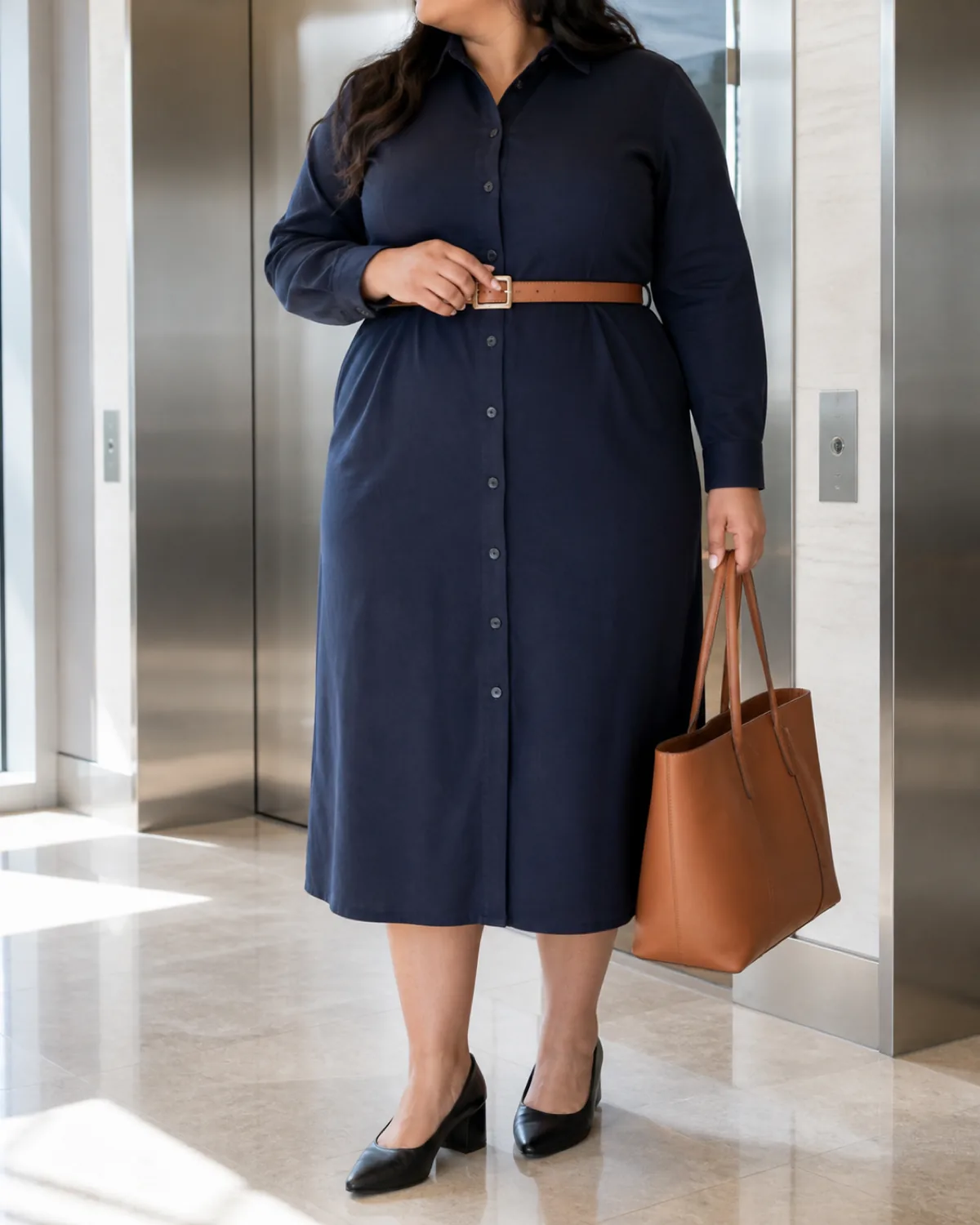
A belted shirt dress is the callback outfit. If you wore separates to the first round, a dress for the second shows you have more than one look without straying from the same formality level.
Button-front dresses in plus sizes need a bust-gap check. If the buttons gap, a hidden snap strip behind the placket fixes it without tailoring. The belt at the natural waist anchors the fabric so it does not tent below the bust.
- A button-front dress needs a bust-gap check before the interview day
- A hidden snap strip behind the placket fixes gapping without visible tailoring
- Belt at the natural waist so the dress does not tent below the bust
- This outfit crosses from business casual into business professional with the right shoes and bag
- Dress code tier: business casual to business professional
The common thread across all eighteen outfits is the same: the garment should follow your body, and you should know how it behaves when you sit down. Test the outfit in a chair the night before. That ten minutes buys more confidence than any amount of shopping.
Where the dress-code definitions come from
- Attire Guide — Career Hub, Duke University
- Interviews: Dress and Presentation Guidelines (PDF, 2023) — Career Development Office, Berkeley Law
- How To Dress for a Job Interview — Indeed Career Guide
- Dress for Success — Career Center, Texas A&M University
- Dress for Success — Pomerantz Career Center, The University of Iowa
- Professional Attire — Career Center, UMass Dartmouth
Keep this one
Save it where you plan outfits
Pin the image above to the board you actually check on a Sunday night. This guide is written to be re-read, not read once.
Tonight, before you close this tab
- Pull every blazer you own and button each one while seated to find which closes without pulling across the bust
- Try on your planned interview outfit and sit in a firm chair for five minutes to check for riding, gapping, or bunching
- Check the hemline of any skirt or dress while seated to confirm it still falls where you intend
- Lay out the full outfit including shoes, bag, and one piece of jewelry the night before so there is no morning substitution