7 Rules for a Work Capsule Wardrobe You Can Actually Repeat
A work capsule wardrobe built on seven rules: neutral bottoms, tonal tops, three layers, two dresses, minimal shoes, quiet accessories, and the repeat test.
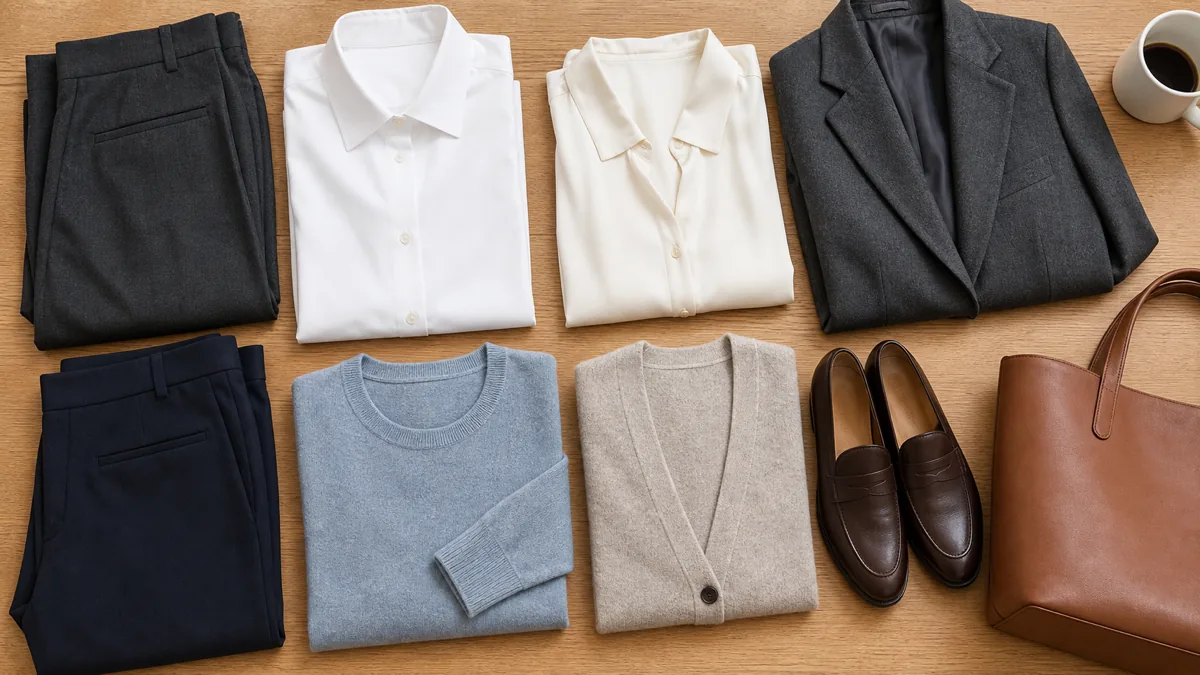
Working out an outfit for tomorrow? Save this page. It is easier to skim the night before than to remember.
At a glance
Works
- Four bottoms in one neutral family paired with six tops in two tonal columns
- A structured blazer for meetings, a cardigan for the desk, a lightweight jacket for the commute
- Two neutral dresses for zero-decision mornings
- A closed-toe flat and a low-heeled pump covering every office scenario
Depends
- Open-toe shoes or sandals — only where you have confirmed the dress code permits them
- A third pair of shoes — justified only if the commute genuinely demands a different shoe
- Bold colour accents — best added outside the capsule once the neutral base is set
Skip
- Statement bags or belts that limit which outfits they match
- Pieces that only work with one other item in the capsule
- Trendy items you would not wear twice in the same week
A capsule wardrobe for work is a small set of pieces that all work together. The goal is not to own less for the sake of it. The goal is to get dressed faster and stop standing in front of the closet wondering what goes with what.
A lot of capsule advice lists thirty-three items without explaining why those thirty-three. These seven rules give you the logic instead of the list.
1. Start with four bottoms that share one neutral family
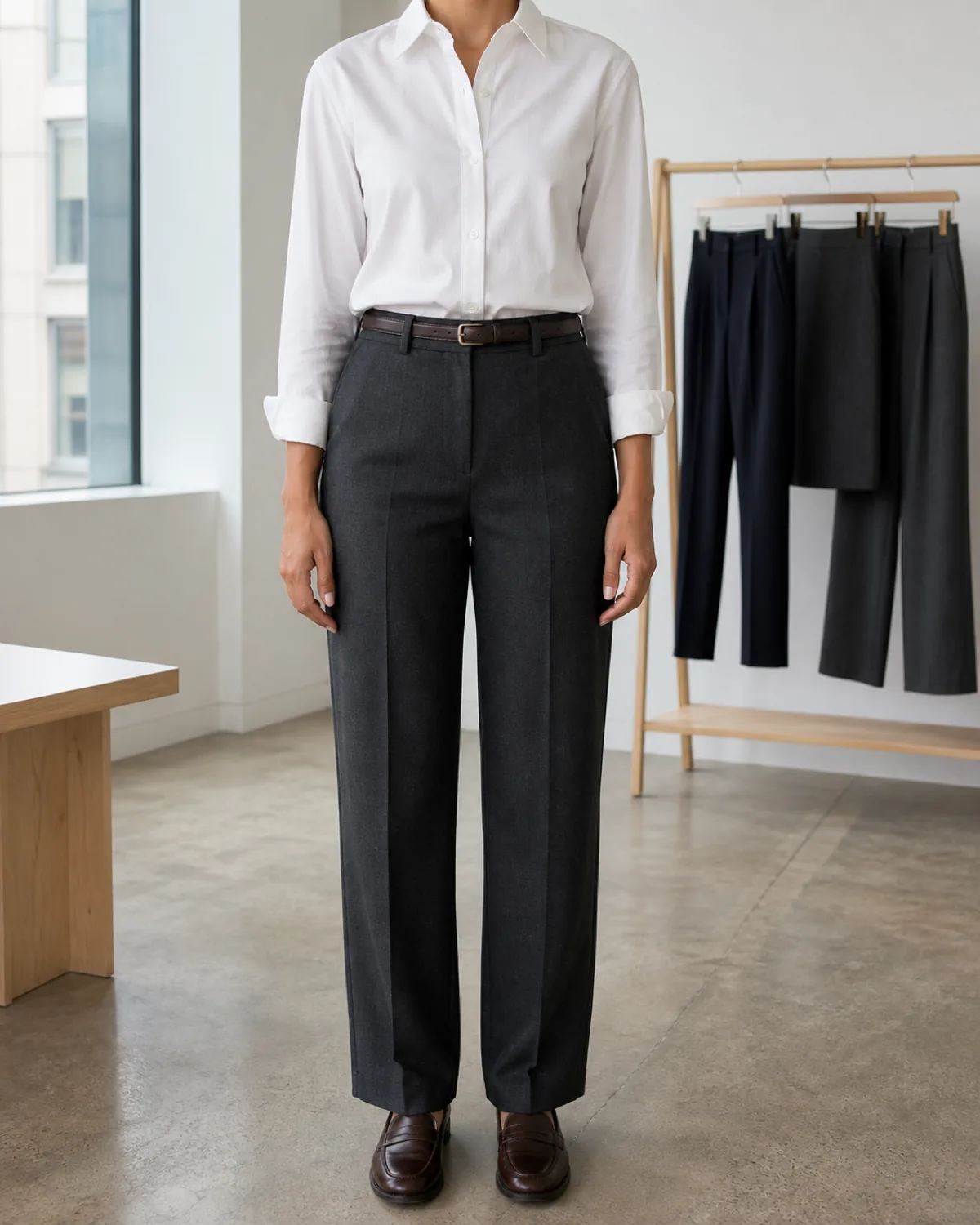
The foundation is bottoms, not tops. When every trouser and skirt in the capsule shares the same neutral base, every top you own matches every bottom. Black, navy, or charcoal. Pick one family and stay there.
Iowa's career centre calls "solid colored pants and skirts in neutral tones" a safe choice for business casual, and notes that neutral pieces can go from professional to business casual. This approach takes that baseline and builds the whole wardrobe on top of it.
Four is enough. Bottoms repeat less visibly than tops.
- Two pairs of straight-leg or slim trousers in slightly different weights
- One pencil skirt or A-line skirt for days you want a different silhouette
- One pair of wide-leg trousers for variety without leaving the colour family
- All four should work with the same belt and the same shoes
2. Add six tops in two tonal columns

Six tops divided into two colour lanes. A warm neutral column (cream, oatmeal, sand) and a cool column (white, pale blue, light grey). Each top works with all four bottoms. That is twenty-four outfit combinations before you add a single layer. In my experience, limiting colour choices to a coordinated set is what makes a capsule wardrobe save time rather than just save space.
The two-column structure keeps outfits from looking random without requiring you to think about colour every morning.
- Three tops in the warm column: a silk or satin blouse, a fine-knit crew-neck, a cotton button-down
- Three tops in the cool column: a crisp white shirt, a pale knit, a simple shell or tee
- Similar necklines within each column so layering stays consistent
- Every top should tuck cleanly into every bottom
Where to start
Find your situation, skip ahead
You are building a work wardrobe from scratch
Start with ideas 1 and 2. Four neutral bottoms and six tonal tops give you twenty-four combinations before you add a single layer.
01 Start with four bottoms that share one neutral family02 Add six tops in two tonal columns
You already have plenty of clothes but getting dressed takes too long
Read idea 7 first, then work backward. The repeat rule tells you what to keep and what to move out of the capsule.
07 The repeat rule: if you would not wear it twice in one week, it does not belong01 Start with four bottoms that share one neutral family
Your office is more formal and you need the capsule to cover meetings
Start with idea 3. A blazer bridges the gap between desk wear and meeting wear. Then read idea 4 for days when you need a one-piece polished look.
03 One blazer, one cardigan, one lightweight jacket04 Two dresses that work as one-piece defaults
3. One blazer, one cardigan, one lightweight jacket

Three layers cover every formality level your office will ask of you. The blazer handles meetings and client days. The cardigan handles the desk and the air conditioning. The lightweight jacket handles the commute and casual Fridays.
Indeed's guide lists "Optional cardigans, blazers or sport coats" among its business-casual ideas, and Illinois's career centre puts cardigans or blazers in the same category. A third lightweight layer gives you something for the days that fall between.
All three should work over every top in the capsule. If a layer only looks right with two of your six tops, it is taking up a slot it has not earned.
- The blazer in the same neutral as the bottoms so it reads as a near-suit when needed
- A fine-gauge cardigan that sits flat under the blazer if you need both layers
- A cotton or blend jacket in a muted tone for days between business casual and smart casual
4. Two dresses that work as one-piece defaults

For the mornings when you cannot make a single decision. A dress is a complete outfit with no pairing to think about. A sheath for the more formal end. A shirtdress for the casual end. Both in neutrals that work with the same shoes and bag as the rest of the capsule.
The dresses also break up the trousers-and-top pattern, which matters if you are repeating outfits in the same week and do not want the repetition to be visible.
- A sheath dress in a neutral that edges toward business professional with the blazer over it
- A shirtdress with a collar for days that need structure without a full suit
- Both at knee length or just below, since Illinois sets business-casual dresses and skirts at or below the knee and Iowa says the same for skirts
- Both should work with the capsule's flat and the capsule's pump
5. Shoes: two pairs, maximum three

A closed-toe flat or loafer for every day. A low-heeled pump for the days that need more formality. That is it. Add a third pair only if your commute genuinely demands a different shoe, not because variety sounds appealing. Indeed's business-casual list names closed-toed shoes such as loafers, pumps or flats, and in my experience two pairs that meet that standard cover every situation.
More than three pairs of work shoes means you are collecting, not capsulating.
- One flat or loafer in a neutral that matches the belt
- One pump with a low heel for presentations, interviews, or client meetings
- A third pair is justified by a practical need like a walking commute or wet weather
- All shoes should work with every bottom and both dresses
6. A bag and a belt that disappear
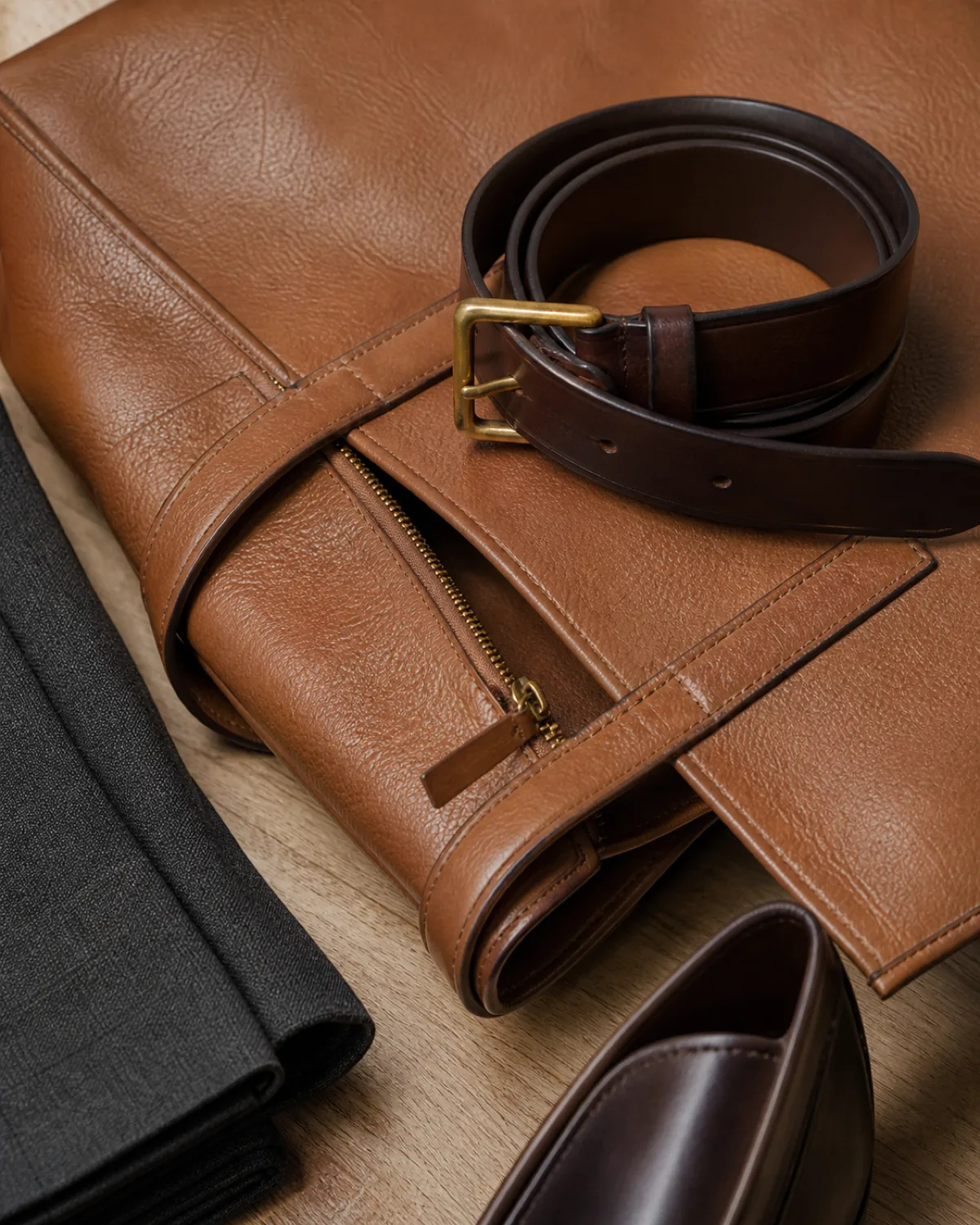
Accessories in the capsule should not call attention to themselves. One structured bag that holds a laptop. One belt. Both in a neutral that matches the shoes. They finish every outfit without creating a new variable.
Statement accessories are fine, but they belong outside the capsule. Inside the capsule, the bag and belt are utilities. They need to work with all twenty-four combinations, and a distinctive piece works with fewer of them.
- A structured tote or satchel in a neutral leather
- A plain belt in the same colour family as the shoes
- No logos, no distinctive hardware, nothing that limits which outfits they pair with
- If you have to think about whether the bag matches, it is the wrong bag for the capsule
7. The repeat rule: if you would not wear it twice in one week, it does not belong

This is the editing principle that holds the capsule together. Before adding anything, count how many of your existing capsule pieces it works with. If the answer is fewer than three, it does not belong. If you would not wear it twice in the same work week, it does not belong.
A capsule is not a minimalist aesthetic. It is a utility filter. Repeating outfits is not a failure. It is the point. The capsule succeeds when getting dressed takes less time than making coffee, and when no one at the office notices that you wore the same trousers on Monday and Thursday.
- Before buying, count the combinations: does it pair with at least three pieces you already own
- If you have not worn it to work in the last two weeks, move it out of the capsule
- Repeating a combination on Monday and Thursday is invisible to everyone but you
- The capsule is done when every piece works with at least three others
Where the dress-code definitions come from
- Dress for Success — Pomerantz Career Center, The University of Iowa
- What Is Business Casual Attire? (With Examples and Tips) — Indeed Career Guide
- Dress for Success — The Career Center, University of Illinois Urbana-Champaign
Keep this one
Save it where you plan outfits
Pin the image above to the board you actually check on a Sunday night. This guide is written to be re-read, not read once.
Tonight, before you close this tab
- Pull out every bottom you wear to work and sort them by colour family
- Count how many tops work with every bottom you kept, and set aside the ones that only match one
- Check whether your office dress code permits open-toe shoes before including sandals
- Try on your two most-worn work outfits and confirm the shoes, bag and belt work with both
- Remove one piece that only works in a single combination and see if you miss it after a week