How to Style a Cardigan for Work So It Reads Polished, Not Cozy
A cardigan reads polished or sloppy depending on the knit weight, the neckline pairing and how you close it. Here is how to get each decision right.
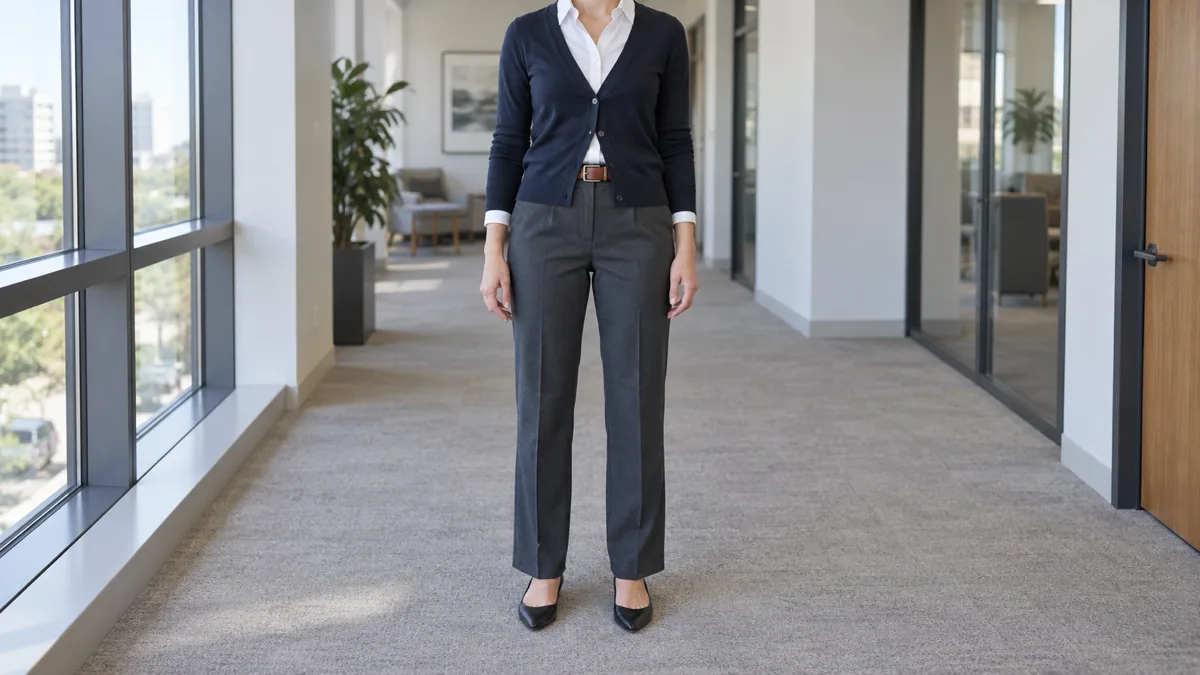
Working out an outfit for tomorrow? Save this page. It is easier to skim the night before than to remember.
At a glance
Works
- A fine-gauge merino or cotton V-neck cardigan buttoned or belted over a collared shirt in a business casual office
- A hip-length cardigan with straight-leg trousers and pointed-toe flats
- A cardigan layered over a tucked blouse with a visible belt at the waist
Depends
- An open cardigan without a belt — reads as intentional in creative offices, too relaxed where people button their blazers
- A crew-neck cardigan over a collarless top — clean but less structured than a V-neck with a collar showing
Skip
- A chunky cable-knit or oversized cardigan in any office with a written dress code
- A pilled, stretched-out cardigan regardless of the setting
- A hooded cardigan or one with novelty prints at any formality level above casual Friday
A cardigan is one of the most useful layering pieces in a work wardrobe. It is also one of the easiest to get wrong.
Indeed lists cardigans as business casual layering, noting they are "optional cardigans, blazers or sport coats (especially for the colder months)." When you choose one, the styling has to justify it.
This guide breaks the decision into parts you can check one at a time.
Why a Cardigan Reads Casual by Default
A cardigan is knit. Knit fabric has no internal structure. It does not hold a shoulder line, it does not press into a crease and it does not maintain a lapel. A blazer does all three of those things by construction. When someone sees a knit layer in a work setting, the first instinct is to read it as off-duty unless something else in the outfit overrides that signal.
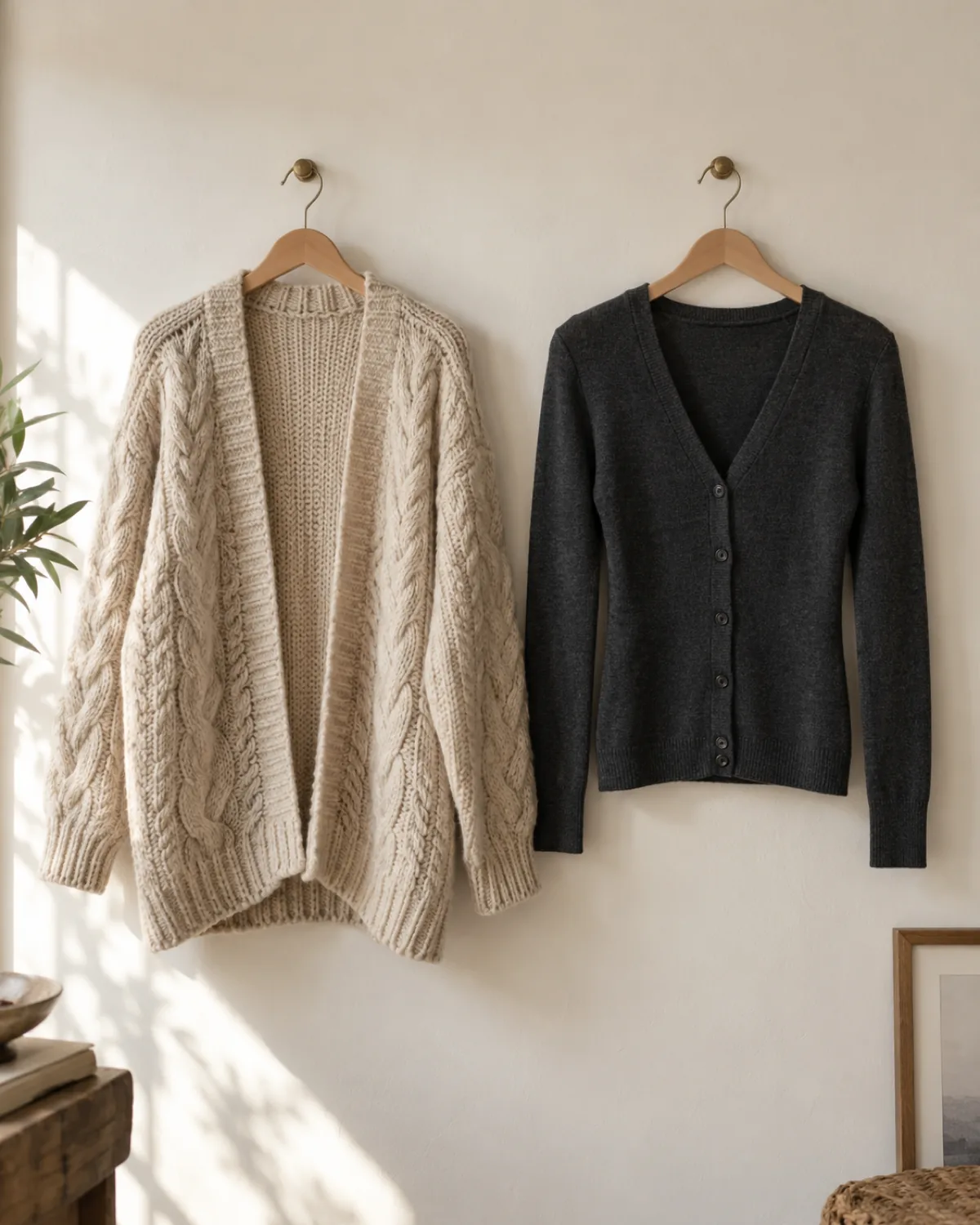
The override is not complicated. It comes from three things: the knit weight, what you wear underneath and how you close it. Get those three right and the cardigan reads as a deliberate choice. Get any one of them wrong and it reads as something you grabbed on the way out.
- A fine-gauge knit with a smooth surface reads closer to a blazer than a sweater.
- A chunky cable-knit with visible texture reads closer to a blanket than a layer.
- The difference between the two is the first thing anyone notices.
Pick the Right Knit Weight and Finish
Knit weight is the single variable that determines whether a cardigan can work in an office. SHRM describes typical business casual as including "pullover sweaters and cardigans," but that description assumes a certain standard of finish. A fine-gauge merino, cotton or cashmere-blend cardigan meets it. A chunky cable-knit or bouclé does not.
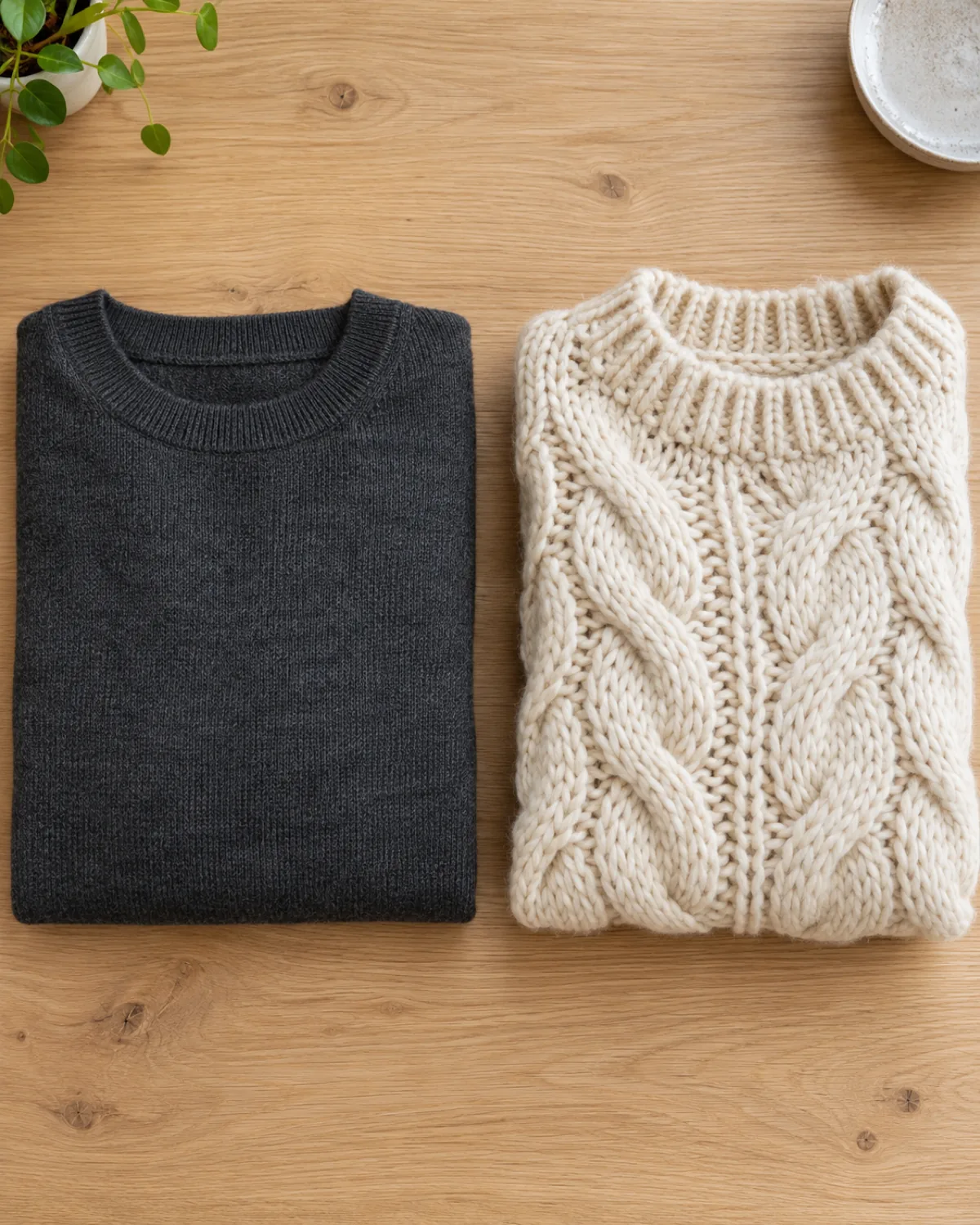
Fine-gauge means the stitches are small enough that the fabric looks nearly smooth from arm's length. The surface catches light evenly instead of creating deep shadows between cables or ribs. This is what makes it readable as an office piece.
- Merino wool is the most versatile: it holds shape, resists pilling and works in most office temperatures.
- Cotton and cotton blends are lighter and better for warm offices or spring-to-fall transitions.
- Cashmere blends look refined but pill faster and need more care.
- Avoid anything you can see your fingers through when you hold it up to light.
Where to start
Find your situation, skip ahead
Your office is business casual and you want a blazer alternative
Start with a fine-gauge V-neck cardigan. Button it or belt it over a tucked collared shirt. Read sections on knit weight and closure first.
02 Pick the Right Knit Weight and Finish04 Button It, Belt It, or Leave It Open
You already own cardigans but they read too casual at work
The fix is usually the knit weight or the closure method. Check whether yours is fine-gauge and whether you are leaving it open by default.
02 Pick the Right Knit Weight and Finish04 Button It, Belt It, or Leave It Open07 When a Cardigan Crosses the Line
You are not sure whether a cardigan is appropriate at all in your office
Look at what people one level above you wear. If they layer structured knits, a cardigan is safe. Blazers only means a cardigan reads too soft.
01 Why a Cardigan Reads Casual by Default05 Pair the Length with Your Bottom Half
Match the Neckline to What Goes Underneath
The neckline of the cardigan determines what you can and cannot pair it with. A V-neck and a crew-neck are not interchangeable even if the knit weight is the same.
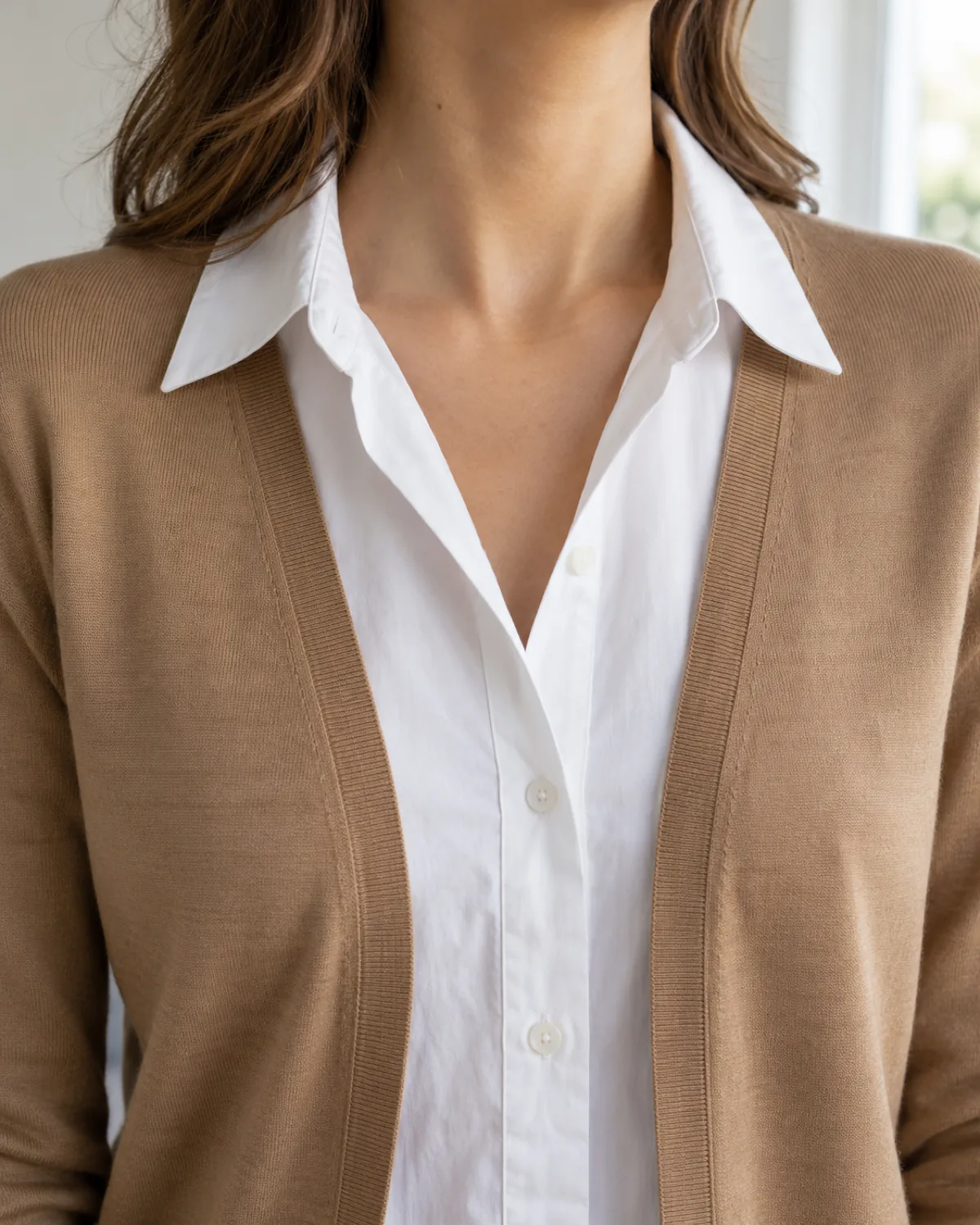
A V-neck cardigan is the more flexible option for work because it frames whatever you wear underneath. A collared shirt with the collar tips sitting above the V reads structured and intentional. Indeed notes that cardigans "can be layered over shirts or blouses for a professional look," and the V-neck is what makes that layering visible.
A crew-neck covers the collar entirely. That works with a collarless shell or a simple tee but loses the structured signal that a visible collar provides.
- V-neck + point-collar shirt = most structured. The collar tips act as a formality anchor.
- V-neck + collarless blouse = slightly softer. Still polished, but leans creative.
- Crew-neck + collarless shell = clean but quiet. Works when you do not need the collar signal.
- Crew-neck + collared shirt = the collar gets bunched. Skip this combination.
Button It, Belt It, or Leave It Open
How you close a cardigan changes how formal it reads. This is the fastest adjustment you can make without buying anything new.
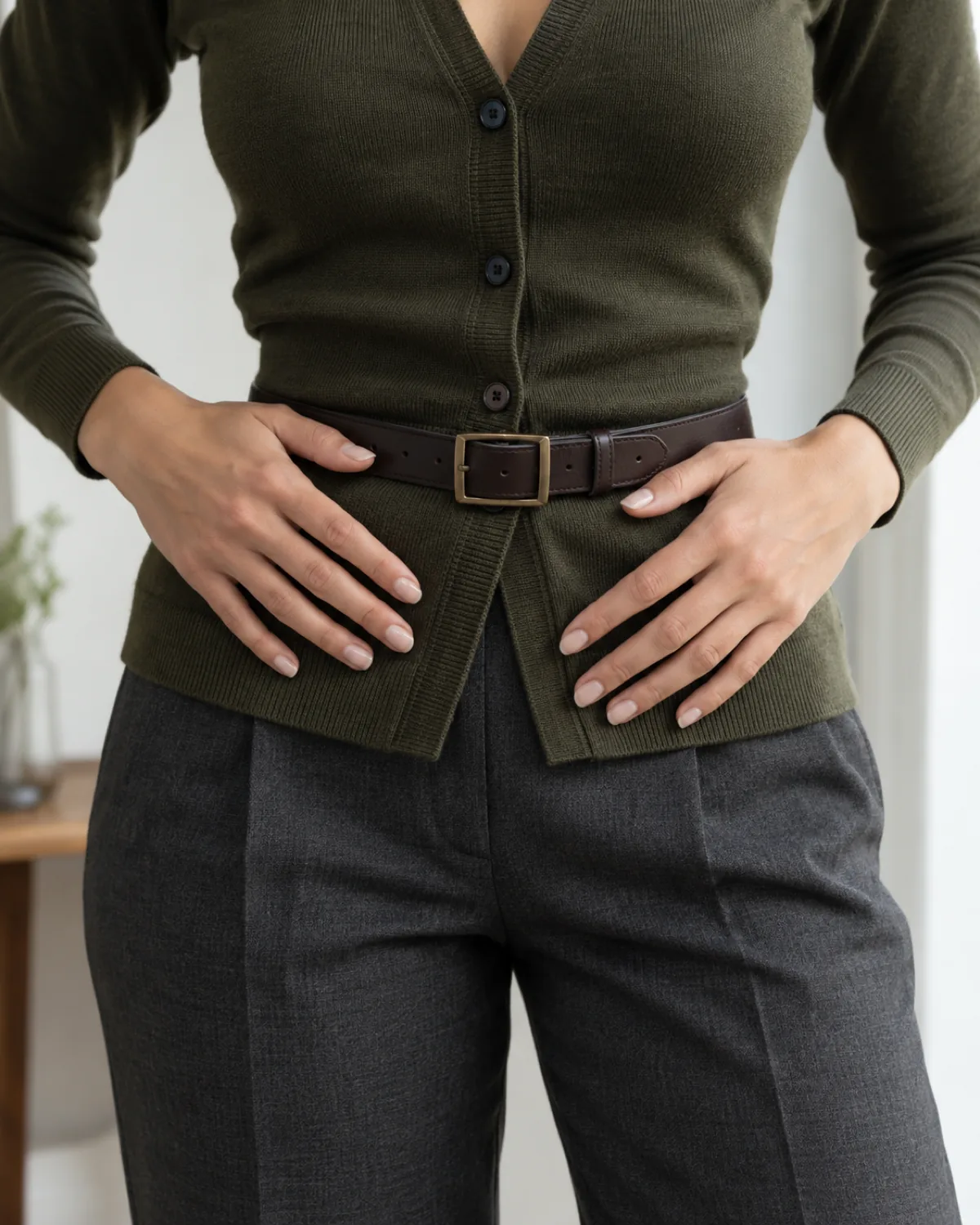
Buttoning the cardigan all the way simulates the closed front of a blazer. It creates a clean line down the centre and holds the fabric against the body. This is the safest option for any business casual office.
Adding a belt over a buttoned cardigan defines the waist and adds a second structural element. It turns a soft layer into something that reads almost like a jacket. The belt should be thin to medium width and match the shoe leather.
Leaving the cardigan open is the most casual option. It works in creative or relaxed offices but loses structure quickly. If you leave it open, tuck the top underneath so there is a visible waistline. An untucked top under an open cardigan reads like you are still getting dressed.
- Fully buttoned: safest for business casual. Reads as intentional and tidy.
- Buttoned and belted: adds waist definition. Reads closer to a jacket than a sweater.
- Open over a tucked top: works in relaxed offices. Loses structure compared to buttoned.
- Open over an untucked top: avoid. Reads as unfinished.
Pair the Length with Your Bottom Half
The hem of the cardigan and the waistband of the trousers or skirt have to work together. A mismatch in proportions is one of the most common reasons a cardigan outfit looks off.
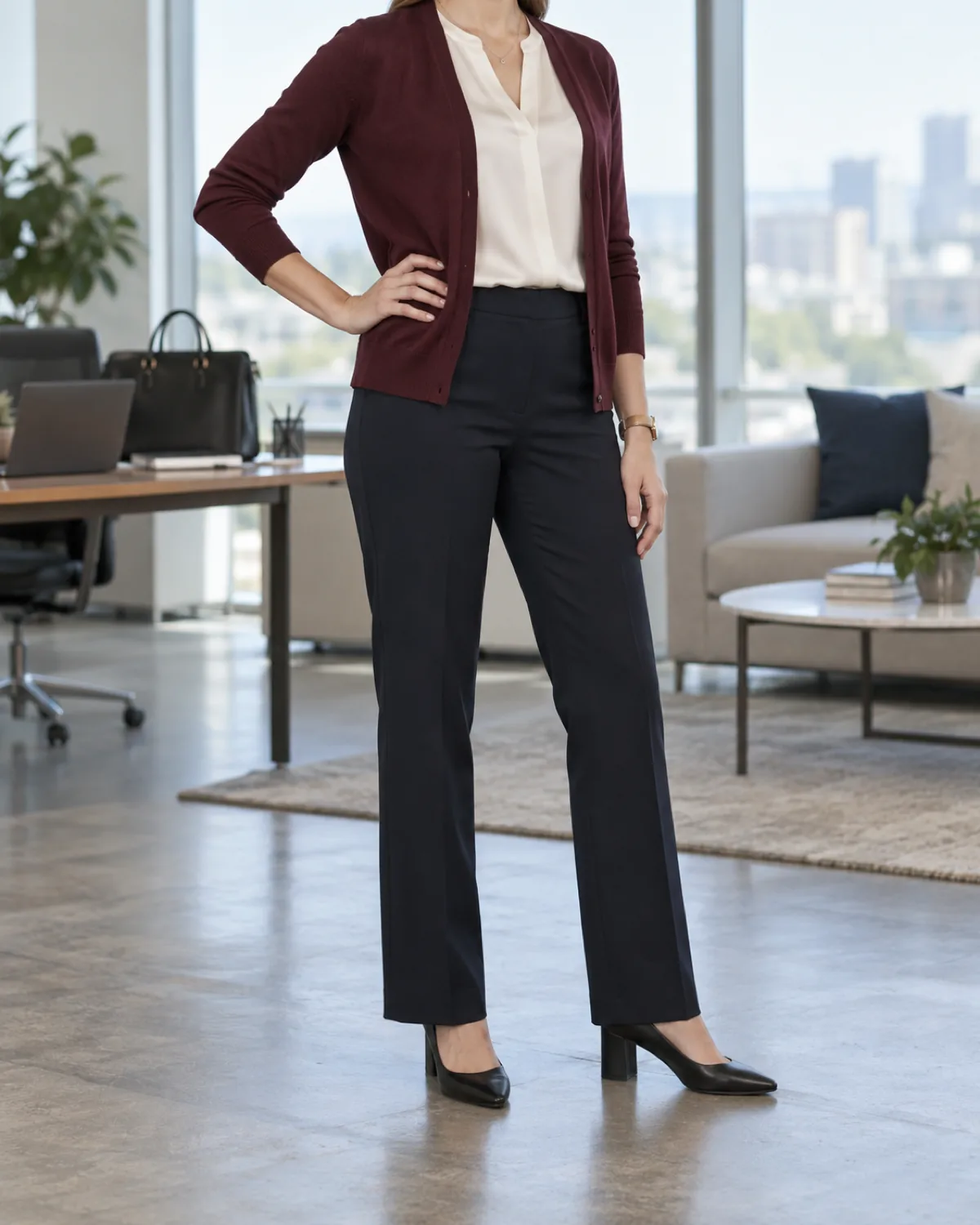
Hip-length is the standard work cardigan length. The hem should fall somewhere between the belt and the widest part of the hip. This length works with straight-leg trousers, tapered trousers and pencil skirts. USC lists "sweater, blouse, or cardigan" alongside "dress pants, chinos, or knee-length skirt" as business casual combinations, and hip-length is the default that makes those pairings work.
Cropped cardigans that end above the waist only work with high-waisted bottoms, and even then they lean casual. They pair best with A-line skirts in creative offices.
Anything longer than hip-length starts to read as loungewear. A knee-length or duster cardigan is not a work layer in most offices.
- Hip-length + straight-leg trousers: the reliable default.
- Hip-length + pencil skirt at or below the knee: clean proportions.
- Cropped + high-waisted A-line: only in creative or casual settings.
- Long/duster: not for the office unless your office has no dress code at all.
Shoes and Bags That Keep It Office-Grade
A cardigan is a soft layer. It needs at least one structured element elsewhere in the outfit to keep it from reading as weekend. Shoes and bags are the easiest place to add that structure.
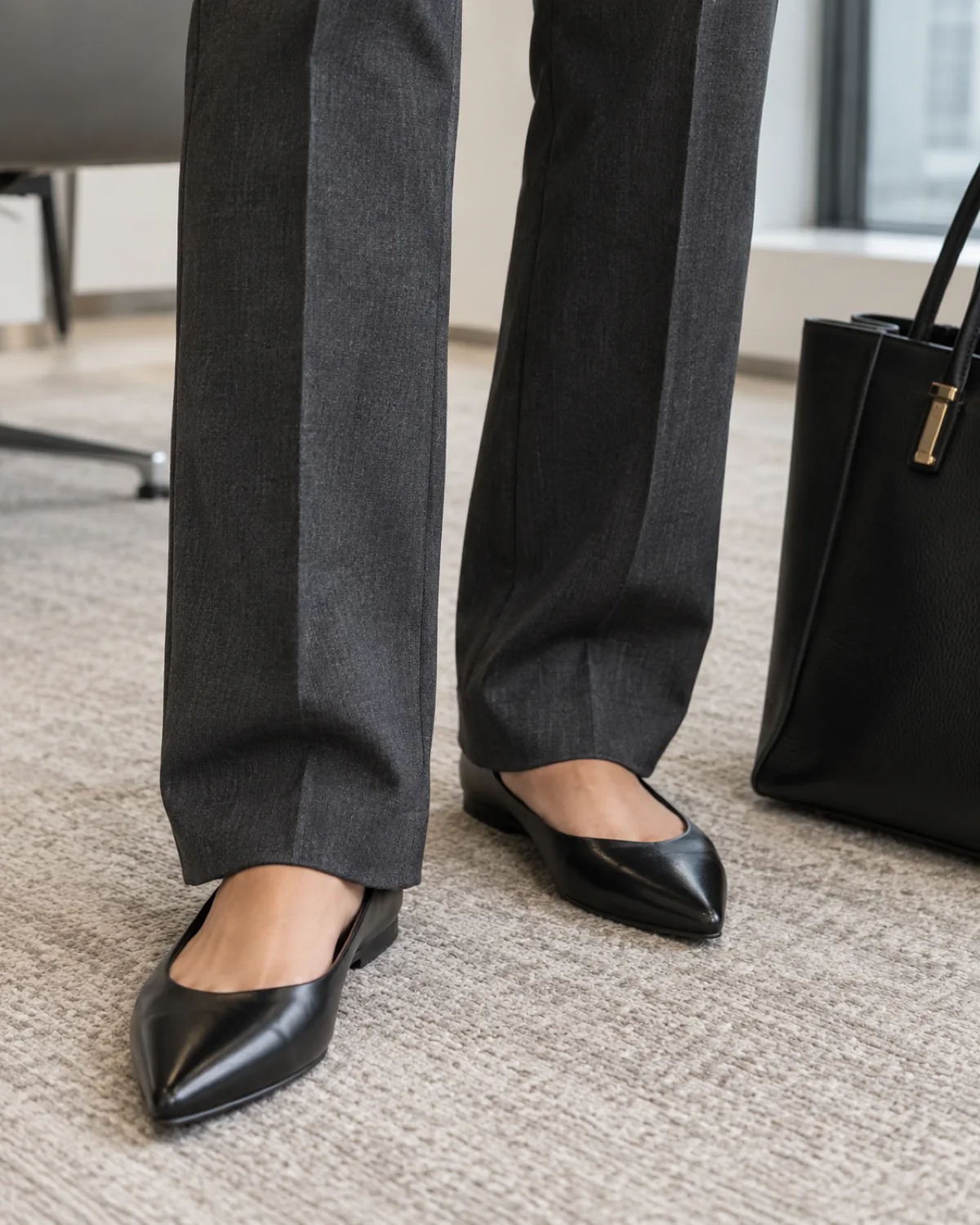
Pointed-toe flats or low block heels are the strongest anchors. They read as deliberate without being uncomfortable. Round-toe flats are softer. Trainers or canvas sneakers pull the outfit away from business casual.
The bag follows the same principle. A structured leather tote or satchel reinforces the office signal. A canvas or nylon bag softens it.
- Pointed-toe leather flats: sharpest option, pairs with any trouser length.
- Low block heels: adds height without sacrificing comfort.
- Loafers: work in most business casual settings.
- Trainers: only if your office explicitly allows them and you are not in meetings.
When a Cardigan Crosses the Line
Some cardigans should not go to the office at all. The line is not always obvious because the same garment type can sit on either side of it.
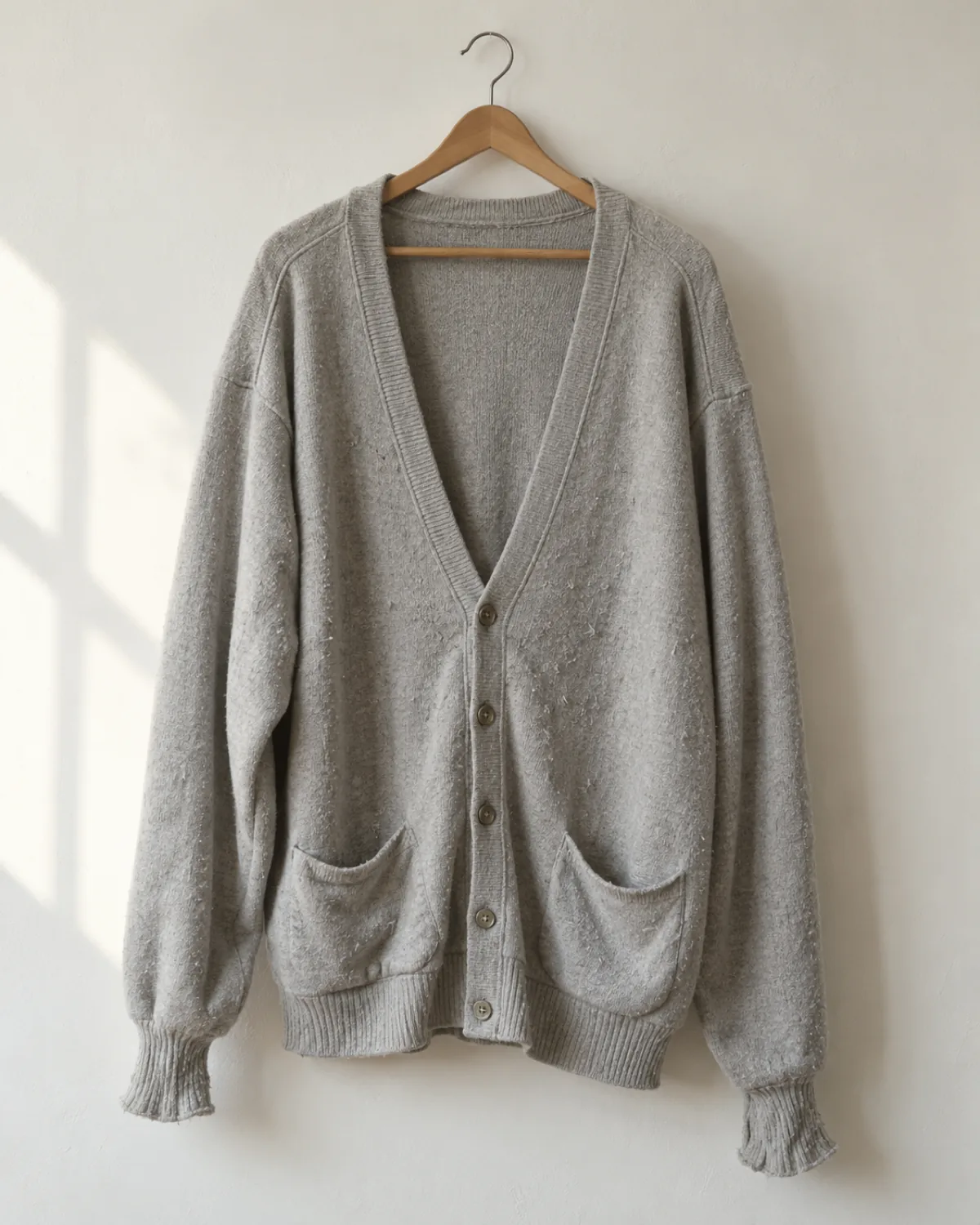
Pilling is the most common red flag. Those small fabric balls across the front panels make any cardigan look neglected, regardless of the cut or the colour. If you can see pilling from two metres away, the cardigan has moved from work layer to house layer.
Stretched-out cuffs and a saggy hem follow close behind. Once the ribbing at the wrists loses its elasticity, the sleeves hang past your hands and the whole silhouette collapses.
- Visible pilling on the front panels or under the arms: retire it from office rotation.
- Cuffs that no longer hold at the wrist: the shape is gone and will not come back.
- Oversized enough to cover your hands: reads as borrowed or sleeping-in.
- Hoods: not an office garment in any dress code that includes the word professional.
- Novelty prints, cartoon graphics or slogan text: not business casual.
One Outfit Formula You Can Repeat
If you want a starting point you can use every week without thinking, this combination works in any business casual office.
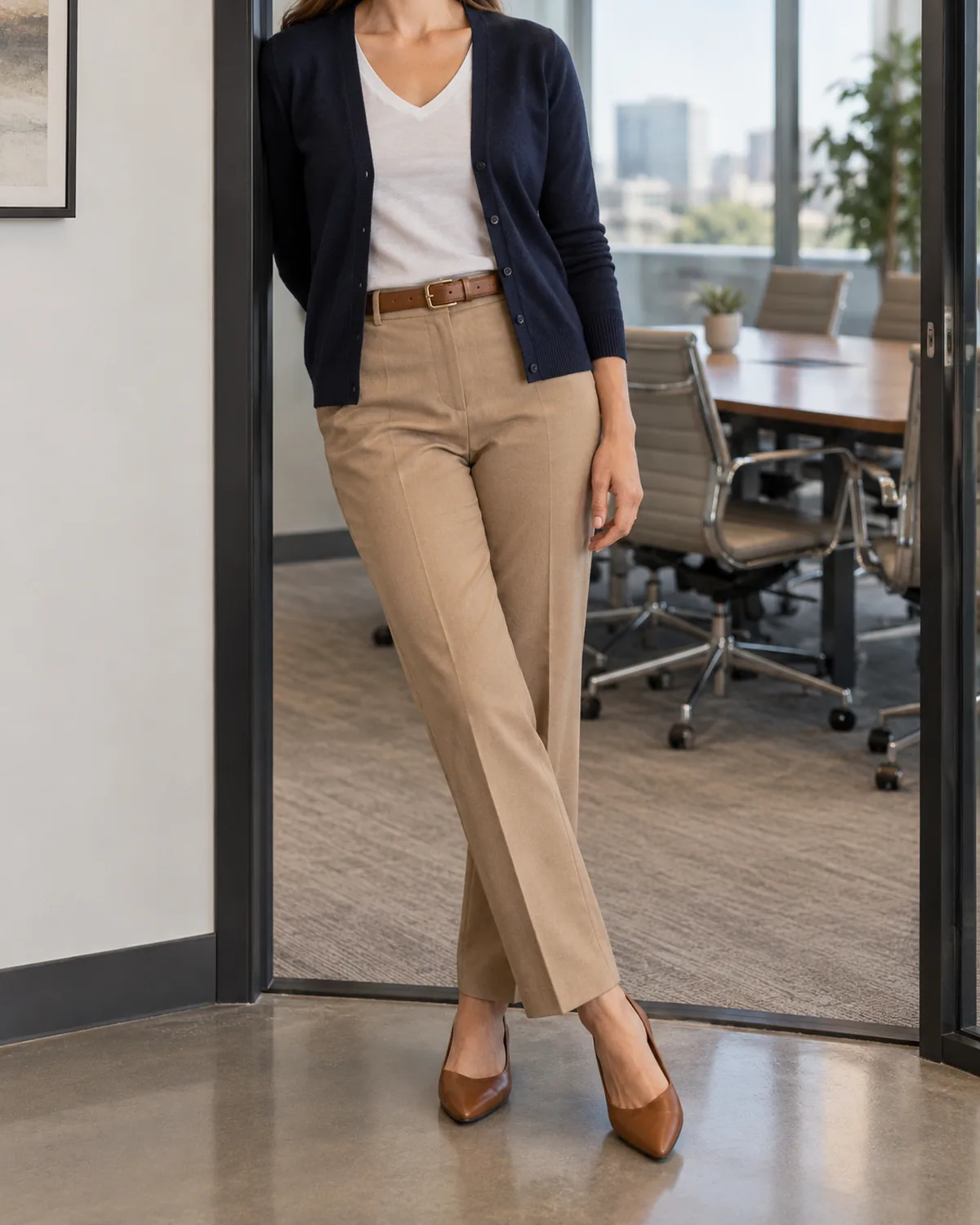
Fine-gauge V-neck cardigan in a dark neutral. White or cream top tucked in. Leather belt. Straight-leg trousers. Pointed-toe flats or low heels in a leather that matches the belt.
That is five pieces. Each one reinforces the others. The V-neck shows the top underneath. The tuck and the belt define the waist. The straight-leg trouser creates a clean line. The shoes finish it.
Rotate the cardigan colour (navy, charcoal, olive, burgundy) and swap the trouser colour (charcoal, camel, navy) and you have a week of outfits from the same formula.
- Dark navy cardigan + white tee + camel trousers + cognac flats.
- Charcoal cardigan + cream blouse + dark navy trousers + black pointed-toe flats.
- Olive cardigan + white shirt + grey trousers + brown leather loafers.
- Burgundy cardigan + ivory blouse + black trousers + black low heels.
Cardigan at Work FAQ
Can you wear a cardigan to a job interview?
In most interview settings, a blazer or structured jacket is the safer choice. Berkeley Law's interview guidelines specify that a suit "should always include a jacket," and a cardigan is not a jacket. If you know the company has an explicitly casual culture and the interview is informal, a fine-gauge cardigan may work. For anything else, stick with a blazer.
Is an oversized cardigan appropriate for the office?
It depends on the office. In a creative or very relaxed environment, an oversized cardigan can work if the rest of the outfit is structured. In a business casual or business professional office, oversized knitwear reads as too relaxed because it eliminates the waist and the shoulder line.
What fabrics work best for a work cardigan?
Fine-gauge merino wool is the most reliable. It holds its shape, resists pilling and works across most office temperatures. Cotton and cotton blends are lighter alternatives for warm offices. Cashmere blends look polished but pill faster. Avoid chunky cable-knit, bouclé and anything loosely woven.
Should you button a cardigan at work?
There is no single rule, but buttoning sends a stronger signal than leaving it open. Fully buttoned reads as tidy and deliberate. Buttoned with a belt reads almost like a jacket. Open works only in relaxed settings with a tucked top underneath. If you are unsure, button it.
Can you wear a cardigan instead of a blazer?
In a business casual office, yes. Indeed lists cardigans as an optional business casual layer alongside blazers and sport coats. In a business professional environment, a cardigan is not structured enough to replace a blazer. If the people at your level and above wear blazers, a cardigan will read as a step down.
Where the dress-code definitions come from
- Employees Dressing Too Casually? Clarify Your Dress Code — SHRM
- What Is Business Casual Attire? (With Examples and Tips) — Indeed Career Guide
- Dress for Success Guide — Career Center, University of Southern California
- What To Wear on Your First Day of Work — Indeed Career Guide
- Interviews: Dress and Presentation Guidelines — Career Development Office, Berkeley Law
Keep this one
Save it where you plan outfits
Pin the image above to the board you actually check on a Sunday night. This guide is written to be re-read, not read once.
Tonight, before you close this tab
- Pull out every cardigan you own tonight and sort them into fine-gauge and chunky piles
- Try buttoning your fine-gauge cardigan all the way and adding a belt to see if it defines your waist
- Check each cardigan for pilling on the front panels and stretched-out cuffs
- Pair one fine-gauge V-neck with a collared shirt and straight-leg trousers and lay it out for tomorrow